Facts
On April 18, 2016, the claimant (Rahul), a minor represented by his mother (Reshma), was struck by a tanker (Reg. No. HR-38T-6941) in Mainpuri, Uttar Pradesh
Source reference: p.1-2The accident resulted in catastrophic injuries, including 83% locomotor disability, 100% blindness, and 90% mental retardation
Source reference: p.2The Motor Accidents Claims Tribunal (MACT), Karkardooma, awarded Rs. 26,25,000/- with 9% interest, calculating the income benchmark based on U.P. minimum wages
Source reference: p.1-2The appellants challenged this award, contending that the claimant was a resident of Delhi and that the non-pecuniary damages were inadequate
Source reference: p.2-3Issues
1. Whether the MACT erred in applying the minimum wages of Uttar Pradesh instead of Delhi for the calculation of loss of future income
Source reference: p.22. Whether the non-pecuniary compensation awarded for "pain and suffering" and "loss of amenities" was adequate considering the claimant’s 100% functional disability
Source reference: p.3Law Applied
The court primarily applied the principles governing the assessment of non-pecuniary damages in motor accident claims, specifically for victims suffering 100% disability.
Source reference: p.3-4It relied on the Supreme Court precedent in K.S. Muralidhar v. R. Subbulakshmi and Anr. (2024), which establishes that "pain and suffering" must reflect the permanent rupture of a victim’s physical and emotional well-being and cannot be restricted by fixed mathematical formulas
Source reference: p.3-4The court also referenced R.D. Hattangadi v. Pest Control (India) (P) Ltd. and Sidram v. United India Insurance Company Ltd. to emphasize that compensation must account for the "unusual deprivation" and loss of amenities of life suffered by a crippled claimant
Source reference: p.5-6Reasoning
Regarding the income benchmark, the Court noted that PW-1 (the mother) provided unrebutted testimony and documentary evidence (Aadhaar Card) proving the family had resided in Delhi for 10-15 years, where the parents worked as a factory laborer and maid servant respectively
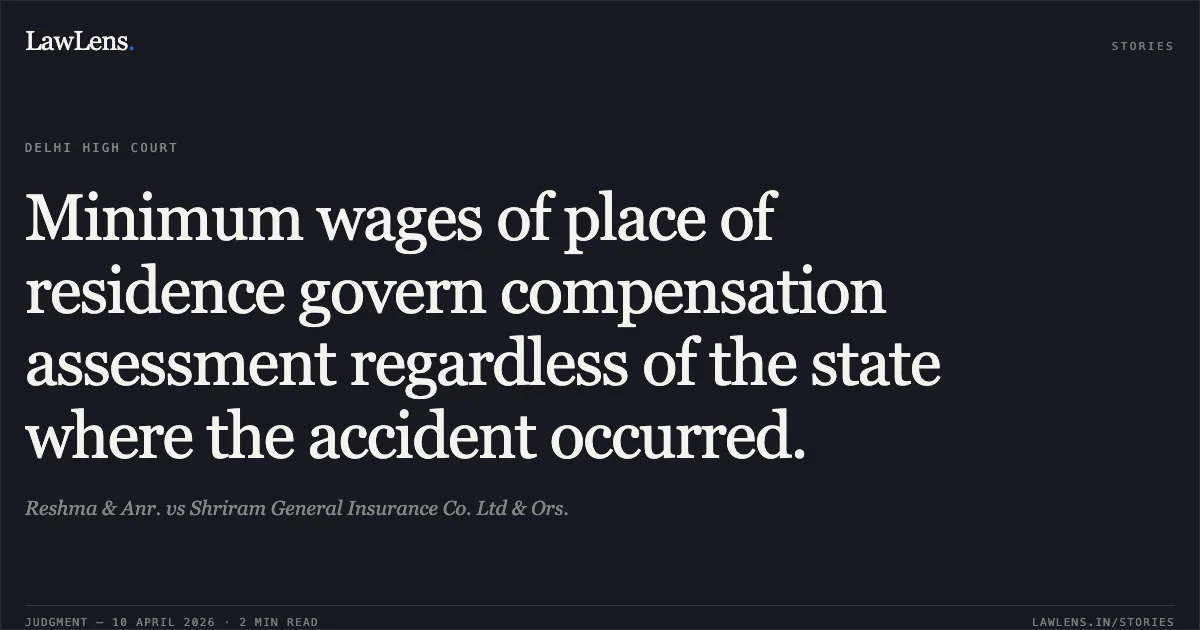
Source reference: p.2Consequently, the Court held that the accident’s occurrence in U.P. during a visit to a native village did not justify using U.P. minimum wages; instead, Delhi’s minimum wage for unskilled workers (Rs. 9,568/-) was applicable
Source reference: p.2-3Regarding non-pecuniary heads, the Court analyzed the subjective and life-altering nature of the injuries (blindness and mental retardation).
Source reference: p.3-6It determined that the initial award of Rs. 1,00,000/- for "pain and suffering" failed to meaningfully reflect the victim’s lifelong deprivation as mandated by the Muralidhar principle
Source reference: p.3-6Holding
The Court answered both issues in the affirmative, holding that the compensation required enhancement to be "just."
The Court increased the monthly income benchmark to Delhi rates and enhanced the non-pecuniary awards for "pain and suffering" and "loss of amenities" from Rs. 1,00,000/- to Rs. 2,50,000/- each
Source reference: p.6-7The total compensation was enhanced by Rs. 10,59,000/-, bringing the total to Rs. 36,84,000/- (rounded) with 9% interest
Source reference: p.7-8The Insurance Company was directed to deposit the enhanced amount within four weeks, with specific directions for a partial lump-sum release and the remainder to be secured in phased Fixed Deposit Receipts (FDRs)
Source reference: p.8Original Court PDF
Reshma & Anr.vsShriram General Insurance Co. Ltd & Ors.
Click to open original judgment
Original judgment, available to read, download and summarize on LawLens.in


![Subsequent exoneration does not retrospectively invalidate a finalized promotion select list.. UNNIKRISHNAN M vs M/o Environment And Forests. CAT - ['Ernakulam']. LawLens](/stories/thumbnails/subsequent-exoneration-does-not-retrospectively-invalidate-a-finalized-promotion-select-li-ce80a0e84f2f4887857271e8b4341c42.webp)