Facts
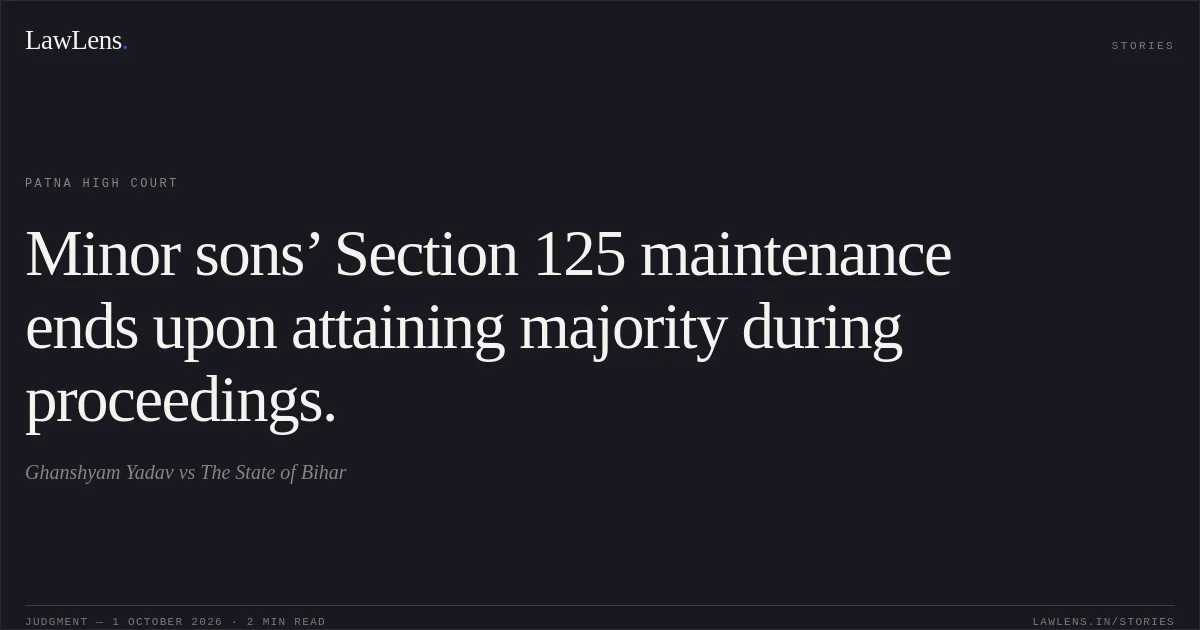
The petitioner challenged the Family Court, Khagaria’s order dated 7 March 2025 in Maintenance Case No. 38 of 2008, which directed him to pay ₹4,000 per month to opposite party no. 2 and ₹1,000 per month to each of her two sons under Section 125 CrPC.
Source reference: p. 2, para. 4He contended that opposite party no. 2 remained married to another man and that the sons had attained majority while the case was pending.
Source reference: no citationThe Family Court had found that, although opposite party no. 2 had been married to another man and had not divorced him, she cohabited with the petitioner and had two sons with him.
Source reference: pp. 3–5, paras. 6, 9The sons were stated to have been aged three and one when the maintenance application was filed in 2008.
Source reference: pp. 2, 4–5, paras. 5, 8Issues
1. Whether the Family Court’s award of maintenance to opposite party no. 2 was liable to be set aside on the ground that she remained married to another man.
Source reference: pp. 4–5, paras. 8–92. Whether the sons’ entitlement to maintenance continued after they attained majority during the pendency of the maintenance case.
Source reference: pp. 4–7, paras. 8, 12–13Law Applied
Section 125 CrPC provides the basis for maintenance claims considered in this case.
Source reference: p. 2, para. 4The High Court stated that revisional jurisdiction is limited: interference is warranted where the challenged order suffers from manifest illegality, infirmity, or incorrectness, and the revisional court should not merely re-appreciate facts to reach a different finding.
Source reference: p. 5, para. 10In assessing opposite party no. 2’s entitlement, the Family Court had relied on N. Usha Rani v. Moodudula Srinivas, 2025 SCC OnLine SC 225, and Badshah v. Urmila Badshah Godse, (2014) 1 SCC 188.
Source reference: p. 5, para. 9The High Court further held that the ages admitted in the maintenance application governed the sons’ entitlement, but that entitlement ended upon their attaining majority.
Source reference: pp. 6–7, paras. 12–13Reasoning
The High Court found no basis for revisional interference with the Family Court’s assessment of opposite party no. 2’s relationship with the petitioner: the Family Court had considered her prior marriage, the absence of divorce, their cohabitation, and the evidence concerning the sons.
Source reference: p. 5, paras. 9–11It nevertheless accepted the petitioner’s challenge as to the duration of the sons’ maintenance.
Source reference: no citationBecause their ages had been stated in the original application, the Court treated those ages as controlling and concluded that they attained majority during the proceedings; later documents showing different ages could not displace the admission.
Source reference: pp. 6–7, paras. 12–13Holding
The revision was disposed of by partly modifying the Family Court’s order.
The maintenance direction in favour of opposite party no. 2 remained undisturbed, as did the sons’ entitlement up to the date they attained majority.
Source reference: p. 7, paras. 13–14The petitioner was not required to pay maintenance to the sons after they attained majority.
Source reference: p. 7, paras. 13–14Acts & Sections Cited
2 provisions across 2 statutes referred to in this judgment. Each provision opens on LawLens.
Code of Criminal Procedure, 19731
Indian Penal Code, 18601
Original Court PDF
Ghanshyam YadavvsThe State of Bihar
Click to open original judgment
Original judgment, available to read, download and summarize on LawLens.in