Facts
The appellant, a partnership firm dealing in paper and boards, filed its return for Assessment Year (AY) 2001-2002
Source reference: para 2.1During a subsequent scrutiny under Section 147 of the Income Tax Act, 1961, the department observed that the assessee claimed Rs. 11,35,879/- as "commission/misappropriation" paid to 31 persons
Source reference: para 2.1The assessee contended that this amount was misappropriated by V. Valliappan (the manager and husband of one partner), who had declared the same as individual income in his own tax returns
Source reference: para 2.2The Assessing Officer (AO) disallowed the claim under Section 40A(2), citing it as excessive and unreasonable
Source reference: para 2.2While the CIT(Appeals) partially allowed the assessee's appeal, the Income Tax Appellate Tribunal (ITAT) reversed the decision, holding that the amount could not be treated as a business expenditure or loss
Source reference: para 2.4The assessee appealed to the High Court on grounds of double taxation and limitation
Source reference: para 3Issues
1. Whether the loss incurred due to embezzlement by an employee/manager is allowable as expenditure incurred for the purpose of the business of the assessee?
Source reference: para 2.62. Whether the provisions of Section 40A(2)(a) regarding disallowed expenditures for related parties are applicable to the facts of the case?
Source reference: para 2.63. Whether the re-assessment notice issued under Section 148 was barred by limitation?
Source reference: para 10Law Applied
The court applied Section 40A(2) of the Income Tax Act, 1961, which empowers the Assessing Officer to disallow expenditures involving payments to relatives or related parties if such payments are excessive or unreasonable compared to market value or business needs
Source reference: para 7It further relied on Sections 147, 148, and 149 of the I.T. Act regarding the procedure and limitation periods for re-assessment, noting that for escaped income exceeding Rs. 1,00,000/-, the limitation period was up to six years (as per the Finance Act, 2001)
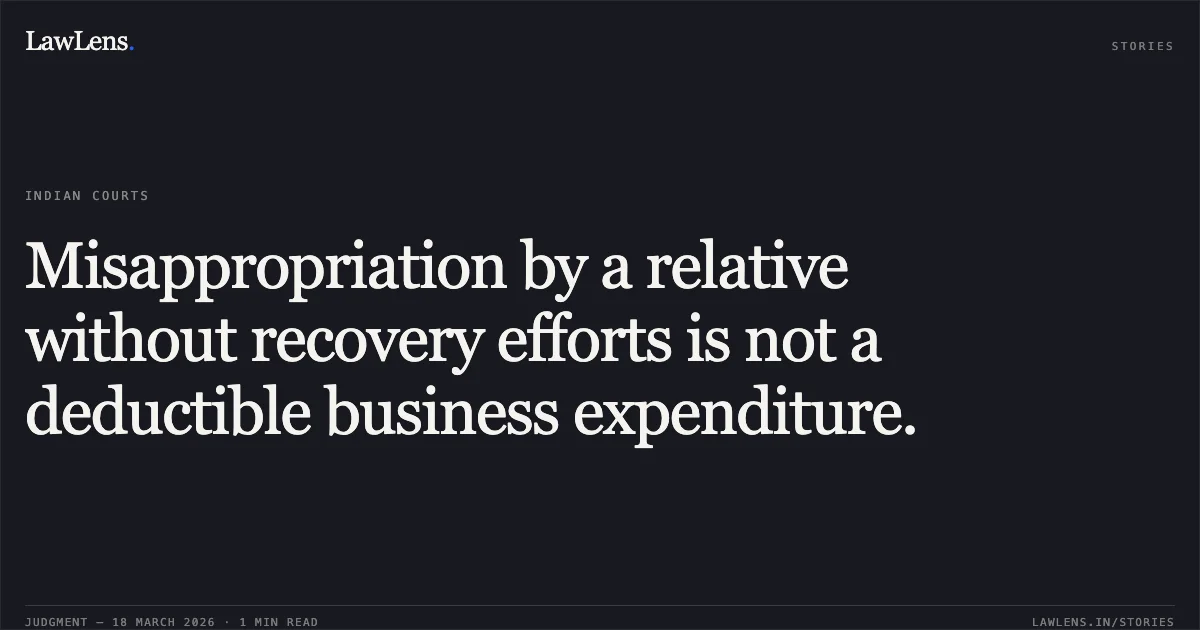
Source reference: para 10The court also upheld the principle that misappropriation cannot be claimed as a valid business expense in the absence of evidence and legal recovery efforts
Source reference: para 8Reasoning
The court reasoned that for a commission to be a valid business expenditure, the assessee must produce documentary evidence such as agreements or bills, which were absent here
Source reference: para 7Under Section 40A(2), the AO is justified in disallowing expenses that do not reflect fair market price or legitimate business interests
Source reference: para 7Regarding the "misappropriation" claim, the court noted the close relationship between the partners and the alleged misappropriator (husband and brother-in-law), suggesting a risk of collusion to evade tax
Source reference: para 8The court found it fatal to the assessee's case that no legal action or recovery proceedings were initiated against V. Valliappan
Source reference: para 8On the issue of double taxation, the court held that income in one person’s hand does not automatically qualify as a deductible expense for another; the assessee must still prove the expenditure's validity
Source reference: para 9Regarding limitation, the court calculated that for AY 2001-2002, the notice issued in November 2007 was within the statutory six-year limit for escaped assessments exceeding Rs. 1 Lakh
Source reference: para 10Holding
The High Court dismissed the appeal and answered the substantial questions of law against the assessee
The court held that the alleged misappropriation could not be treated as a valid business expenditure as the assessee failed to substantiate the loss or demonstrate bona fide recovery efforts
Source reference: para 8, 11The disallowance under Section 40A(2) was upheld as the expenditure was deemed excessive and unreasonable
Source reference: para 11The court also confirmed that the re-assessment notice was not barred by limitation
Source reference: para 10Acts & Sections Cited
11 provisions across 1 statute referred to in this judgment. Linked provisions open on LawLens.
Finance Act, 2001
Original Court PDF
M/S KARPAGA VINAYAGAR PAPERSvsTHE ASSISTANTCOMMISSIONER
Click to open original judgment
Original judgment, available to read, download and summarize on LawLens.in