Facts
The respondent joined the Delhi Transport Corporation (“DTC”) as a Retainer Driver on 6 February 1981.
Source reference: no citationDTC issued him a charge-sheet dated 28 June 1994 alleging unauthorised absence for 139 days between September 1993 and May 1994.
Source reference: paras. 3–8Following a departmental enquiry, he was removed from service on 28 November 1994.
Source reference: paras. 3–8The Labour Court, by order dated 30 September 2004, held the domestic enquiry vitiated because the respondent’s explanation had been wrongly treated as an unequivocal admission and because the enquiry record did not demonstrate a meaningful opportunity of defence.
Source reference: paras. 3–8After evidence was led before the Labour Court, it held the removal illegal and directed reinstatement with continuity of service and 10% back wages by Award dated 19 March 2009.
Source reference: para. 9DTC challenged both the order invalidating the enquiry and the consequential Award under Articles 226 and 227 of the Constitution.
Source reference: para. 10Issues
Whether the Labour Court was justified in holding that the domestic enquiry was vitiated for violation of the principles of natural justice.
Source reference: paras. 22–24Whether, notwithstanding the invalid domestic enquiry, the charge of unauthorised absence was established on the evidence subsequently led before the Labour Court.
Source reference: paras. 34–40Whether the punishment of removal from service was shockingly disproportionate to the established misconduct and whether the Labour Court’s order of reinstatement, continuity of service and back wages warranted interference.
Source reference: paras. 53–59Law Applied
Judicial review under Articles 226 and 227 is limited; the writ court does not ordinarily reappreciate evidence or act as an appellate authority, but may interfere where the decision is perverse, legally erroneous, procedurally unfair or suffers from a jurisdictional error.
Source reference: para. 23Under Sur Enamel and Stamping Works Ltd. v. Workmen, 1963 SCC OnLine SC 97, a domestic enquiry must clearly communicate the charges, afford a fair and effective opportunity to meet the evidence, cross-examine witnesses and lead defence evidence, and require the Enquiry Officer to record reasoned findings.
Source reference: para. 25A formal recital that an opportunity was afforded does not establish compliance with natural justice; the opportunity must be real, meaningful and capable of effective use.
Source reference: paras. 26–32Although the ultimate burden of proving misconduct remains on the management, once the employee admits absence and asserts that it was sanctioned or justified, the employee bears the evidentiary burden of substantiating that positive defence.
Source reference: paras. 39–43Under Section 11-A of the Industrial Disputes Act, interference with punishment is justified only where the penalty is shockingly disproportionate or relevant circumstances have been ignored; reinstatement does not automatically follow merely because the domestic enquiry is defective.
Source reference: paras. 50, 54–55Reasoning
The Court upheld the Labour Court’s finding that the domestic enquiry was invalid because the one-page, pre-typed enquiry report contained only formal recitals of opportunity and did not demonstrate the respondent’s meaningful participation in the defence; his signature and decision to defend himself without a representative did not amount to waiver.
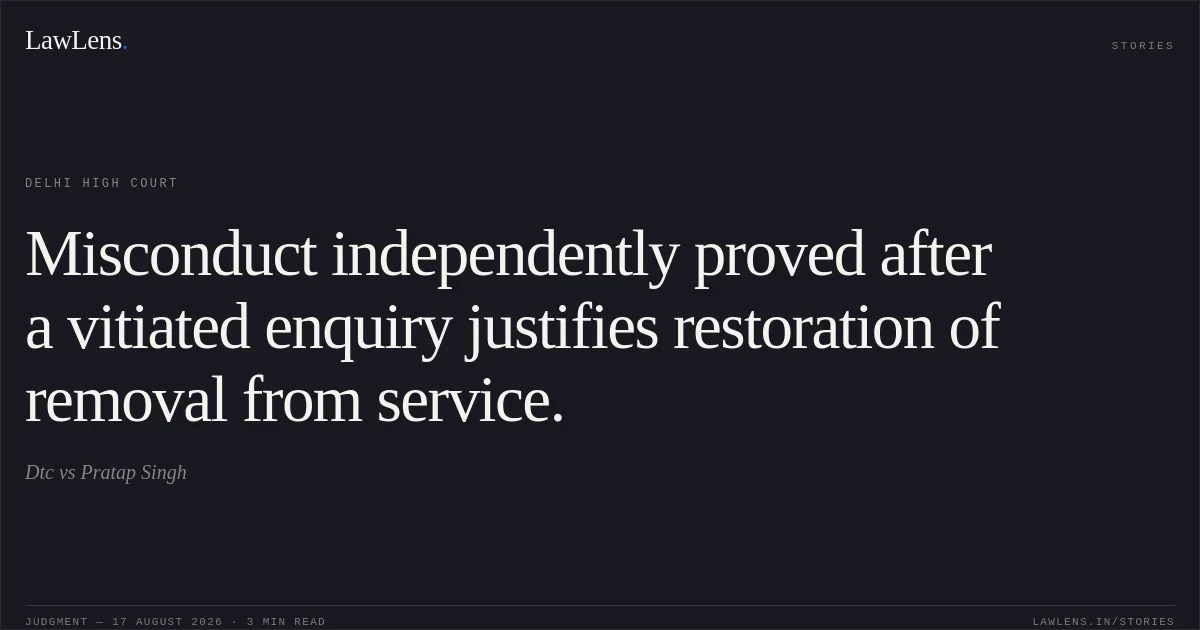
Source reference: paras. 28–33However, the invalidity of the enquiry did not prevent DTC from proving the misconduct independently before the Labour Court.
Source reference: paras. 35–46The respondent admitted his absence and relied on family circumstances and alleged leave applications as justification, but neither he nor the person who purportedly forwarded the applications established that leave had been sanctioned.
Source reference: paras. 35–46The medical material did not cover the relevant period, and the non-production of the original attendance register could not neutralise the admitted fact of absence.
Source reference: paras. 35–46The Court therefore held that the Labour Court had adopted an erroneous approach by treating the absence of some management documents as fatal to DTC’s case.
Source reference: paras. 44–46Given the admitted and repeated absence aggregating to 139 days, along with the respondent’s past disciplinary record, removal from service was not shown to be shockingly disproportionate.
Source reference: paras. 44–46, 53–56Holding
The writ petition was partly allowed.
The Court upheld the Labour Court’s order dated 30 September 2004 declaring the domestic enquiry vitiated.
Source reference: paras. 59–61However, it quashed the Award dated 19 March 2009 insofar as it declared the removal illegal and directed reinstatement with continuity of service and 10% back wages.
Source reference: paras. 59–61The charge of unauthorised absence was held established on the evidence, and DTC’s order of removal from service was restored.
Source reference: paras. 59–61Pending applications were disposed of and there was no order as to costs.
Source reference: para. 62Acts & Sections Cited
1 provisions across 1 statute referred to in this judgment. Linked provisions open on LawLens.
Industrial Disputes Act, 19471
Original Court PDF
DtcvsPratap Singh
Click to open original judgment
Original judgment, available to read, download and summarize on LawLens.in