Facts
The petitioners challenged an order confirming recovery of ₹12,88,99,060 from Petitioner No. 1, with interest and an equal penalty, and imposing penalties on its directors under Sections 122(1A) and 122(3) of the CGST Act.
Source reference: para. 4–5The Department alleged that Petitioner No. 1 had availed and utilised ITC on invoices from non-existent suppliers without receiving the goods.
Source reference: para. 4–5The petitioners sought, among other reliefs, to set aside the order, read down Sections 155 and 122(1A), and challenged the demand reflected in Form GST DRC-07 as exceeding the amount in the show-cause notice and adjudication order.
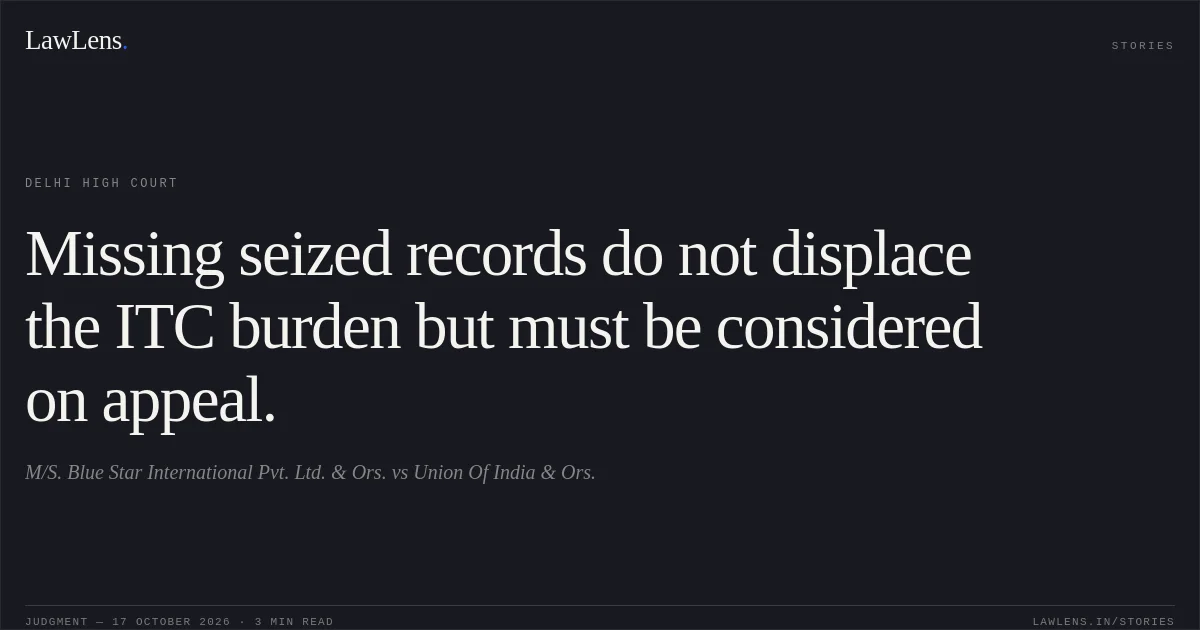
Source reference: para. 1, 3They also asserted that seized records had not been returned and that this impaired their ability to establish ITC eligibility; the Department maintained that available records had been supplied and that evidentiary objections could be raised in appeal.
Source reference: para. 10–11The Department acknowledged that repeated DRC-07 summaries had been generated due to a portal glitch and stated that it would rectify them.
Source reference: para. 8Issues
1. Whether the High Court should entertain the challenge to the adjudication order despite the petitioners’ statutory appellate remedy under Section 107 of the CGST Act.
Source reference: para. 2, 142. Whether the Department’s failure to return or produce certain seized records justified reading down Section 155 of the CGST Act.
Source reference: para. 9–133. Whether the erroneous repetition of the demand in Form GST DRC-07 required correction, including for purposes of calculating the appellate pre-deposit.
Source reference: para. 3, 8, 154. Whether the challenge to penalties under Section 122(1A) should be considered in light of Parag Garg v. Commissioner, Adjudication, CGST, Delhi West & Anr.
Source reference: para. 3, 14Law Applied
Section 107 of the CGST Act provides a statutory appeal against an adjudication order; the Court relegated the petitioners to that remedy.
Source reference: para. 14Section 155 places the burden of proving ITC eligibility on the person claiming the credit, but the allocation of that burden is distinct from the evidentiary effect of missing records; the latter may be assessed in the appeal.
Source reference: para. 9, 13Section 75(7) was invoked in the petitioners’ objection that the DRC-07 demand exceeded the amount specified in the show-cause notice and confirmed by the adjudication order.
Source reference: para. 3The challenge to penalties under Section 122(1A) was to be examined in accordance with the Court’s decision in Parag Garg.
Source reference: para. 3, 14Section 14 of the Limitation Act, 1963 may be relied upon by the petitioners to seek exclusion of the period during which the writ petition was pending, subject to the Appellate Authority’s consideration in accordance with law.
Source reference: para. 16Reasoning
The Court declined to read down Section 155 because the statutory burden of proving ITC eligibility and the consequences of missing records are separate questions.
Source reference: para. 13Determining which records remained unavailable, their relevance, any resulting prejudice, and whether supplied or reconstructed material was considered required examination of the record and was suitable for the appellate forum.
Source reference: para. 13The Department’s recorded inability to furnish seized documents was nevertheless required to be considered when assessing whether the petitioners discharged the statutory burden.
Source reference: para. 13Given the available appeal under Section 107, the Court left the substantive challenges to the demand, interest, penalties, and evidence for the Appellate Authority.
Source reference: para. 2, 14The acknowledged portal error warranted correction, and the pre-deposit was to be calculated by reference to the demand actually confirmed, not the erroneous repetition in the summaries.
Source reference: para. 8, 15Holding
The writ petition and pending application were disposed of, with the petitioners relegated to the statutory appeal under Section 107.
The Section 122(1A) penalty challenge was left to be examined in accordance with Parag Garg, and all other objections were left open before the Appellate Authority.
Source reference: para. 14, 17The Respondents were directed to correct the erroneous DRC-07 summaries within fifteen days, make consequential portal corrections, and communicate them to the petitioners; any appellate pre-deposit was to be based on the demand confirmed by the adjudication order.
Source reference: para. 15The petitioners were permitted to seek exclusion of the writ-petition period under Section 14 of the Limitation Act, with that application to be decided in accordance with law.
Source reference: para. 16The Court expressed no opinion on the merits of the disputed transactions or ITC entitlement.
Source reference: para. 16Acts & Sections Cited
6 provisions across 2 statutes referred to in this judgment. Each provision opens on LawLens.
Central Goods and Services Tax Act, 20175
Limitation Act, 19631
Original Court PDF
M/S. Blue Star International Pvt. Ltd. & Ors.vsUnion Of India & Ors.
Click to open original judgment
Original judgment, available to read, download and summarize on LawLens.in