Facts
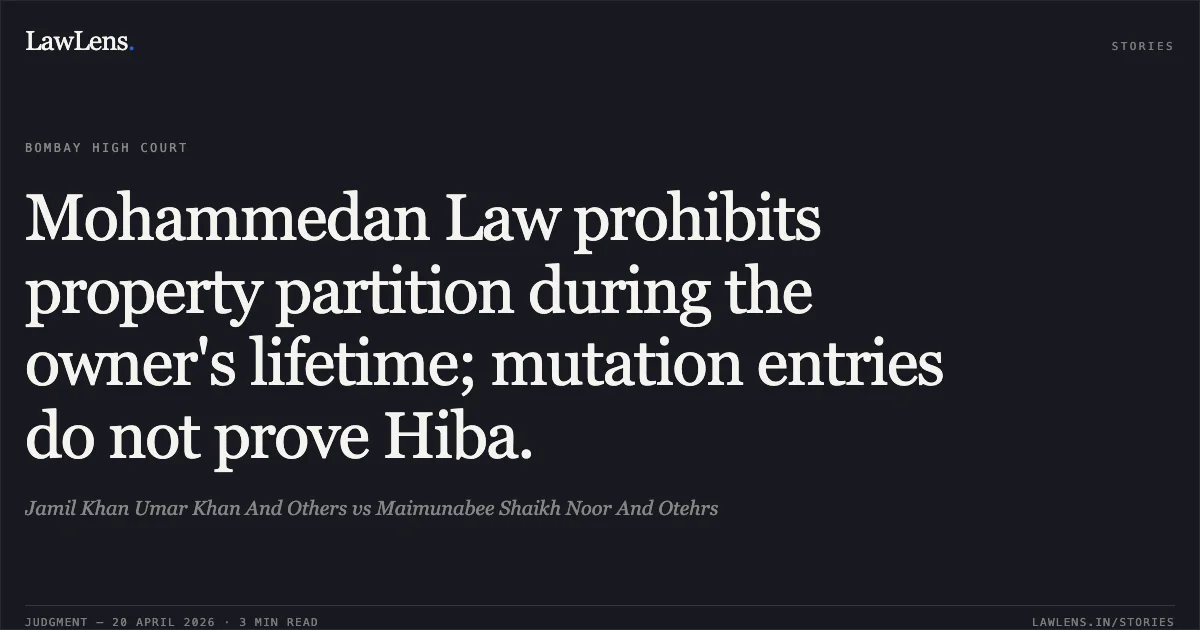
The Plaintiffs (sisters) filed a suit for partition and possession against their brothers (Defendants 1 and 2) regarding ancestral property (Gut No. 152) originally owned by their grandfather and inherited by their father, Umar Khan
Source reference: para. 2–3Umar Khan died intestate on August 15, 2011
Source reference: para. 3The Defendants claimed that a partition occurred in 1985 via a mutation entry (Exh. 46), wherein Umar Khan allotted portions of the land to them, and later allegedly gifted the remainder through an oral gift (Hiba)
Source reference: para. 3–4The Trial Court decreed the suit, awarding the sisters a 1/8th share each and the brothers a 2/8th share each, while declaring subsequent sale deeds non-binding on the Plaintiffs’ shares
Source reference: para. 5The First Appellate Court confirmed this decree
Source reference: para. 6The Defendants (Appellants) challenged these findings on the grounds of limitation and the validity of the 1985 partition
Source reference: para. 7–8Issues
1. Whether the suit for partition and possession filed in 2016 was within the period of limitation, considering the alleged allotment of property in 1985
Source reference: para. 8(A)2. Whether Mutation Entry No. 46 constitutes legal proof of partition under Muslim Personal Law, given that partition is generally impermissible during the lifetime of the father
Source reference: para. 8(B)Law Applied
The Court primarily applied the principles of Mohammedan Law, which stipulate that rights to inheritance devolve upon legal heirs only after the death of the ancestor
Source reference: para. 9It relied on the precedent Mansoor Saheb vs. Salima (AIR Online 2024 SC 833), which establishes that partition of property between a Muslim person and their heirs during that person's lifetime is impermissible
Source reference: para. 10, 13While transfer via Hiba (oral gift) is recognized, it requires specific pleadings and the fulfillment of legal requirements to be valid
Source reference: para. 10Additionally, the Court noted that mutation entries in revenue records do not serve as documents of title or proof of partition
Source reference: para. 10–11Reasoning
Regarding limitation, the Court observed that since Umar Khan died in 2011, the Plaintiffs' rights only accrued upon his death; thus, the 1985 "allotment" did not trigger the limitation period for a partition suit
Source reference: para. 9The cause of action effectively arose in 2015 when the Defendants contested the Plaintiffs' names in revenue proceedings, making the 2016 suit timely
Source reference: para. 9On the second issue, the Court found the Defendants' claim of a 1985 partition legally untenable under Muslim Law, as the father was alive at that time
Source reference: para. 13Although the Defendants later argued the transfer was a Hiba, the Court noted a lack of specific pleadings in the written statement regarding such a gift
Source reference: para. 10, 14The Court further held that Mutation Entry No. 46 and the subsequent cultivation by the brothers were merely for maintenance or convenience and did not extinguish the Plaintiffs' legal inheritance rights
Source reference: para. 10–11Holding
The High Court answered the first issue in the affirmative, holding the suit was within limitation, and the second issue in the negative, holding the mutation entry was not proof of partition
The Court found no substantial question of law and dismissed the Second Appeal, thereby confirming the lower courts' judgments that the daughters were entitled to their respective shares in the estate of Umar Khan
Source reference: para. 15All pending civil applications were disposed of accordingly
Source reference: para. 15Acts & Sections Cited
2 provisions across 1 statute referred to in this judgment. Each provision opens on LawLens.
Code of Civil Procedure, 19082
Original Court PDF
Jamil Khan Umar Khan And OthersvsMaimunabee Shaikh Noor And Otehrs
Click to open original judgment
Original judgment, available to read, download and summarize on LawLens.in