Facts
The complainant alleged that the petitioner had promised to secure government-teacher appointments and received ₹1,50,000 from him on 24 April 2011, but neither procured appointment letters nor returned the money.
Source reference: pp. 2–4; paras. 3–9The complaint also alleged assault and abuse.
Source reference: pp. 2–4; paras. 3–9After the complainant’s solemn affirmation and statements of six witnesses were recorded, the Magistrate took cognizance under Sections 406, 423 and 504 IPC and issued process on 28 June 2016.
Source reference: pp. 2–4; paras. 3–9The petitioner challenged the order and ensuing proceedings under Section 482 CrPC, arguing that the allegations did not disclose the offences alleged
Source reference: pp. 2–4, 8; paras. 3–9, 10–16Issues
Whether money allegedly paid to secure a government appointment through an unlawful arrangement could constitute “entrustment” for criminal breach of trust under Sections 405–406 IPC
Source reference: pp. 10–11; paras. 30–31Whether the complaint and inquiry materials disclosed a prima facie basis to continue proceedings against the petitioner, including under Sections 423 and 504 IPC, or whether the proceedings should be quashed under Section 482 CrPC
Source reference: pp. 4–6, 15–17; paras. 8–16, 41–43Law Applied
Section 405 IPC requires entrustment of property or dominion over it, followed by dishonest misappropriation, conversion, use or disposal in breach of a legal direction or contract; Section 406 prescribes the punishment
Source reference: pp. 8–10; paras. 25–27The Court treated an agreement to obtain a government appointment for money as unlawful under Section 23 of the Indian Contract Act, 1872, which renders agreements with unlawful objects or considerations void
Source reference: pp. 11–12; paras. 32–34Relying on *Chellor Mankkal Narayan Ittiravi Nambudiri v. State of Travancore-Cochin*, (1952) 2 SCC 392, and *Vijay Sharma v. State of Bihar*, 2011 (1) PLJR 780, the Court held that money knowingly paid as illegal gratification is not entrusted to the recipient in the sense required for criminal breach of trust
Source reference: pp. 13–15; paras. 38–39It also applied the quashing principles in *State of Haryana v. Bhajan Lal*, 1992 Supp (1) SCC 335, including where the allegations do not prima facie constitute an offence or the proceeding is manifestly attended by mala fides
Source reference: pp. 15–16; para. 41Reasoning
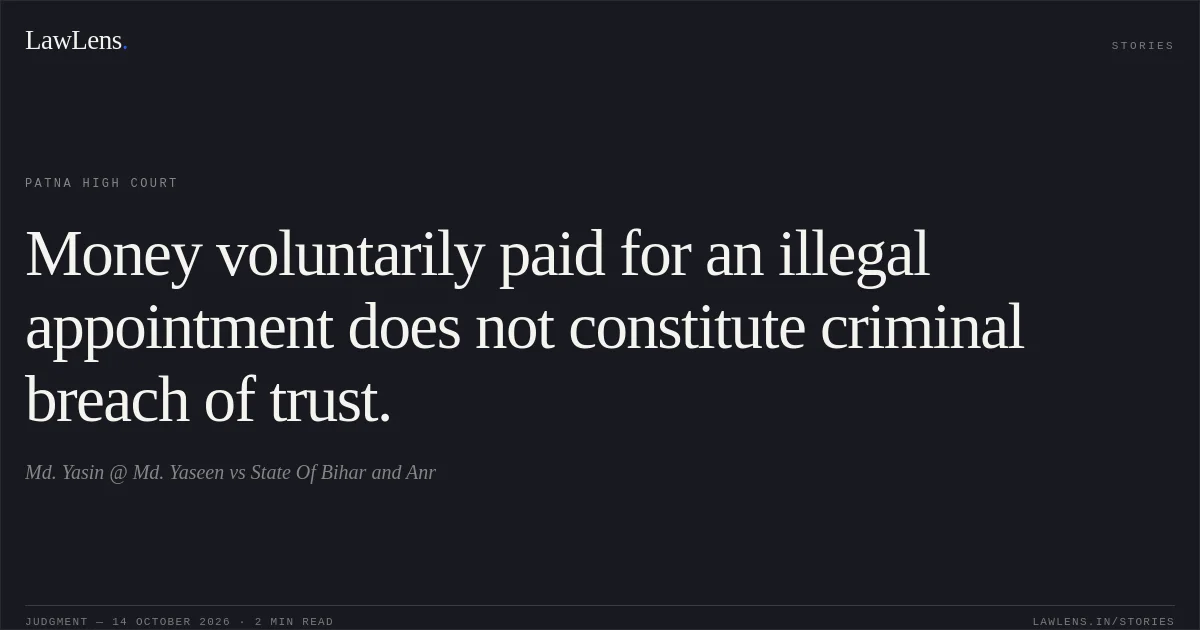
The Court viewed the alleged payment as having been made voluntarily for the unlawful purpose of securing a government appointment for money.
Source reference: pp. 10–13; paras. 28–37On that premise, it reasoned that the complainant had parted with the money for the agreed purpose and that the petitioner did not receive it in trust or retain dominion over it on the complainant’s behalf; accordingly, failure to procure the appointment or refund the money did not establish the entrustment and misappropriation elements of Section 405 IPC
Source reference: pp. 10–13; paras. 28–37Applying *Bhajan Lal*, the Court concluded that the prosecution should not continue.
Source reference: pp. 15–17; paras. 41–43Although cognizance had also been taken under Sections 423 and 504 IPC, the judgment did not separately analyse the elements of those offences
Source reference: pp. 15–17; paras. 41–43Holding
The Court allowed the Section 482 CrPC application, quashed the Magistrate’s order dated 28 June 2016 taking cognizance under Sections 406, 423 and 504 IPC, and quashed the criminal proceedings arising from the complaint insofar as they concerned the petitioner
Acts & Sections Cited
10 provisions across 3 statutes referred to in this judgment. Each provision opens on LawLens.
Indian Penal Code, 18608
Code of Criminal Procedure, 19731
Indian Contract Act, 18721
Original Court PDF
Md. Yasin @ Md. YaseenvsState Of Bihar and Anr
Click to open original judgment
Original judgment, available to read, download and summarize on LawLens.in