Facts
The appellants are homebuyers who entered into construction and sale agreements in 2016 with Respondent No. 1 (the developer) for residential apartments, with possession due by December 2018.
Source reference: para. 2.1Alleging deficiency in service and non-delivery, the appellants filed Consumer Case No. 13 of 2023 before the NCDRC against the developer (R1), its associated company (R2), directors/promoters (R3-5), and landowners (R6-7).
Source reference: para. 2.2During the pendency of the complaint, the NCLT initiated the Corporate Insolvency Resolution Process (CIRP) against R1 on 23.08.2024, triggering a moratorium under Section 14 of the IBC.
Source reference: para. 2.3The appellants filed interlocutory applications (I.A. Nos. 14200 and 15656 of 2024) requesting the NCDRC to continue proceedings against the remaining respondents (R2-7).
Source reference: para. 2.4, 2.5The NCDRC rejected these applications on 20.01.2025, holding that liability could not be independently examined as the primary contract was with R1.
Source reference: para. 2.6Issues
1. Whether the NCDRC was justified in adjourning the complaint sine die against all respondents due to a moratorium operating solely against the corporate debtor (Respondent No. 1).
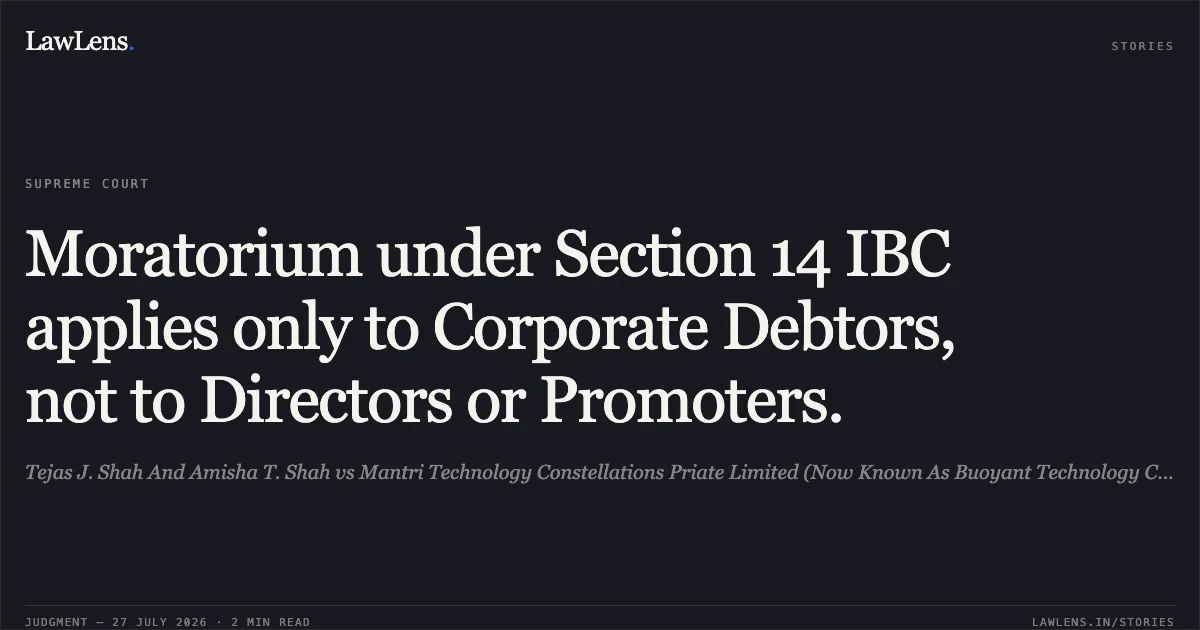
Source reference: para. 42. Whether the protection of a moratorium under Section 14 of the IBC extends to promoters, directors, or associated entities of the corporate debtor.
Source reference: para. 6, 11Law Applied
The Court primarily applied Section 14 of the Insolvency and Bankruptcy Code (IBC), 2016, which mandates a moratorium on proceedings specifically against the "corporate debtor" to preserve its assets.
Source reference: para. 5It relied on the precedent in P. Mohanraj v. Shah Brothers Ispat Pvt. Ltd., which established that Section 14 applies only to the corporate debtor and not to natural persons.
Source reference: para. 6furthermore, it cited Ansal Crown Heights Flat Buyers Association v. Ansal Crown Infrabuild Pvt. Ltd., confirming that moratoriums do not protect promoters and directors.
Source reference: para. 7Saranga Anilkumar Aggarwal v. Bhavesh Dhirajlal Sheth, asserting that the "protective sweep" of a moratorium cannot be expanded beyond the statutory text to stultify consumer remedies.
Source reference: para. 8Reasoning
The Court reasoned that the scope of a moratorium is strictly statutory and cannot be enlarged by judicial interpretation to include subsidiaries, directors, or personal guarantors unless expressly provided by the IBC.
Source reference: para. 6The Supreme Court found the NCDRC’s approach erroneous because it effectively decided the merits of the case—attributing deficiency only to R1—at an interlocutory stage while simultaneously claiming the liability was yet to be determined.
Source reference: para. 12Since no independent moratorium operated in favor of Respondent Nos. 2 to 7, there was no legal bar to continuing proceedings against them.
Source reference: para. 11The Court emphasized that the NCDRC must adjudicate the liability of the remaining respondents based on pleadings and evidence rather than foreclosing the inquiry due to the lead developer’s insolvency.
Source reference: para. 13Holding
While proceedings against Respondent No. 1 remain stayed under Section 14 of the IBC, the NCDRC must proceed to hear and dispose of Consumer Complaint No. 13 of 2023 against Respondent Nos. 2 to 7 in accordance with law.
The Supreme Court allowed the appeals in part, setting aside the NCDRC's order dated 20.01.2025.
Source reference: para. 15, 16Acts & Sections Cited
4 provisions across 2 statutes referred to in this judgment. Each provision opens on LawLens.
Insolvency and Bankruptcy Code, 2016.3
Negotiable Instruments Act, 18811
Original Court PDF
Tejas J. Shah And Amisha T. ShahvsMantri Technology Constellations Priate Limited (Now Known As Buoyant Technology Constellations Pvt. Ltd.)
Click to open original judgment
Original judgment, available to read, download and summarize on LawLens.in


