Facts
The appellant-wife and respondent-husband married on 18 June 2006 and have two minor daughters, aged approximately nine and eight years. The parties separated following marital discord.
Source reference: paras. 3.1–3.6In 2022, the appellants instituted proceedings under Section 125 of the Code of Criminal Procedure, 1973 (“CrPC”), seeking monthly maintenance of ₹2,50,000. The wife, an MBBS and DGO-qualified gynaecologist, claimed to earn ₹1,50,000 per month, while the husband, an MBBS and MD-qualified paediatrician, stated that he earned ₹2,00,000 per month.
Source reference: paras. 3.1–3.6The Family Court awarded interim maintenance of ₹30,000 per month to each daughter but declined interim maintenance to the wife.
Source reference: paras. 3.1–3.6The Allahabad High Court reduced the maintenance to ₹15,000 per month for each daughter, principally on the ground that the wife was also earning and should share the burden.
Source reference: paras. 3.7–3.9, 8Issues
Whether the High Court was justified in reducing the interim maintenance awarded to the two minor daughters from ₹30,000 to ₹15,000 per month each merely because the mother was employed and earning.
Source reference: paras. 8–10Whether the Family Court’s award of aggregate interim maintenance of ₹60,000 per month, having regard to the parties’ financial status and the needs of the minor daughters, warranted interference in revision.
Source reference: paras. 9–13Law Applied
The Court applied Section 125 CrPC, which enables a wife and minor children unable to maintain themselves to claim maintenance from the person legally obliged to support them.
Source reference: no citationThe obligation to maintain minor children is shared by both parents, but the financial contribution of each parent cannot be determined by mechanically dividing the children’s expenses equally.
Source reference: para. 10The Court recognised that the parent with whom the children reside contributes substantially through daily care and upbringing, which is a real contribution although not readily quantifiable in monetary terms.
Source reference: para. 10The fact that the mother is gainfully employed does not, by itself, justify reducing the father’s contribution towards the children’s maintenance.
Source reference: paras. 9–11Interim maintenance must be assessed on the apparent needs of the children, the parties’ income and status, and the material placed before the court; such an interlocutory determination should not be disturbed absent perversity or demonstrable excessiveness.
Source reference: paras. 9, 12–13Reasoning
The Supreme Court found that the High Court had not held the Family Court’s assessment to be perverse or the aggregate sum of ₹60,000 per month to be excessive; indeed, it accepted that amount as sufficient for the daughters but reduced it solely because the mother was earning.
Source reference: para. 9This reasoning improperly treated parental responsibility as capable of being divided by arithmetic.
Source reference: para. 10The daughters lived with the mother, who bore their daily-care and upbringing responsibilities while also working, constituting a substantial non-monetary contribution.
Source reference: para. 10Further, even without accounting for the wife’s income, the husband’s admitted income of ₹2,00,000 per month, his professional qualification as a doctor, and the educational and upbringing needs of two school-going children supported the Family Court’s award of ₹30,000 per daughter.
Source reference: para. 11The Family Court had considered the parties’ income affidavits and the expenses placed on record, and its assessment was therefore neither unreasonable nor liable to interference in revision.
Source reference: para. 12The fact that the Section 125 CrPC proceedings remained pending also supported preserving the interim arrangement until final adjudication.
Source reference: para. 13Holding
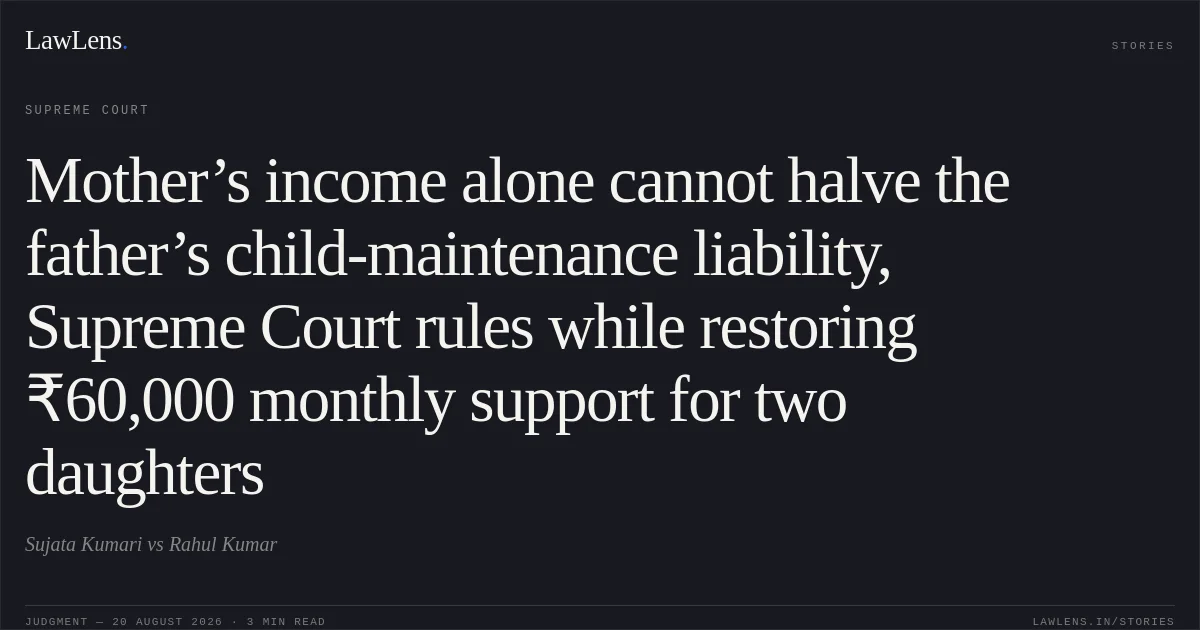
The Court held that the wife’s employment and income, by themselves, did not justify halving the father’s liability towards the minor daughters.
The High Court’s order dated 9 February 2026 was set aside, and the Family Court’s order dated 21 October 2024 was restored, requiring the respondent-husband to pay interim maintenance of ₹30,000 per month to each daughter, aggregating to ₹60,000 per month.
Source reference: para. 14Any arrears were directed to be paid to the wife within three months.
Source reference: paras. 14–15The pending Section 125 CrPC maintenance proceedings were directed to be decided independently and uninfluenced by the interim orders under challenge.
Source reference: paras. 14–15Acts & Sections Cited
1 provisions across 1 statute referred to in this judgment. Each provision opens on LawLens.
Code of Criminal Procedure, 19731
Original Court PDF
Sujata KumarivsRahul Kumar
Click to open original judgment
Original judgment, available to read, download and summarize on LawLens.in