Facts
The appellants were the parents of a 19-year-old deceased who died in a motor-vehicle accident involving truck No. HR-38C-4951, insured with Reliance General Insurance Company Ltd.
Source reference: paras. 2, pp. 1–2The Motor Accidents Claims Tribunal, Giridih, assessed the deceased’s monthly income at ₹4,000, applied a 1/4 deduction towards personal expenses and a multiplier of 16, and awarded ₹5,91,000 with interest at 9% per annum from the date of institution of the claim petition until realization.
Source reference: para. 2, pp. 1–2In appeal, the claimants sought enhancement, contending that the deceased earned ₹6,000 per month as a Rajmistry and that the Tribunal had failed to award amounts for future prospects, funeral expenses, loss of estate and loss of consortium in accordance with applicable precedent.
Source reference: paras. 3–5, pp. 2–3The Insurance Company opposed enhancement, arguing that the alleged income was unsupported by the employer or documentary evidence, and also challenged the rate of interest.
Source reference: paras. 6–7, p. 3Issues
Whether the deceased’s monthly income should be assessed at ₹6,000, as claimed by the appellants, or at ₹4,000, as determined by the Tribunal?
Source reference: paras. 9–14, pp. 3–4Whether the deductions for personal expenses and the multiplier applied by the Tribunal were legally correct, considering that the deceased was a bachelor aged 19 years?
Source reference: paras. 15–16, p. 4Whether the claimants were entitled to an addition towards future prospects and enhanced amounts under the conventional heads, including funeral expenses, loss of estate and loss of consortium?
Source reference: paras. 17–20, pp. 4–5Whether the award of interest at 9% per annum required interference?
Source reference: para. 21, p. 5Law Applied
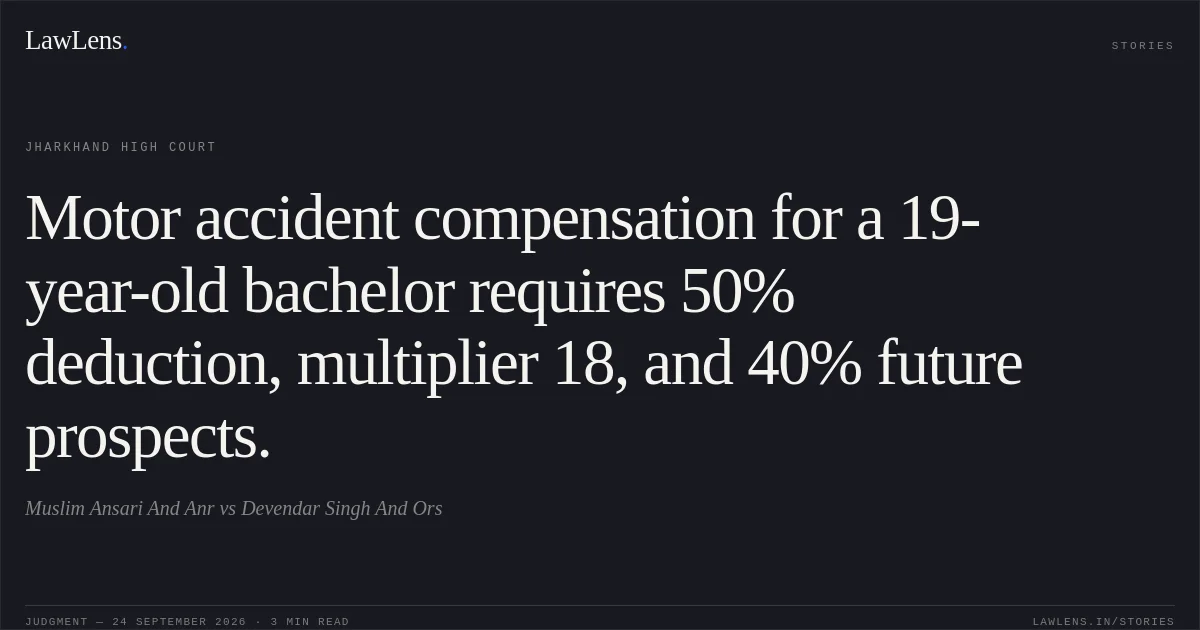
The Court applied the principles in Sarla Verma v. Delhi Transport Corporation, (2009) 6 SCC 121, under which a deduction of 50% is ordinarily made towards the personal and living expenses of a bachelor and the multiplier is selected with reference to the deceased’s age; for a deceased aged 15–20 years, the applicable multiplier is 18.
Source reference: paras. 10–19, pp. 3–5The Court applied National Insurance Co. Ltd. v. Pranay Sethi, (2017) 16 SCC 680, which recognizes addition towards future prospects and prescribes standardized amounts for funeral expenses and loss of estate.
Source reference: paras. 10–19, pp. 3–5It also relied on Magma General Insurance Co. Ltd. v. Nanu Ram @ Chuhru Ram, (2018) 18 SCC 130, recognizing consortium payable to the parents of a deceased child.
Source reference: paras. 10–19, pp. 3–5The Court further accepted assessment of income on the basis of relevant minimum-wage notifications where direct documentary evidence of earnings is unavailable.
Source reference: paras. 10–19, pp. 3–5Reasoning
The Court upheld the Tribunal’s assessment of monthly income at ₹4,000 because, although four witnesses—including the parents—stated that the deceased earned ₹6,000 per month, neither the employer nor any employment register, salary record or other documentary proof was produced.
Source reference: paras. 10–14, pp. 3–4The assessment was therefore consistent with the minimum-wage notification prevailing in 2008.
Source reference: paras. 10–14, pp. 3–4However, the Tribunal incorrectly deducted only one-fourth of the income.
Source reference: paras. 15–16, p. 4Since the deceased was a bachelor, Sarla Verma required a 50% deduction for personal expenses.
Source reference: paras. 15–16, p. 4Further, because he was 19 years old, the correct multiplier was 18 rather than 16.
Source reference: paras. 15–16, p. 4Applying a 40% addition for future prospects to the annual income of ₹48,000, deducting 50% for personal expenses and applying the multiplier of 18, the Court calculated the dependency compensation at ₹6,04,800.
Source reference: paras. 17–18, p. 4It then awarded ₹15,000 for funeral expenses, ₹15,000 for loss of estate and ₹80,000 towards consortium at ₹40,000 for each parent, resulting in total compensation of ₹7,14,800.
Source reference: paras. 18–20, pp. 4–5Given that the accident occurred in 2008, the Court found no reason to interfere with the Tribunal’s award of 9% interest.
Source reference: para. 21, p. 5Holding
The appeal was partly allowed.
The Court enhanced the compensation from ₹5,91,000 to ₹7,14,800, while maintaining interest at 9% per annum from the date of institution of the claim petition until realization.
Source reference: paras. 20–21, p. 5The Insurance Company was directed to deposit the enhanced amount, together with applicable interest, within eight weeks, after deducting the amount already paid.
Source reference: paras. 22–23, p. 5Upon deposit, the appellants were permitted to withdraw the amount through regular banking channels.
Source reference: para. 24, p. 5The Insurance Company retained the right to recover the compensation from the vehicle owner, as that aspect had not been challenged in the appeal.
Source reference: para. 25, p. 5No order as to costs was made.
Source reference: para. 26, p. 5Original Court PDF
Muslim Ansari And AnrvsDevendar Singh And Ors
Click to open original judgment
Original judgment, available to read, download and summarize on LawLens.in
![Land acquisition alone creates no enforceable right to public employment absent statutory or applicable policy entitlement.. MAHESH KR SINGH vs RAILWAY. CAT - ['Patna']. LawLens](/stories/thumbnails/land-acquisition-alone-creates-no-enforceable-right-to-public-employment-absent-statutory-1a15be750fd3445f9b58d68728e76006.webp)