Facts
The claimants sought compensation under Sections 166 and 140 of the Motor Vehicles Act, 1988, alleging that Surendra Singh Parmar was injured when tanker No. MP-06/HC-0580 overturned on 1 January 2018 and that his injuries later caused his death.
Source reference: para. 2–3They relied on the FIR, police papers, vehicle-related documents, medical records and oral evidence; the insurer disputed the tanker’s involvement and contended that Parmar had been travelling in it.
Source reference: para. 4–5, 8The Claims Tribunal dismissed the claim, principally relying on a medical record, Ex. P-195, which referred to a fall from a tractor. The claimants appealed.
Source reference: para. 1, 6, 14Issues
1. Whether the Claims Tribunal was justified in finding that the tanker’s involvement was not proved on the basis of the discrepancy in Ex. P-195, without assessing the other evidence cumulatively?
Source reference: para. 102. Whether the Tribunal’s award should be set aside and the matter remanded for determination of the remaining issues?
Source reference: para. 18–20Law Applied
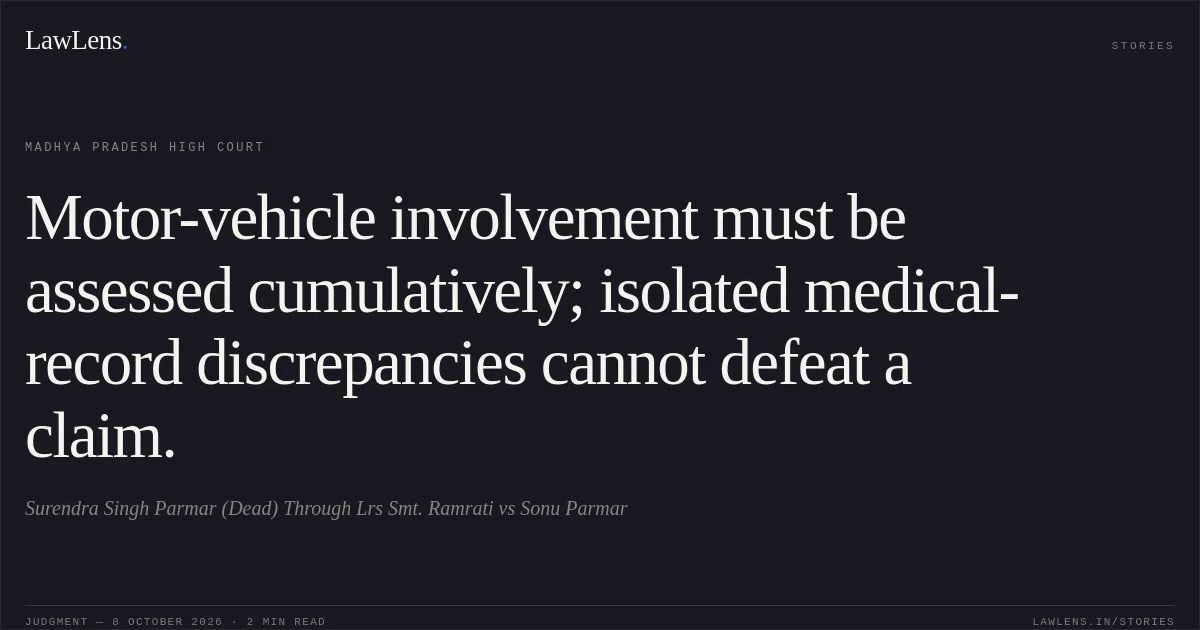
Claims under Sections 166 and 140 of the Motor Vehicles Act, 1988 are assessed on the civil standard of preponderance of probabilities, not proof beyond reasonable doubt; the evidence must be considered holistically, and strict proof of an accident in a particular manner is not required.
Source reference: para. 11–12In Raj Kumar Das v. National Insurance Co. Ltd., the Supreme Court held that isolated inconsistencies in medical records cannot displace the cumulative evidentiary record where the other evidence supports the occurrence.
Source reference: para. 11–12The Court also referred to Mathew Alexander v. Mohd. Shafi and Dulcina Fernandes v. Joaquim Xavier Cruz on the applicable standard of proof, and Sunita v. Rajasthan State Road Transport Corporation on assessing the evidence on record rather than rejecting a claim for want of additional eyewitness evidence.
Source reference: para. 11Oriental Insurance Company Ltd. v. Prem Lata Shukla recognises that a document relied upon by a party must be read as a whole; however, that principle does not dispense with appreciation of all the evidence.
Source reference: para. 8, 17Reasoning
Ex. P-195 was relevant, but its reference to a fall from a tractor could not, by itself, determine whether the tanker was involved. The FIR and police papers identified the tanker and its driver, and the record also included oral evidence and documents concerning the tanker in the criminal proceedings.
Source reference: para. 13–16Applying the preponderance-of-probabilities standard, the Court held that the Tribunal should have assessed the medical entry alongside this other evidence rather than treating the discrepancy as conclusive. The Tribunal’s failure to consider the cumulative evidentiary record rendered its finding on involvement unsustainable.
Source reference: para. 15–18Holding
The High Court set aside the Tribunal’s award and held that the involvement of tanker No. MP-06/HC-0580 in the accident was established on the evidence available.
Because the Tribunal had not decided the remaining issues, the matter was remanded for findings on those issues and a fresh award after hearing the parties.
Source reference: para. 20The parties were directed to appear before the Tribunal on 6 November 2026, with disposal to be pursued expeditiously, preferably within five months; the appeal was partly allowed.
Source reference: para. 21–23Acts & Sections Cited
3 provisions across 1 statute referred to in this judgment. Each provision opens on LawLens.
Motor Vehicles Act, 19883
Original Court PDF
Surendra Singh Parmar (Dead) Through Lrs Smt. RamrativsSonu Parmar
Click to open original judgment
Original judgment, available to read, download and summarize on LawLens.in