01Facts
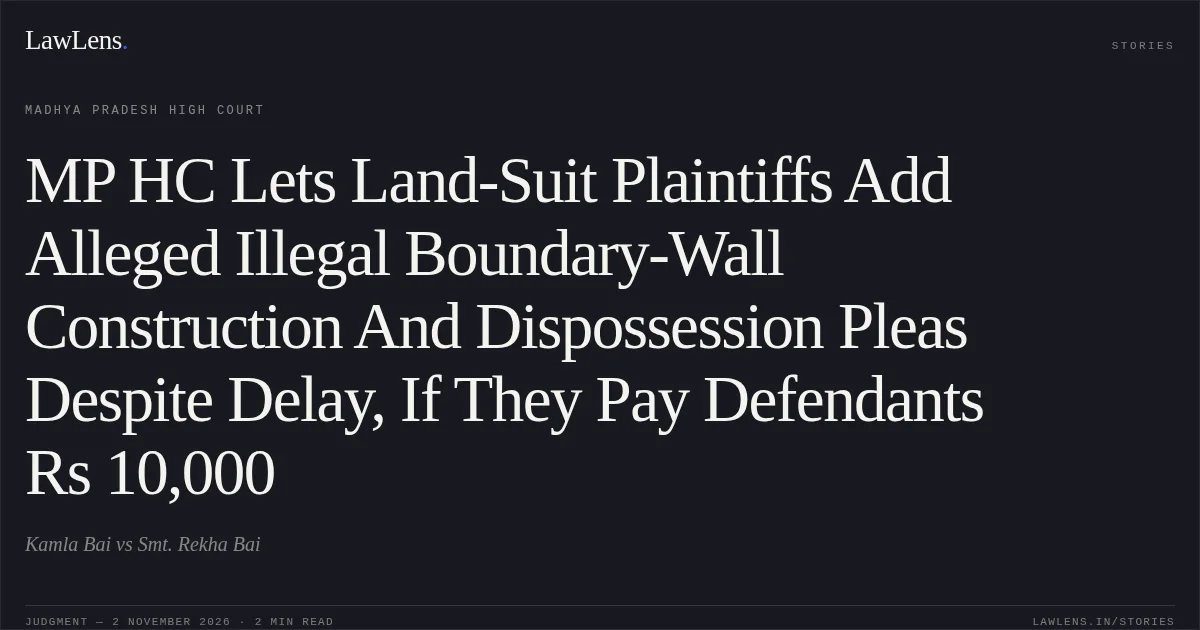
The petitioners, plaintiffs in a suit for declaration of title and permanent injunction, challenged the Civil Judge’s order rejecting their application under Order VI Rule 17 read with Section 151 of the Code of Civil Procedure, 1908 (CPC), to amend the plaint.
¶ 1The proposed amendments concerned an alleged illegal boundary wall and the plaintiffs’ alleged dispossession from the suit land. The trial court rejected the application, noting that the defendants’ counterclaim had been filed in 2021 and that the plaintiffs had not plausibly explained their delay or shown due diligence. The application was made at the plaintiffs’ evidence stage.
¶ 1–202Issues
i.Whether the trial court’s rejection of the amendment application was justified on the grounds of delay and lack of an explanation of due diligence.
¶ 2–3, 7ii.Whether the plaint amendment should be allowed where no specific prejudice to the defendants or loss of a valid defence was identified.
¶ 3–4, 7–803Law Applied
Article 227 of the Constitution provides the supervisory jurisdiction invoked to challenge the trial court’s order. Order VI Rule 17 CPC governs amendment of pleadings, and Section 151 CPC was cited in the amendment application.
¶ 1Relying on Life Insurance Corporation of India v. Sanjeev Builders Pvt. Ltd. and Another, (2022) 16 SCC 1, the Court applied the principles that amendments necessary for effective adjudication should generally be allowed unless they cause injustice or prejudice, change the nature of the suit, introduce a time-barred claim, are mala fide, or deprive the opposing party of a valid defence. Delay alone is not a sufficient ground to refuse amendment, and costs may compensate the other side.
¶ 6Provisions in the judgment · 1 · Linked ones open on LawLens
Code of Civil Procedure, 1908 Section 151
04Reasoning
Although the plaintiffs had delayed in seeking amendment, the Court found that neither the trial court nor the defendants had identified any prejudice that would result from allowing it, or shown that the amendment would remove a valid defence.
¶ 7Applying the principles in Sanjeev Builders, the Court concluded that delay alone did not warrant rejection and that the defendants could be protected by an award of costs; they could also seek consequential amendments to their pleadings.
¶ 7–805Holding
The Court allowed the petition, set aside the trial court’s order, and allowed the plaint amendment subject to payment of ₹10,000 in costs to the defendants as a condition precedent to carrying it out.
¶ 8The defendants were granted liberty to seek consequential amendments to their written statement or counterclaim. The petition was disposed of accordingly.
¶ 8–9Original Court PDF
Kamla BaivsSmt. Rekha Bai
Click to open original judgment
Original judgment, available to read, download and summarize on LawLens.in