01Facts
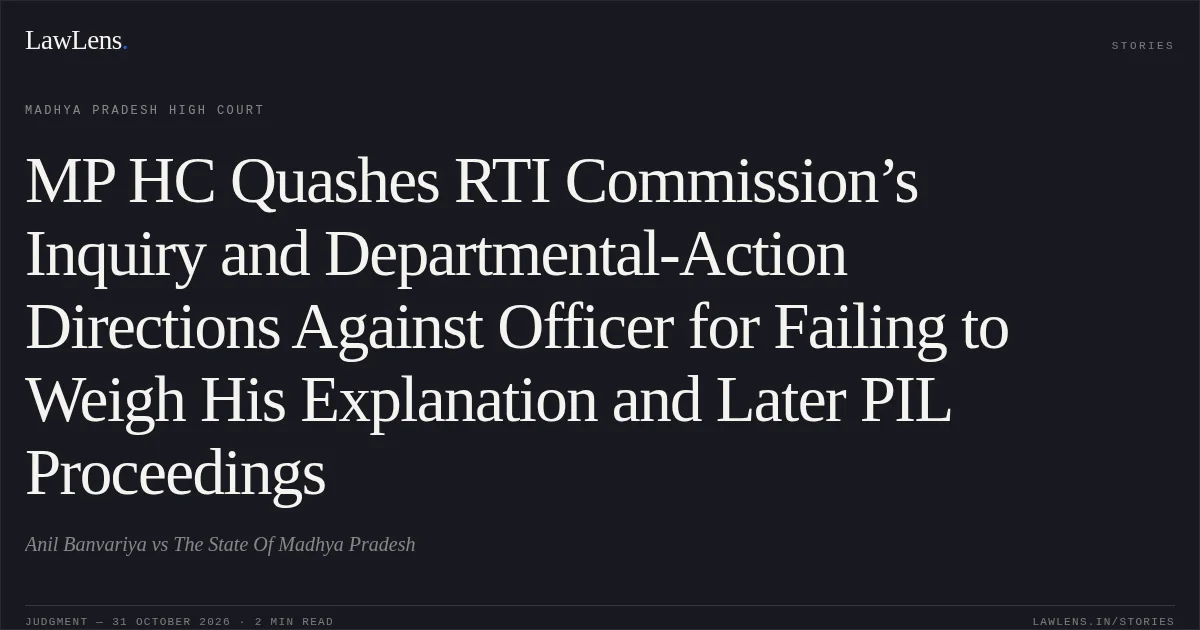
The petitioner, then Sub-Divisional Officer, Lashkar, was subject to proceedings before the State Information Commission concerning an alleged failure, as Public Information Officer, to provide information sought under the Right to Information Act, 2005.
pp. 1–3The request concerned a compliance report in Writ Petition (PIL) No. 19017 of 2020.
pp. 1–3The petitioner maintained that the report was submitted to the High Court after he learned of the proceedings, and that he had explained to the Commission that the requested information was not available in his office at the relevant time
pp. 1–3The PIL was disposed of after the Division Bench considered the compliance and inspection reports; the Supreme Court later dismissed the challenge to that disposal
p. 4The Commission’s orders dated 27 March 2024 and 29 April 2025 directed initiation of an inquiry and departmental proceedings against the petitioner.
p. 1He challenged those orders under Article 226.
p. 1Applications for intervention and impleadment were dismissed as not pressed
p. 102Issues
i.Whether the State Information Commission’s orders directing an inquiry and departmental proceedings could stand when they did not adequately consider the petitioner’s explanation and the subsequent proceedings before the High Court.
pp. 4–5ii.Whether the direction to initiate departmental proceedings was sustainable where the Commission had not adequately examined the relevant facts, the petitioner’s explanation, and whether any deliberate or culpable failure had occurred.
p. 503Law Applied
The Court considered the Right to Information Act, 2005, under which a Public Information Officer is required to discharge statutory duties concerning the furnishing of information, and the Madhya Pradesh Civil Services (Conduct) Rules, 1965, under which departmental proceedings had been directed.
p. 1, 3Applying Article 226 and general principles of administrative law and natural justice, the Court held that a statutory authority’s decision affecting a public servant’s service interests must rest on relevant material, remain within its statutory jurisdiction, and comply with natural justice.
p. 5An allegation of delay alone does not dispense with consideration of the officer’s explanation; a direction carrying serious civil consequences cannot be issued mechanically without examining whether the circumstances disclose deliberate or culpable failure.
p. 5No judicial precedents were cited.
Provisions in the judgment · 1 · Linked ones open on LawLens
Right to Information Act, 2005 Section 6
04Reasoning
The Court found that the compliance report, the High Court’s subsequent consideration of the PIL, and the petitioner’s explanation about the information’s availability were material to the Commission’s assessment.
pp. 4–5The impugned orders did not demonstrate adequate consideration of those matters and appeared to proceed on the premise of non-compliance.
p. 5In particular, the direction to initiate departmental proceedings was not shown to follow from an examination of whether the petitioner’s conduct involved deliberate or culpable failure.
p. 5The orders therefore could not be sustained.
p. 505Holding
The Court allowed the petition and quashed the State Information Commission’s orders dated 27 March 2024 and 29 April 2025.
pp. 5–6All consequential directions issued pursuant to those orders were also quashed.
pp. 5–6Original Court PDF
Anil BanvariyavsThe State Of Madhya Pradesh
Click to open original judgment
Original judgment, available to read, download and summarize on LawLens.in