Facts
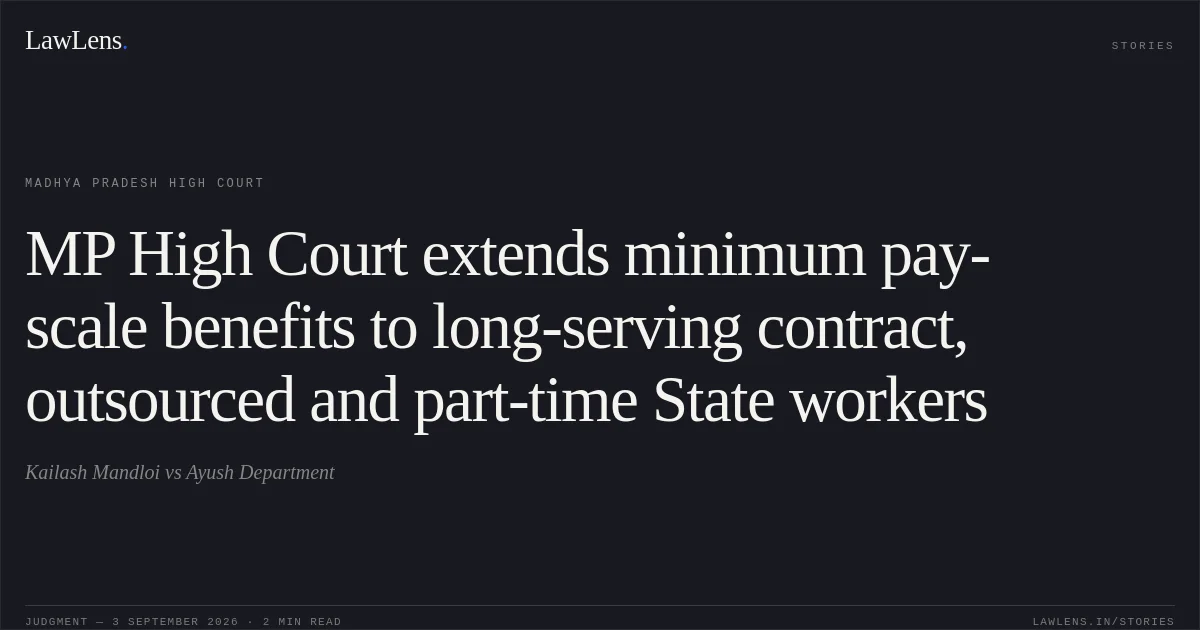
The petitioner was engaged as a “Swachhak” on contract basis by order dated 26 September 2002 and his engagement was repeatedly extended by the State Government. He continued to work for approximately 20 years.
Source reference: paras. 1–3, pp. 1–2The petitioner sought regularisation/classification and payment of at least the minimum of the applicable pay scale under the State Government’s policy dated 7 October 2016. His representation was rejected on the ground that the policy applied to daily-wage workers and excluded contract, outsourced and temporary employees. Earlier, in W.P. No. 2863 of 2021, the High Court had directed the competent authority to decide his representation; the subsequent rejection led to the present petition.
Source reference: paras. 1–3, pp. 1–2Issues
Whether a contract worker continuously engaged by the State Government for approximately 20 years could be denied the benefit of classification and minimum pay under the Government Circular dated 7 October 2016 merely because he was engaged on a contract basis.
Source reference: paras. 5–6, pp. 2–4Whether the petitioner was entitled to an order directing the respondents to classify him under the Circular dated 7 October 2016 and grant consequential benefits.
Source reference: paras. 6–7, pp. 3–4Law Applied
The Court applied Articles 14 and 16 of the Constitution, which prohibit arbitrary discrimination and require equality of treatment in public employment, along with the Directive Principles under Articles 38, 39(a) and 43, which require the State to promote social and economic justice, secure adequate means of livelihood, and endeavour to provide workers with a living wage and decent conditions of life.
Source reference: paras. 2, 5–6, pp. 1–4The Court interpreted the State Government Circular dated 7 October 2016 as a beneficial policy for classifying long-serving workers as skilled, semi-skilled or unskilled and paying them the minimum of the applicable pay scale where regularisation was not possible for want of sanctioned or vacant posts.
Source reference: paras. 2, 5–6, pp. 1–4Reasoning
Although the Circular formally referred to daily-wage workers and excluded contract, outsourced and part-time employees, the Court held that the petitioner’s repeated engagement for about two decades demonstrated a continuing and genuine requirement for his services.
Source reference: paras. 5–6, pp. 2–4Denying him classification and minimum pay solely because his engagement was labelled “contractual” would deprive him of adequate livelihood, economic justice and a decent standard of life, while similarly situated long-serving workers received the policy’s benefits. The Court therefore found no rational basis for excluding contract workers who had been continuously engaged by the State for more than ten years and treated such exclusion as inconsistent with the constitutional objectives embodied in Articles 38, 39(a) and 43.
Source reference: paras. 5–6, pp. 2–4Holding
The writ petition was allowed. The Court thus granted classification and minimum-pay-related benefits, rather than directing regularisation into a sanctioned permanent post.
The respondents were directed to pass appropriate orders classifying the petitioner in accordance with the Circular dated 7 October 2016 and to extend all consequential benefits available under that policy.
Source reference: paras. 7–9, p. 4Original Court PDF
Kailash MandloivsAyush Department
Click to open original judgment
Original judgment, available to read, download and summarize on LawLens.in