Facts
The complainant alleged that she came into contact with the revisionist, a political leader, in 2018; that he offered her political protection and advancement; and that, after appointing her to a district-level political position, he developed an intimate relationship with her. She alleged that the revisionist raped her at his residence in March 2020, repeatedly established physical relations with her on the promise of divorcing his wife and marrying her, and subsequently threatened and blackmailed her. She further alleged that on 24 August 2024 he forcibly obtained her signatures on blank papers and threatened to defame her.
Source reference: paras. 3–5An FIR was registered on 17 January 2025 under Sections 64(2), 351(3), 127(2) and 69 of the Bharatiya Nyaya Sanhita, 2023 (“BNS”). The complainant reiterated her allegations in statements recorded during investigation and before the Magistrate. Her husband, son and daughter-in-law also supported aspects of her allegations. The medico-legal report recorded no signs of recent force or injury, although sexual violence was not ruled out.
Source reference: paras. 6–14The investigation also produced an audio recording of a conversation between the parties, which, according to the prosecution, indicated a continuing physical relationship and the revisionist’s alleged promise to marry the complainant; an FSL report subsequently identified the revisionist’s voice in the recording.
Source reference: paras. 10–12, 23The police filed a charge-sheet. The revisionist sought discharge, contending that the material disclosed a consensual relationship between two married adults and did not establish rape, deceitful inducement, criminal intimidation or wrongful confinement. The trial court rejected the discharge application on 5 May 2025. Although the revision was filed before the High Court, the trial court framed charges on 16 May 2025.
Source reference: paras. 15–22Issues
1. Whether the material collected during investigation disclosed sufficient ground, or a grave suspicion, to proceed against the revisionist for the offences under Sections 64(2), 69, 351(3) and 127(2) BNS.
Source reference: paras. 28–332. Whether the allegations of rape and sexual exploitation on a promise of marriage were prima facie sustainable, or whether the prosecution material instead demonstrated a long-standing consensual relationship between two married adults.
Source reference: paras. 34–473. Whether the High Court could examine the legality of the order rejecting discharge notwithstanding the subsequent framing of charges by the trial court.
Source reference: paras. 49–52Law Applied
The Court applied the principles governing discharge and framing of charges under Section 227 of the Code of Criminal Procedure, read with the revisional jurisdiction under Section 442 BNSS. At this stage, the court may sift and weigh the material in a limited manner to determine whether the facts, taken at face value, disclose the ingredients of the alleged offences and whether a grave suspicion arises; however, it must not conduct a full trial or assess evidence conclusively.
Source reference: paras. 29–32The Court relied on Union of India v. Prafulla Kumar Samal, Sajjan Kumar v. CBI, State v. J. Doraiswamy and Tarun Jit Tejpal v. State of Goa for these principles.
Source reference: paras. 29–32It also relied on Biswajyoti Chatterjee v. State of West Bengal, Prashant v. State (NCT of Delhi) and Kunal Rameshbhai Kalyani v. State of Gujarat for the proposition that a prolonged physical relationship, particularly where the complainant knew that the accused was already married, may indicate consensual relations rather than sexual intercourse induced by a false promise of marriage.
Source reference: paras. 40, 43The Court further invoked the Bhajan Lal principles permitting interference where allegations are absurd, inherently improbable or amount to an abuse of process.
Source reference: para. 46It held that the subsequent framing of charges did not extinguish its jurisdiction to examine the earlier order rejecting discharge.
Source reference: para. 49Reasoning
The Court found that the prosecution material, when assessed against the broad probabilities of the case, did not disclose a grave suspicion sufficient to proceed with the charges. The complainant was a mature, politically active woman aged approximately 49 years, with a subsisting marriage and grown-up children. The material indicated that she had voluntarily entered into and maintained a prolonged relationship with the revisionist, another married person, including frequent visits to his residence, sometimes at night.
Source reference: paras. 34, 44The Court considered the medico-legal record significant because it noted no physical violence, restraint, weapon, verbal threat or inducement, and because the complainant reportedly stated that no allurement had been offered during the examination.
Source reference: paras. 35–37It also found that the later assertion that the revisionist could procure her divorce “within two minutes” appeared implausible and constituted an improvement over the earlier version.
Source reference: paras. 38–39The audio conversation, in the Court’s view, suggested that the complainant had herself approached the revisionist and was seeking marriage, which was inconsistent with the allegation that she had been continuously sexually exploited through blackmail.
Source reference: paras. 41–42Although the Court acknowledged that absence of injuries is not by itself conclusive in a rape case, it held that the totality of the material—particularly the long-standing relationship, the parties’ marital status, the inconsistencies in the complainant’s account and the contents of the medical and electronic evidence—rendered the prosecution version inherently improbable and insufficient to justify continuation of the criminal proceedings.
Source reference: paras. 44–48The Court also held that Section 346(1) BNSS did not justify hurried framing of charges because the provision applied to the trial stage and, in any event, the offences charged did not fall within the specified categories.
Source reference: paras. 50–52Holding
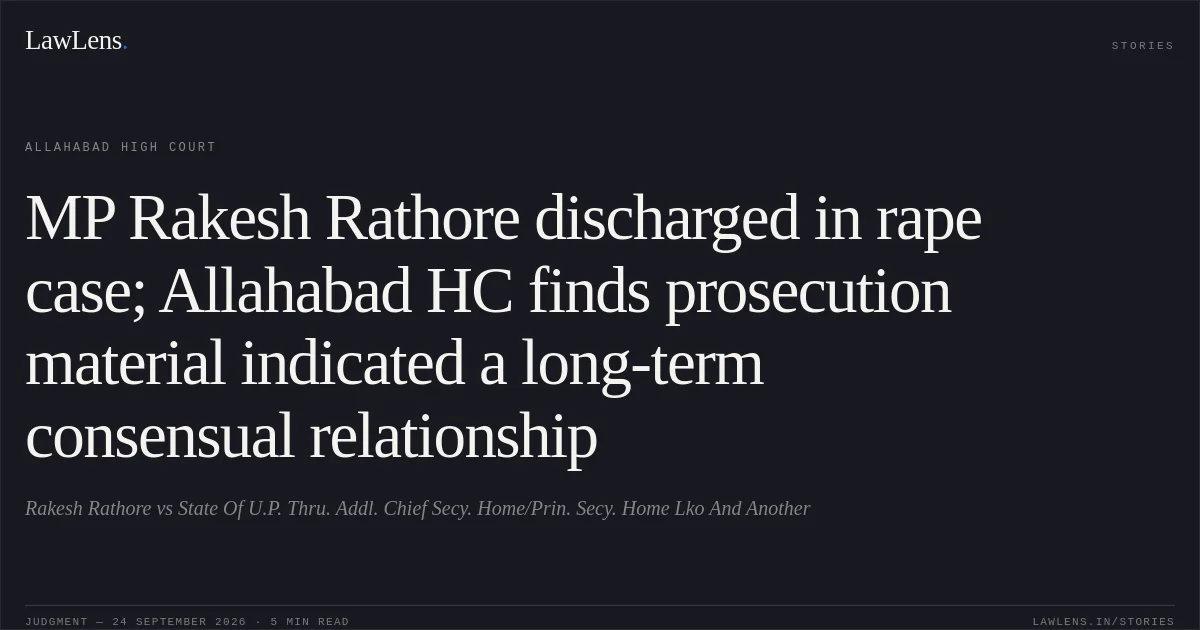
The High Court answered the issues in favour of the revisionist. It held that the prosecution material did not establish a prima facie case or grave suspicion for the alleged offences and instead indicated a prolonged consensual extra-marital relationship between two mature adults.
The Court further held that the subsequent framing of charges did not prevent it from examining the validity of the order rejecting discharge.
Source reference: para. 53The revision was accordingly allowed; the trial court’s order dated 5 May 2025 was set aside, the discharge application was allowed, and the revisionist was discharged from all charges under Sections 64(2), 69, 351(3) and 127(2) BNS.
Source reference: para. 53Acts & Sections Cited
17 provisions across 3 statutes referred to in this judgment. Each provision opens on LawLens.
Bharatiya Nagarik Suraksha Sanhita, 20234
Bharatiya Nyaya Sanhita, 2023
Code of Criminal Procedure, 19733
Original Court PDF
Rakesh RathorevsState Of U.P. Thru. Addl. Chief Secy. Home/Prin. Secy. Home Lko And Another
Click to open original judgment
Original judgment, available to read, download and summarize on LawLens.in