Facts
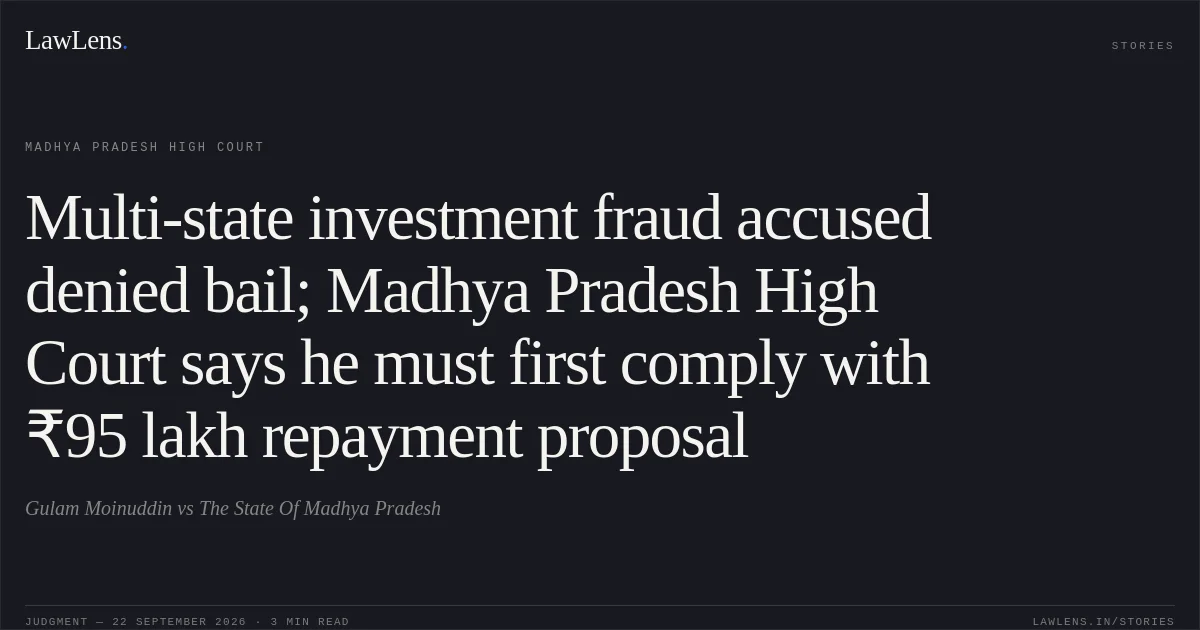
The applicant sought regular bail under Section 483 of the Bharatiya Nagarik Suraksha Sanhita, 2023, corresponding to Section 439 of the Code of Criminal Procedure, 1973, in Crime No. 150 of 2025 registered at Crime Branch, Indore, for offences under Sections 420, 409, 34, 120-B and 201 of the IPC and Section 6(1) of the Madhya Pradesh Nikshepakon Ka Sanrakshan Adhiniyam, 2000.
Source reference: para. 1He had been in custody since 12 October 2025, and his first bail application had been rejected on merits on 9 March 2026.
Source reference: para. 1The prosecution alleged that the applicant induced victims to invest in “Sunrise Guru Capital India, Mumbai” by promising high returns.
Source reference: para. 2After initially returning some amounts with profit, he allegedly transferred investors’ funds, amounting to approximately ₹3,45,48,095, into the accounts of his wife, brother-in-law and sister, and acquired movable and immovable properties in their names.
Source reference: para. 2The applicant was arrested, while the co-accused remained untraceable; a charge-sheet was filed against him with further investigation continuing under Section 173(8) CrPC.
Source reference: para. 2The repeat bail application was based on the applicant’s asserted willingness to pay the entire amount to the complainants.
Source reference: para. 3Two victims objected to bail but subsequently consented to the applicant’s proposal to pay ₹95,00,000 in phases after release.
Source reference: paras. 3–5Issues
Whether the applicant was entitled to regular bail in the repeat application after the first bail application had been rejected on merits, particularly on the basis of his proposal to pay ₹95,00,000 to two consenting victims?
Source reference: paras. 1, 3–5Whether the applicant’s criminal antecedents, alleged use of incorrect addresses, risk of absconding, and the continued unavailability of co-accused justified refusal of bail despite the victims’ consent to the proposed payment?
Source reference: paras. 4, 6–7Whether the trial should be expedited by recording the statements of the victims and other witnesses at the earliest?
Source reference: para. 8Law Applied
The Court applied Section 483 of the Bharatiya Nagarik Suraksha Sanhita, 2023, read with Section 439 CrPC, governing the High Court’s power to grant regular bail.
Source reference: para. 1The alleged offences under Sections 420, 409, 34, 120-B and 201 IPC and Section 6(1) of the Madhya Pradesh Nikshepakon Ka Sanrakshan Adhiniyam, 2000 were treated as serious economic and investment-related offences.
Source reference: para. 1In considering bail, the Court took into account the seriousness of the allegations, the applicant’s criminal antecedents, the possibility of absconding, and the risk of interference with or frustration of the ongoing investigation.
Source reference: para. 4The objectors relied on P. Chidambaram v. Directorate of Enforcement, (2020) 13 SCC 791, and Y.S. Jagan Mohan Reddy v. CBI, (2013) 7 SCC 439, concerning the cautious approach applicable to bail in serious economic offences.
Source reference: para. 4The Court further held that the consent of only two victims could not, by itself, justify bail where substantial risks arising from the applicant’s conduct and antecedents remained.
Source reference: para. 7Reasoning
The Court found that the applicant was alleged to have diverted approximately ₹3.45 crore to the accounts of close relatives, who remained unavailable to the Investigating Officer.
Source reference: paras. 2, 7His alleged involvement in similar offences in Maharashtra, Andhra Pradesh, Karnataka, Uttar Pradesh and Madhya Pradesh, together with allegedly false or unverified addresses and repeated changes of residence, indicated a substantial risk of absconding.
Source reference: paras. 4, 6The fact that the applicant’s relatives and co-accused were still untraceable reinforced the concern that release could impede the course of justice or frustrate recovery of the alleged proceeds.
Source reference: para. 7Although two victims consented to the proposed phased payment of ₹95,00,000, the Court held that such consent did not neutralise the seriousness of the allegations, the criminal antecedents, or the flight risk.
Source reference: para. 7It therefore considered it appropriate that the applicant first comply with the payment proposal and thereafter seek regular bail, rather than granting bail merely on the basis of the victims’ concurrence.
Source reference: para. 7Holding
The High Court dismissed the repeat bail application at that stage.
It declined to grant regular bail solely because two victims had consented to the applicant’s proposal for phased payment of ₹95,00,000, in view of the applicant’s alleged criminal antecedents, questionable addresses, absconding risk, and the continued unavailability of the co-accused.
Source reference: paras. 6–8The trial court was directed to proceed on priority and record the statements of the victims and witnesses.
Source reference: para. 8Crime Branch, Indore, was directed to produce the victims and/or adduce the relevant evidence before the trial court.
Source reference: para. 8Acts & Sections Cited
7 provisions across 3 statutes referred to in this judgment. Each provision opens on LawLens.
Bharatiya Nagarik Suraksha Sanhita, 20231
Code of Criminal Procedure, 19732
Indian Penal Code, 18604
Original Court PDF
Gulam MoinuddinvsThe State Of Madhya Pradesh
Click to open original judgment
Original judgment, available to read, download and summarize on LawLens.in