Facts
The Respondent, suffering from multiple sclerosis and low vision, holds a disability certificate issued by the DEPwD certifying a 45% cumulative disability (15% low vision; 30% multiple sclerosis)
Source reference: p.2-3She applied for the Combined Graduate Level Examination 2021 under the Persons with Disabilities (PwD) quota. Despite clearing all tiers, her candidature was rejected during document verification on the ground that "Multiple Sclerosis Disease [is] not admissible for reservation"
Source reference: p.3-4The Central Administrative Tribunal (CAT) allowed her challenge against this rejection on 12 December 2025
Source reference: p.4The Petitioner (Union of India/SSC) challenged the CAT order via the present writ petition.
Source reference: p.4Issues
1. Whether multiple sclerosis is a disability that qualifies for the benefit of reservation under Section 34(1) of the Rights of Persons with Disabilities (RPWD) Act, 2016.
Source reference: para. 10 / p.42. Whether a person whose benchmark disability (40% or more) is derived from a combination of multiple sclerosis and another ailment is entitled to the 4% statutory reservation.
Source reference: para. 12-13 / p.6Law Applied
Section 34(1) of the RPWD Act, 2016, which mandates a 4% reservation for "persons with benchmark disability"
Source reference: p.7"Benchmark disability" is defined under Section 2(r) as a person with not less than 40% of a "specified disability"
Source reference: p.7A "specified disability" under Section 2(z)(c) refers to those listed in the Schedule to the Act, where Clause 4(a)(i) explicitly includes "multiple sclerosis" as a chronic neurological condition
Source reference: p.8The inclusive interpretation doctrine established in Vikash Kumar v. UPSC and Ravinder Kumar Dhariwal v. Union of India, mandating that the Act be interpreted to fulfill its remedial philosophy
Source reference: para. 23 / p.9Reasoning
The Court rejected the Petitioner's argument that multiple sclerosis is excluded from the categories in Section 34(1)(a) to (d). It reasoned that the first part of Section 34(1) creates a broad statutory obligation to reserve seats for all "persons with benchmark disabilities," while the second part [clauses (a) to (e)] merely provides a mechanism for distribution; the latter cannot override or restrict the former
Source reference: para. 16-17 / p.7Since multiple sclerosis is explicitly listed as a "specified disability" in the Schedule to the Act, the Respondent—having a certified 45% disability—qualifies as a "person with benchmark disability"
Source reference: para. 21 / p.8The Court further noted that the SCC’s own advertisement (Annexure XIV) listed multiple sclerosis at S.No. 17 as a qualifying disability, thus estopping the Petitioner from denying its admissibility
Source reference: para. 28-30 / p.10-13The Court affirmed the Tribunal's view that multiple sclerosis, as a neurodevelopmental disorder, could also fall under the umbrella of "mental illness" mentioned in Section 34(1)(d)
Source reference: para. 26 / p.10Holding
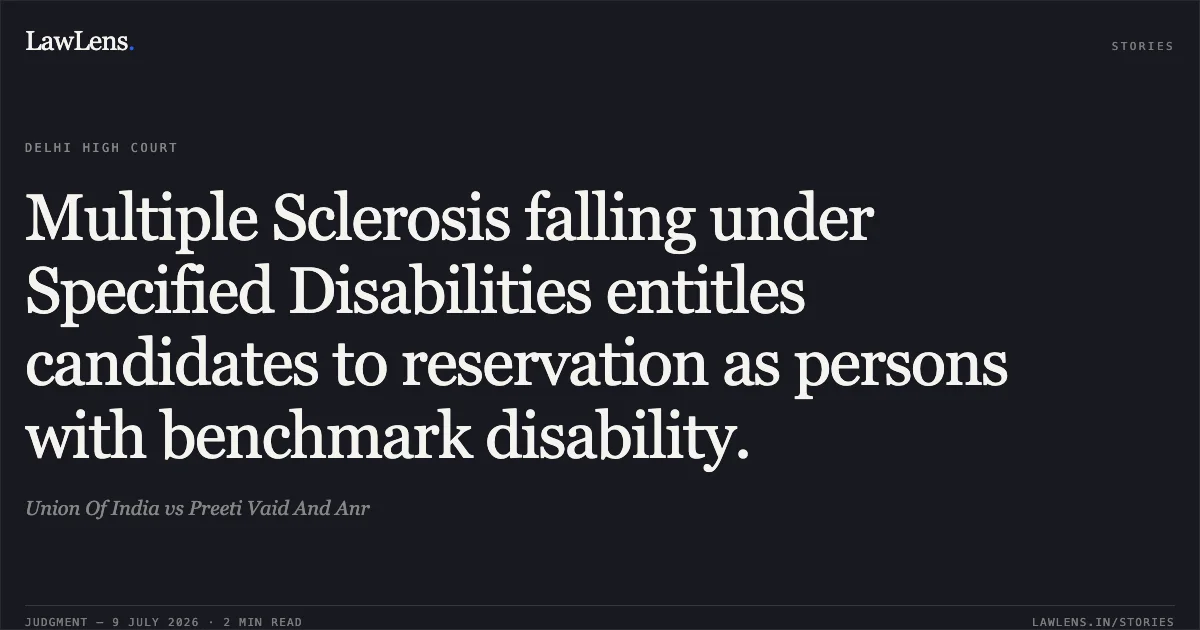
The High Court dismissed the writ petition in limine, holding that the Respondent is legally entitled to reservation as a PwD candidate
The Court affirmed the CAT’s direction to treat the Respondent as eligible for a PwD vacancy, ruling that once a candidate possesses a valid disability certificate above 40% for a scheduled disability, the state cannot narrow the scope of the Act to deny reservation
Source reference: para. 31-33 / p.13-14Acts & Sections Cited
4 provisions across 1 statute referred to in this judgment. Each provision opens on LawLens.
Rights of Persons with Disabilities Act, 2016.4
Original Court PDF
Union Of IndiavsPreeti Vaid And Anr
Click to open original judgment
Original judgment, available to read, download and summarize on LawLens.in


![Subsequent exoneration does not retrospectively invalidate a finalized promotion select list.. UNNIKRISHNAN M vs M/o Environment And Forests. CAT - ['Ernakulam']. LawLens](/stories/thumbnails/subsequent-exoneration-does-not-retrospectively-invalidate-a-finalized-promotion-select-li-ce80a0e84f2f4887857271e8b4341c42.webp)