Facts
The acquired lands were recorded in the names of three sons of Soma Munda: Sauna, Bhadwa and Induwa Munda. Bhadwa died issueless; Daho Devi was a descendant of Induwa, and Mohan Munda was a descendant through the female line of Sauna.
Source reference: paras. 2–6, 12–15, 18–25The appellants, descendants of Sauna through his son Bandhan, objected to awarding compensation to Daho and Mohan, asserting a Munda custom that excluded women from inheritance and entitled them only to maintenance.
Source reference: paras. 2–6, 12–15, 18–25Daho and Mohan claimed inheritance, contending that the family had become sufficiently Hinduised and was governed by the Hindu Succession Act, 1956.
Source reference: paras. 2–6, 12–15, 18–25The Land Acquisition Rehabilitation and Resettlement Authority rejected the appellants’ claim and allocated shares to Daho and Mohan. The appellants appealed.
Source reference: paras. 2–6, 12–15, 18–25Issues
Whether Daho Devi and Mohan Munda were entitled to inherit the acquired property, despite the appellants’ claim that Munda custom excluded female heirs.
Source reference: para. 35Whether the alleged custom excluding women from inheritance was proved, or whether the parties were sufficiently Hinduised to be governed by the Hindu Succession Act, 1956.
Source reference: paras. 39, 42–44Law Applied
Section 64 of the Right to Fair Compensation and Transparency in Land Acquisition, Rehabilitation and Resettlement Act, 2013 provides for reference of disputes concerning entitlement to compensation.
Source reference: paras. 5, 12Section 2(2) of the Hindu Succession Act, 1956 excludes members of Scheduled Tribes from the Act’s application, subject to proof that the parties have adopted Hindu traditions and are governed by Hindu law.
Source reference: paras. 16(E)–(G)A party relying on a custom that derogates from general law must specifically plead and prove it through clear and unambiguous evidence; the custom must satisfy the applicable requirements of antiquity, certainty, uniformity, continuity and compulsory observance.
Source reference: paras. 16(I)–(L), 17In Ram Charan v. Sukhram, the Supreme Court held that where neither a custom excluding female heirs nor a contrary customary rule is established, the court may apply justice, equity and good conscience, read with Article 14, to protect equal inheritance rights.
Source reference: para. 16(M)Reasoning
The appellants pleaded a custom excluding widows and daughters but produced no specific examples or sufficient evidence showing that the alleged rule was ancient, uniform, certain, continuous and compulsory.
Source reference: paras. 42–43Conversely, although Daho and her witnesses referred to Hindu festivals, names and rituals, the evidence also showed continued observance of Sarna practices; the Court therefore found that Hinduisation sufficient to attract the Hindu Succession Act had not been proved.
Source reference: paras. 40–44With neither the asserted exclusionary custom nor the claimed Hindu-law status established, the Court applied Ram Charan and the principles of justice, equity and good conscience. It also noted that the appellants included widows and daughters claiming compensation, while seeking to deny inheritance to Daho.
Source reference: paras. 45–48Holding
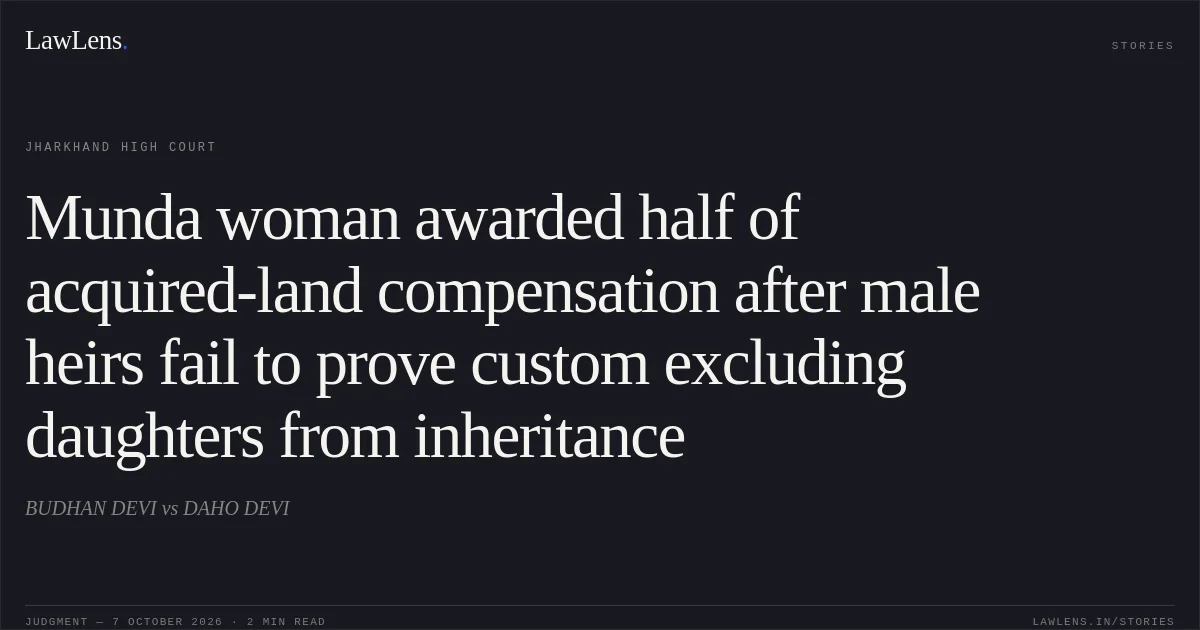
The appeal was dismissed. The Court held that Daho Devi was entitled to one-half of the compensation and upheld the allocation of one-quarter of the total compensation to Mohan Munda’s share.
That share could be disbursed to his legal heirs and successors in accordance with law.
Source reference: paras. 48–52Acts & Sections Cited
4 provisions across 3 statutes referred to in this judgment. Each provision opens on LawLens.
Right to Fair Compensation and Transparency in Land Acquisition, Rehabilitation and Resettlement Act, 20131
Hindu Succession Act, 19562
Hindu Adoptions and Maintenance Act, 19561
Original Court PDF
BUDHAN DEVIvsDAHO DEVI
Click to open original judgment
Original judgment, available to read, download and summarize on LawLens.in