Facts
The appeals challenged a Single Judge’s order concerning the election for Chairman of the Municipal Board, Khatushyamji.
Source reference: paras. 1–4Polling was scheduled for 21 September 2026, but one elected councillor did not vote that day.
Source reference: paras. 1–4The State Election Commission directed that the election continue on 25 September to enable all councillors to participate.
Source reference: paras. 1–4In a writ petition challenging that direction, the Single Judge quashed the Commission’s order and directed the Returning Officer to count the votes cast on 21 September and declare the result, while preserving the remedy of an election petition.
Source reference: paras. 1–4The councillor affected by the order was not impleaded in the writ proceedings.
Source reference: para. 12The result was subsequently declared and an election certificate issued on 26 September 2026.
Source reference: para. 20Issues
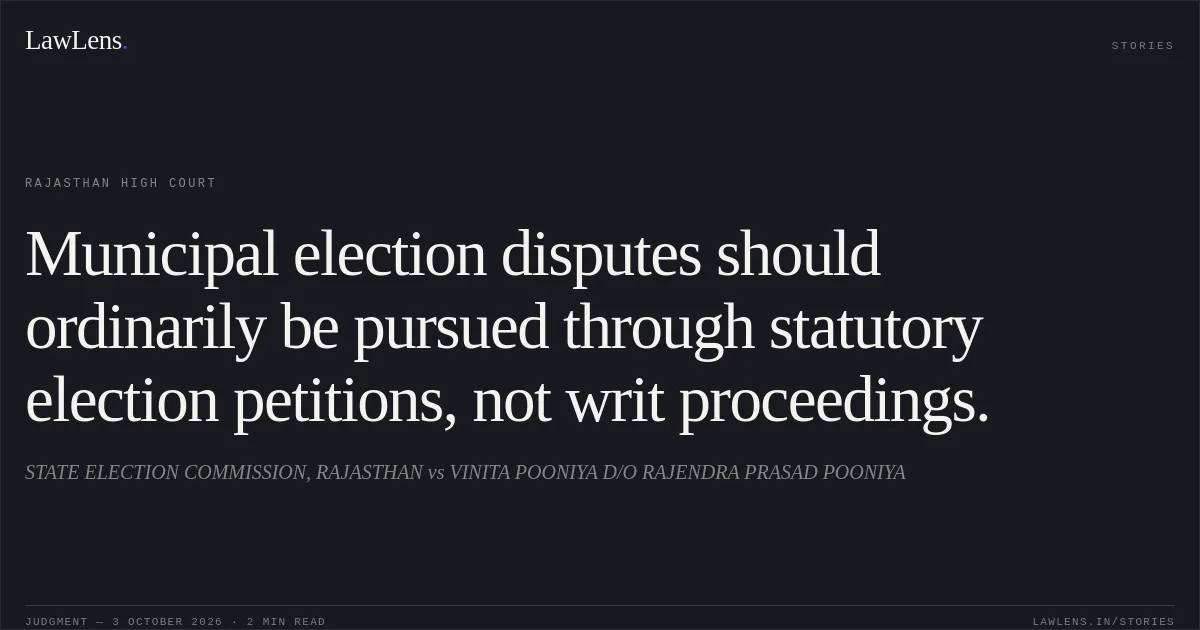
Whether the High Court should interfere in writ jurisdiction with the conduct of a municipal election where the governing law provides an election-petition remedy.
Source reference: paras. 10, 13–15Whether the Single Judge’s order should be set aside because the affected councillor was not impleaded in the writ proceedings.
Source reference: paras. 7, 17Law Applied
Article 243ZA vests the State Election Commission with superintendence, direction and control over municipal elections, while Article 243ZG(b) provides that a municipal election may be questioned only by an election petition presented in the prescribed manner.
Source reference: para. 13Applying the principles in N.P. Ponnuswami v. Returning Officer, Namakkal Constituency, AIR 1952 SC 64, and Mohinder Singh Gill v. Chief Election Commissioner, (1978) 1 SCC 405, the Court treated “election” as encompassing the process from its commencement to declaration of results.
Source reference: para. 13Anugrah Narain Singh v. State of U.P., (1996) 6 SCC 303, and Ashok Kumar v. Election Commission of India, (2000) 8 SCC 216, support judicial restraint where intervention would interrupt or protract an election, while recognising a limited scope for intervention that facilitates its completion.
Source reference: paras. 14–15Sections 31 and 32 of the Rajasthan Municipalities Act, 2009 provide the statutory election-petition mechanism for challenging an election.
Source reference: para. 18Reasoning
The Court held that the Single Judge had not finally determined the disputed facts concerning the councillor’s alleged abduction, her absence from the poll, the legality of the Commission’s direction or the validity of the subsequent voting; those matters could be examined in an election petition, where evidence could be considered.
Source reference: paras. 16, 18–19The Court also found that non-impleadment did not, in these circumstances, require the order to be set aside: the order had not finally adjudicated the councillor’s substantive electoral rights and the statutory remedy remained available.
Source reference: para. 17Given that the election had concluded and a result had been declared, the statutory election remedy was the appropriate forum for challenging its validity.
Source reference: para. 20Holding
The appeals were dismissed.
The Court found no jurisdictional error warranting interference with the Single Judge’s order and left open, for determination in an election petition, the allegations concerning abduction, the validity of the Commission’s order, the exercise of powers under the Election Rules, the voting conducted on 25 September and the ultimate validity of the election.
Source reference: paras. 21–23Acts & Sections Cited
2 provisions across 1 statute referred to in this judgment. Each provision opens on LawLens.
RAJASTHAN MUNICIPALITIES ACT,20092
Original Court PDF
STATE ELECTION COMMISSION, RAJASTHANvsVINITA POONIYA D/O RAJENDRA PRASAD POONIYA
Click to open original judgment
Original judgment, available to read, download and summarize on LawLens.in