Facts
Appellant No. 5, convicted under Sections 147, 148, 323/149, 460/149 and 302/149 IPC and sentenced to life imprisonment by judgment dated 23 May 2023, sought permission to renew his passport, which had expired on 29 March 2026.
Source reference: paras. 1–5; pp. 1–3He had disclosed the pending appeal in his renewal application, but the Passport Authority required permission from the competent criminal court.
Source reference: paras. 1–5; pp. 1–3He submitted that renewal alone would not authorise foreign travel, for which separate court permission would be required.
Source reference: paras. 1–5; pp. 1–3The Passport Authority opposed the application, relying on Section 6(2)(e) of the Passports Act, 1967, and contending that the 1993 notification concerning Section 6(2)(f) did not apply.
Source reference: paras. 1–5; pp. 1–3Issues
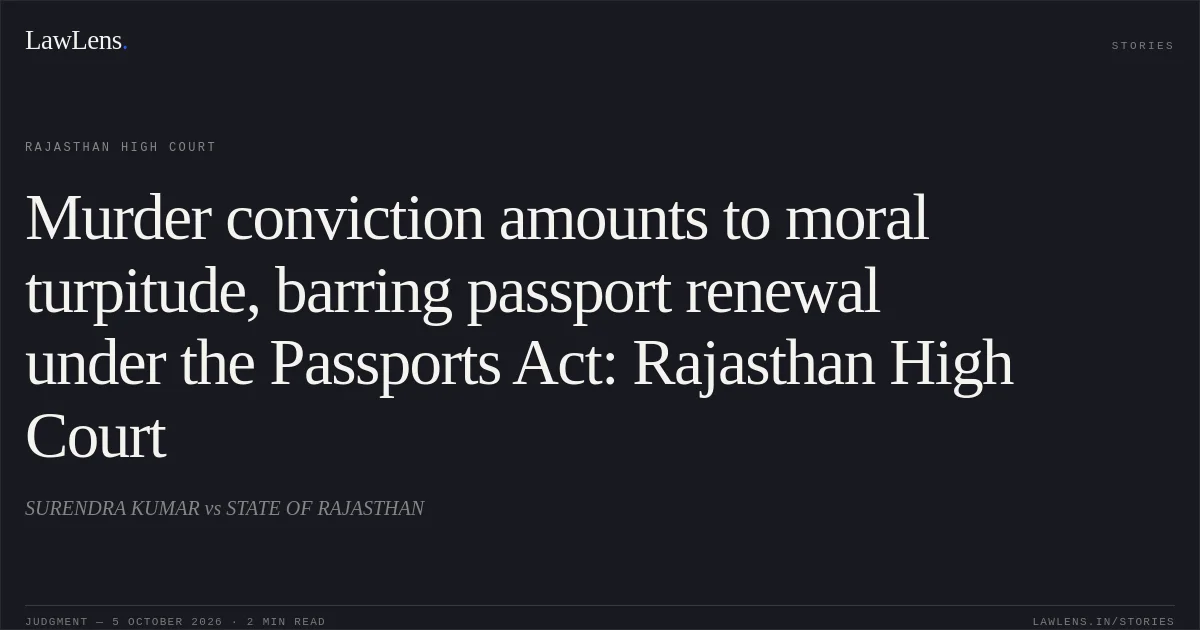
Whether a conviction under Section 302 IPC constitutes conviction for an offence involving moral turpitude under Section 6(2)(e) of the Passports Act, 1967
Source reference: paras. 8–11; pp. 4–7Whether the Court could permit renewal of the applicant’s passport, or grant relief from the statutory restrictions, in light of Sections 6(2)(e) and 6(2)(f) and the 25 August 1993 notification
Source reference: paras. 12–14; pp. 7–9Law Applied
Section 6(2)(e) of the Passports Act requires refusal of a passport where, within the preceding five years, the applicant has been convicted in India of an offence involving moral turpitude and sentenced to imprisonment for at least two years; Section 6(2)(f) concerns criminal proceedings pending before an Indian criminal court.
Source reference: para. 7; p. 4In State Bank of India & Ors. v. P. Soupramaniane, (2019) 18 SCC 135, the Supreme Court explained that moral turpitude depends on the facts and circumstances, including whether the act shocks society’s moral conscience, the motive, and whether it reflects depravity of character; aggravated violence involving a dangerous weapon capable of causing death may qualify.
Source reference: paras. 9–10; pp. 4–7The Central Government’s notification dated 25 August 1993 exempts applicants from Section 6(2)(f), subject to conditions including production of a court order permitting departure from India; it does not provide a corresponding exemption from Section 6(2)(e).
Source reference: paras. 12–14; pp. 7–9Reasoning
The applicant’s conviction under Section 302/149 IPC and life sentence fell within the five-year period specified in Section 6(2)(e).
Source reference: paras. 8–11; pp. 4–7Applying the principles in P. Soupramaniane, the Court held that a Section 302 conviction involves aggravated assault accompanied by the requisite criminal intention and therefore falls within offences involving moral turpitude.
Source reference: paras. 8–11; pp. 4–7The Court distinguished Section 6(2)(f), which addresses pending allegations, from Section 6(2)(e), which applies following conviction.
Source reference: paras. 12–14; pp. 7–9Because the 1993 notification relaxes only Section 6(2)(f) and no equivalent relaxation applies to clause (e), the Court held that it could not grant the requested relief in a manner that would disregard the statutory restriction.
Source reference: paras. 12–14; pp. 7–9Holding
The Court dismissed the applicant’s application as not maintainable.
It held that the conviction under Section 302/149 IPC attracted Section 6(2)(e), and that the notification relating to Section 6(2)(f) did not provide a basis to relax that restriction.
Source reference: paras. 15–16; p. 9The applicant was left at liberty to pursue any other appropriate remedy available in law.
Source reference: paras. 15–16; p. 9Acts & Sections Cited
9 provisions across 2 statutes referred to in this judgment. Each provision opens on LawLens.
Indian Penal Code, 18606
Passports Act, 19673
Original Court PDF
SURENDRA KUMARvsSTATE OF RAJASTHAN
Click to open original judgment
Original judgment, available to read, download and summarize on LawLens.in