Facts
The appellant was convicted by the Trial Court under Section 302 of the IPC for the murder of Bokha alias Ramhulas
Source reference: para 4On March 27, 2020, following a dispute regarding the return of paddy, the appellant allegedly assaulted the deceased with an axe (tangi) in the courtyard of the deceased’s house
Source reference: para 5The prosecution case relied on the testimony of Rajkunwar (PW-1), who claimed to be an eye-witness
Source reference: para 5The Trial Court sentenced the appellant to life imprisonment
Source reference: para 4The appellant challenged the conviction on the grounds that the incident was not premeditated, occurred during a sudden quarrel, and lacked the requisite intention for murder
Source reference: para 12Issues
1. Whether the death of the deceased was homicidal in nature
Source reference: para 162. Whether the prosecution established the appellant's guilt beyond a reasonable doubt as the perpetrator of the crime
Source reference: para 243. Whether the case falls under Exception 4 to Section 300 of the IPC, necessitating a modification of the conviction to Section 304 IPC
Source reference: para 32Law Applied
The court primarily applied Section 300 (Exception 4) and Section 304 Part II of the IPC regarding culpable homicide not amounting to murder
Source reference: para 32, 40It relied on the distinction between "intention" and "knowledge" as elucidated in Anbazhagan v. The State Rep. by Inspector of Police (2023 INSC 632), where acts done with knowledge of likely consequences but without intention to cause death fall under Section 304 Part II
Source reference: para 35It further applied the principle from Velthepu Srinivas v. State of A.P. (2024 SCC OnLine SC 107), which classifies assaults occurring in the heat of passion without premeditation as culpable homicide rather than murder
Source reference: para 36Reasoning
The court affirmed the homicidal nature of death based on the medical testimony of Dr. A.K. Vishwakarma (PW-5), who identified extensive cranial trauma and a 27 cm temporo-parietal fracture
Source reference: para 19-21The court found the prosecution's ocular evidence insufficient to sustain a murder conviction. The sole eye-witness, PW-1, admitted in cross-examination that visibility was obstructed by a wooden fence and her testimony was based partly on assumption
Source reference: para 26-27The court noted that the recovery of the weapon was technically flawed, as seizure witnesses did not understand the memorandum and the Investigating Officer admitted no blood was visible on the axe at the time of seizure
Source reference: para 28-29The court reasoned that while the appellant was responsible for the fatal blow, the incident arose from a sudden quarrel over paddy without premeditation
Source reference: para 37, 40Consequently, the court found that the appellant possessed the "knowledge" that his act was likely to cause death, but the "intention" to murder was not established
Source reference: para 41Holding
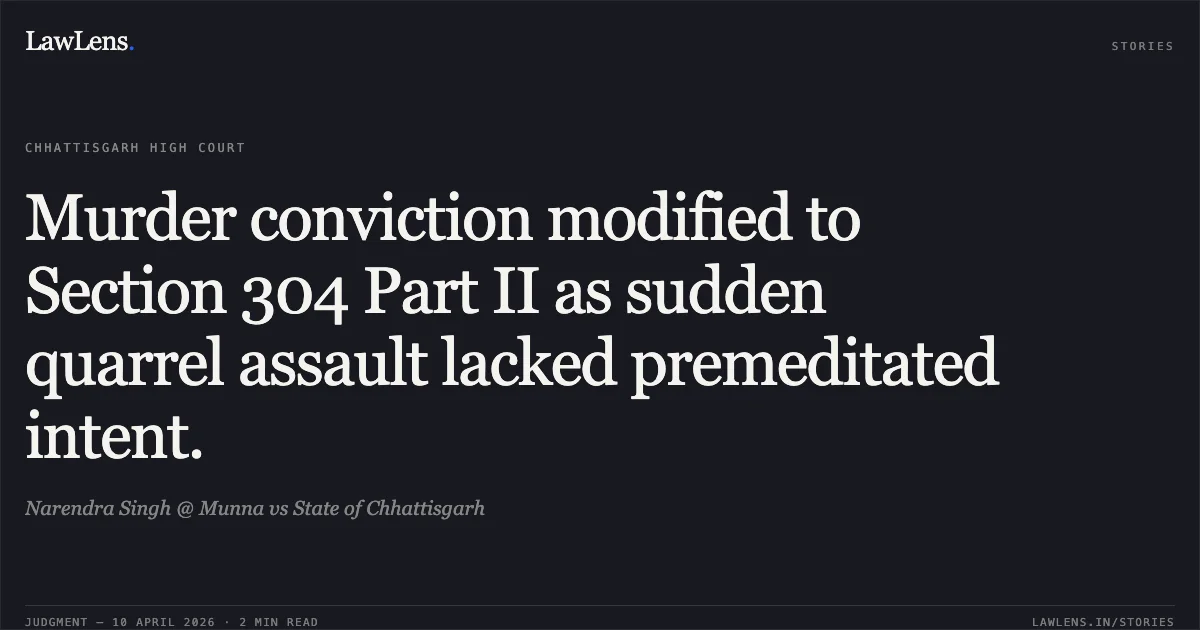
The court partly allowed the appeal, setting aside the conviction under Section 302 IPC and substituting it with a conviction under Section 304 Part II IPC
The court held that the offense was a homicide committed without premeditation in the heat of passion
Source reference: para 40The appellant’s sentence was modified from life imprisonment to seven years of rigorous imprisonment
Source reference: para 42Acts & Sections Cited
5 provisions across 2 statutes referred to in this judgment. Each provision opens on LawLens.
Code of Criminal Procedure, 19731
Indian Penal Code, 18604
Original Court PDF
Narendra Singh @ MunnavsState of Chhattisgarh
Click to open original judgment
Original judgment, available to read, download and summarize on LawLens.in


