Facts
The appellant was convicted under Section 302 IPC for allegedly striking Anil Reba Singh on the head with an axe on 16 May 2020; the deceased died on 29 May 2020.
Source reference: paras. 2–6, 17The Sessions Court sentenced the appellant to life imprisonment and imposed a fine.
Source reference: paras. 2–6, 17In appeal, the appellant challenged, among other matters, the 25-day delay in lodging the FIR, the reliability of the eyewitness evidence, and the proof connecting the alleged assault to the death.
Source reference: paras. 2–6, 17The prosecution relied principally on PW-3, who claimed to have witnessed the assault, and on the post-mortem evidence recording a head injury and opining that death resulted from coma following that injury.
Source reference: paras. 8, 11Issues
1. Whether the prosecution proved beyond reasonable doubt that the appellant’s alleged assault on 16 May 2020 caused the deceased’s death.
Source reference: paras. 23–24, 36–372. Whether the unexplained delay in lodging the FIR and the evidentiary discrepancies undermined the reliability of the prosecution case.
Source reference: paras. 17, 23–303. Whether the appellant’s statement under Section 313 CrPC could be used to support the prosecution case or otherwise affect the assessment of reasonable doubt.
Source reference: paras. 32–35Law Applied
Section 302 IPC requires the prosecution to prove the accused’s guilt beyond reasonable doubt.
Source reference: no citationDelay in lodging an FIR is not automatically fatal, but an unexplained or unreasonable delay may raise suspicion and requires the court to assess its effect on the prosecution’s credibility (Hariprasad alias Kishan Sahu v. State of Chhattisgarh; Apren Joseph alias Current Kunjunju v. State of Kerala; Ram Jag v. State of U.P.).
Source reference: paras. 18–22Section 313 CrPC gives an accused an opportunity to explain incriminating circumstances; the statement is not substantive evidence and cannot, by itself, sustain a conviction, though it may be considered alongside the prosecution evidence (Nar Singh v. State of Haryana; Reena Hazarika v. State of Assam; Mohan Singh v. Prem Singh).
Source reference: paras. 33–35Evidence is to be weighed, not counted (Laxmibai (Dead) through LRs v. Bhagwanthbuva (Dead) through LRs).
Source reference: para. 36Reasoning
The Court considered the 25-day delay in reporting the incident inadequately explained: the stated reason was the informant’s involvement in the Shraddha ceremony, although that ceremony followed the deceased’s death, and no explanation was provided for the earlier period.
Source reference: paras. 17, 23–24The prosecution produced no medical records documenting the deceased’s treatment between the alleged assault and death, and no treating medical professional testified; the evidence also conflicted on where the deceased died and when he returned home.
Source reference: paras. 23, 25–27Although the Court accepted that the post-mortem subject was the deceased, it found that the evidentiary gaps left doubt as to whether the recorded injury resulted from the alleged assault.
Source reference: paras. 28–29, 36Discrepancies concerning the seizure of the axe further weakened the prosecution’s account.
Source reference: para. 30The appellant’s Section 313 explanation was not treated as evidence against him; considered in context, it did not cure the prosecution’s failure to establish the causal connection beyond reasonable doubt.
Source reference: paras. 32–36Holding
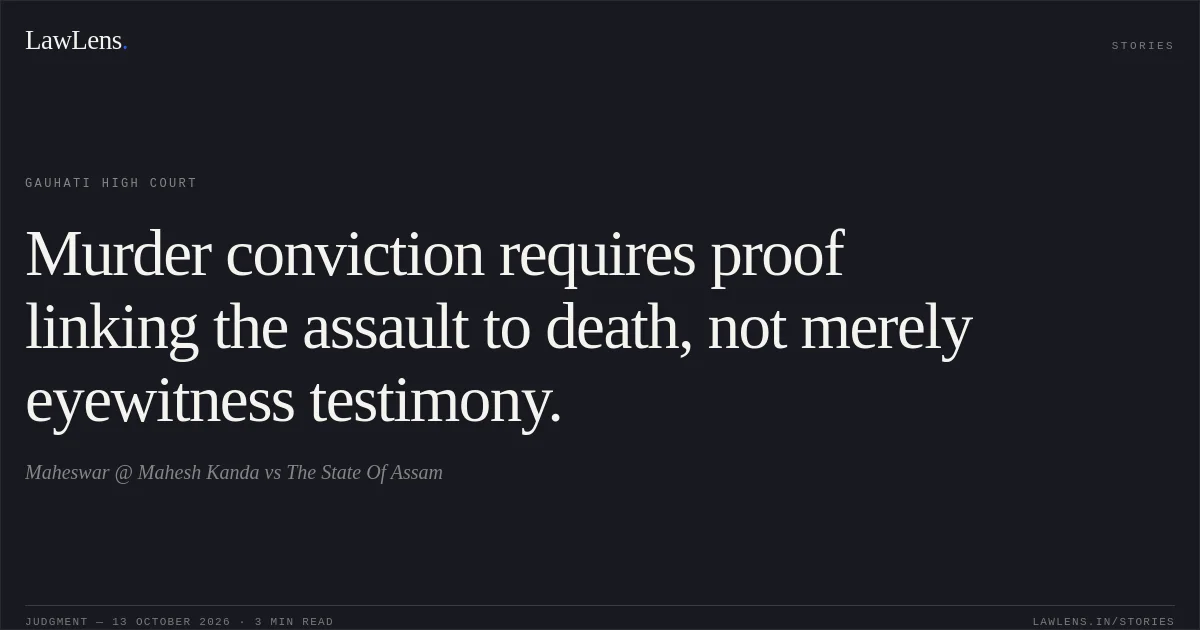
The Court held that the prosecution had not proved beyond reasonable doubt that the appellant’s alleged assault caused the deceased’s death.
It allowed the appeal, set aside the conviction and sentence under Section 302 IPC, and directed that the appellant be released if in custody, unless required in another case.
Source reference: paras. 36–38Acts & Sections Cited
4 provisions across 2 statutes referred to in this judgment. Each provision opens on LawLens.
Indian Penal Code, 18601
Code of Criminal Procedure, 19733
Original Court PDF
Maheswar @ Mahesh KandavsThe State Of Assam
Click to open original judgment
Original judgment, available to read, download and summarize on LawLens.in