Facts
The dispute concerned correction of revenue records and mutation in respect of land bearing Khasra No. 284/5, P.H.N. 115, admeasuring 5.48 acres, situated at Village Dharampura, Raipur.
Source reference: para. 3–4A registered sale deed dated 16 July 1953 had allegedly been executed by the Sarwarakar/Mahant of Shri Ram Chandra Swami Gopidas Temple in favour of Respondents 6 and 7.
Source reference: para. 3–4The petitioner-Trust contended that the vendor lacked title and that the sale was void for want of prior sanction under Section 14 of the Chhattisgarh Public Trust Act, 1951.
Source reference: para. 3–4Respondents 6 and 7 sought correction of the revenue records.
Source reference: para. 3Their application was initially rejected, but after an earlier writ petition was withdrawn with liberty to file a fresh mutation application, they filed proceedings before the Naib Tehsildar.
Source reference: para. 3The Naib Tehsildar allowed the application on 22 May 2018.
Source reference: para. 3The order was affirmed by the Sub-Divisional Officer, the Commissioner, and the Board of Revenue.
Source reference: para. 3The petitioner’s revision before the Board of Revenue was dismissed on 13 September 2022, following which the petitioner invoked the writ jurisdiction of the High Court.
Source reference: para. 3Issues
Whether the revenue authorities were justified in mutating/correcting the revenue records in favour of Respondents 6 and 7 on the basis of the registered sale deed dated 16 July 1953?
Source reference: paras. 3, 7–8Whether the alleged invalidity of the sale deed, including the absence of statutory sanction and the petitioner’s asserted title and possession, could be adjudicated in mutation proceedings or required recourse to a civil court?
Source reference: paras. 4, 8Whether the orders of the Naib Tehsildar, SDO, Commissioner, and Board of Revenue warranted interference under Article 226 of the Constitution?
Source reference: paras. 7–9Law Applied
The Court applied the principle that where a registered sale deed exists and the purchaser seeks mutation on its basis, revenue authorities are ordinarily required to record the purchaser’s name in the revenue records.
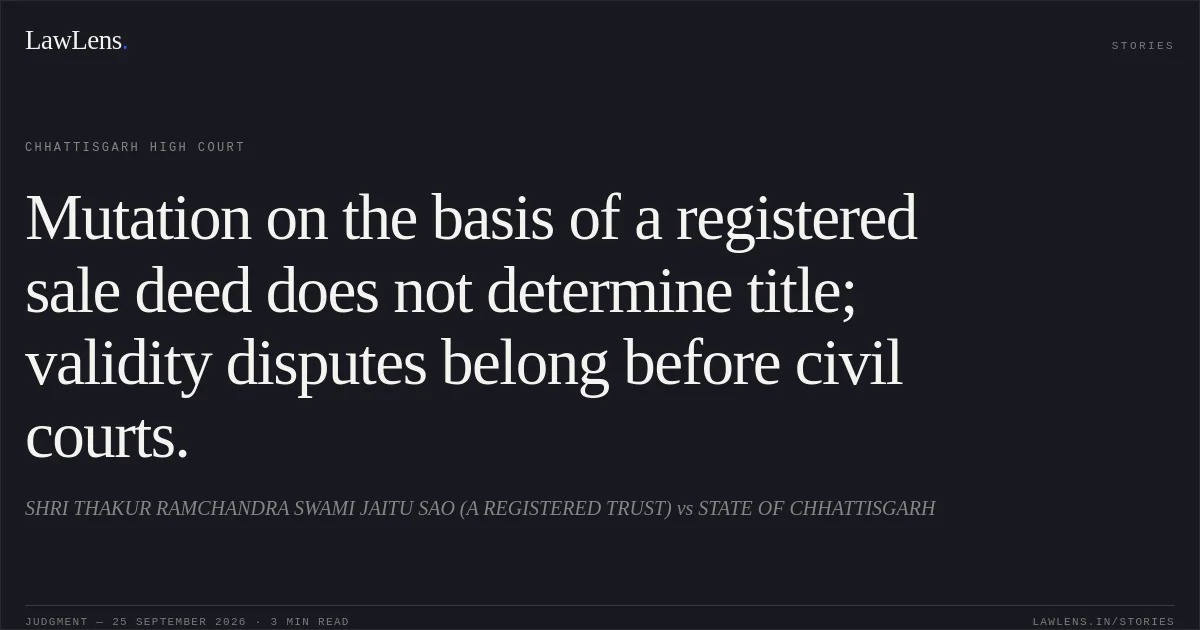
Source reference: para. 8Revenue mutation proceedings do not finally determine title; a person disputing the validity, legality, or cancellation of the sale deed must approach the competent civil court for appropriate declaratory and cancellation relief.
Source reference: para. 8The proceedings arose under the appellate and revisional framework of Section 44(2) of the Chhattisgarh Land Revenue Code, 1959.
Source reference: para. 3Although the petitioner relied on Section 14 of the Chhattisgarh Public Trust Act, 1951, the High Court did not adjudicate the alleged invalidity of the sale deed under that provision and left the issue open for determination by the competent civil court.
Source reference: paras. 4, 8Reasoning
The Court found that the revenue authorities had proceeded on the basis of a registered sale deed in favour of Respondents 6 and 7 and that their decision had been concurrently affirmed by the SDO, Commissioner, and Board of Revenue.
Source reference: para. 7Since mutation is a fiscal and record-of-rights exercise, the revenue authorities were justified in entering the purchasers’ names on the strength of the registered instrument.
Source reference: para. 8The petitioner’s objections that the sale deed was void, that the vendor lacked title, and that statutory sanction was absent involved substantive questions of title and validity of the conveyance, which could not appropriately be finally determined in mutation proceedings.
Source reference: para. 8Those objections were therefore required to be raised before a competent civil court in an action for cancellation and related reliefs.
Source reference: para. 8In view of the concurrent findings and the limited scope of the writ petition, no ground for interference was established.
Source reference: paras. 7–9Holding
The High Court held that the Board of Revenue had correctly declined to interfere with the mutation/record-correction proceedings based on the registered sale deed.
The petitioner-Trust’s challenge to the validity of the sale deed was left open to be pursued before the competent civil court.
Source reference: paras. 8–9The writ petition was consequently dismissed.
Source reference: paras. 8–9Acts & Sections Cited
2 provisions across 2 statutes referred to in this judgment. Linked provisions open on LawLens.
Chhattisgarh Land Revenue Code, 19591
Chhattisgarh Public Trust Act, 19511
Original Court PDF
SHRI THAKUR RAMCHANDRA SWAMI JAITU SAO (A REGISTERED TRUST)vsSTATE OF CHHATTISGARH
Click to open original judgment
Original judgment, available to read, download and summarize on LawLens.in