Facts
The petitioners claimed ownership and possession over land measuring 1.29 acres comprised in Khata No. 11, Plot No. 168, situated at Mauza Phulwariya, District Patna, asserting succession through the original Khatiyani Raiyats, including Late Dukhan Singh and Janki Kuar.
Source reference: paras. 2–3They applied for mutation in Mutation Case No. 1127 of 2013–14. Following an inquiry, the Circle Inspector reported that the petitioners were in possession and had succeeded to the land, whereafter the Circle Officer allowed mutation in their favour on 12 February 2014.
Source reference: paras. 4–5The private respondents challenged that order in Mutation Appeal No. 13 of 2016–17, which was dismissed by the Deputy Collector Land Reforms. In Mutation Revision No. 56 of 2016–17, however, the Additional Collector set aside the orders of the Circle Officer and the Deputy Collector on 25 July 2017, inter alia, on the basis of discrepancies in the genealogical tables and the existence of prior revenue entries.
Source reference: paras. 6–7The petitioners’ challenge before the Bihar Land Tribunal in BLT Case No. 145 of 2020 was dismissed on 19 May 2022.
Source reference: para. 8Before the High Court, the petitioners relied on the Khatiyan, the inquiry report, their alleged continuous possession, and their status as successors of the recorded tenants. The respondents relied upon a registered sale deed dated 26 April 1922 and subsequent Jamabandi entries created in favour of persons claiming through the purchaser, contending that the mutation proceedings could not determine the competing claims of title.
Source reference: paras. 9–15Issues
1. Whether the petitioners were entitled to mutation of their names on the basis of alleged succession, possession, and Khatiyan entries despite the existence of an earlier sale deed and long-standing Jamabandi in favour of persons claiming through the private respondents?
Source reference: paras. 16–19, 232. Whether the revenue authorities could adjudicate the disputed questions of title, succession, genealogical identity, and validity of the competing sale deeds in summary mutation proceedings?
Source reference: paras. 19, 22–233. Whether the orders of the Additional Collector and the Bihar Land Tribunal suffered from illegality warranting interference under Article 226 of the Constitution?
Source reference: paras. 16, 24–25Law Applied
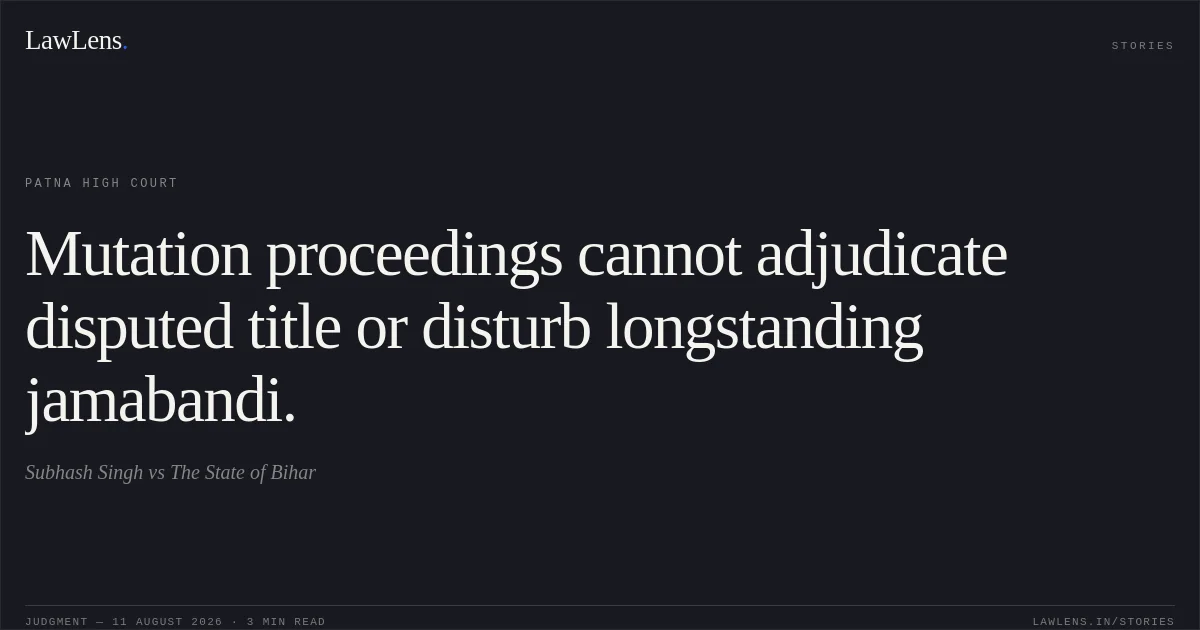
The Court applied the settled principle that mutation entries are fiscal in nature and do not confer, create, or extinguish title.
Source reference: para. 23It further held that long-standing Jamabandi or revenue entries cannot ordinarily be disturbed in summary mutation proceedings, particularly where competing claims of ownership exist.
Source reference: para. 23Disputed questions concerning title, succession, validity of sale deeds, possession, and genealogical entitlement must be adjudicated by a competent civil court, and not by revenue authorities exercising limited mutation jurisdiction.
Source reference: paras. 19, 22The Court also proceeded on the principle that the existence of a prior Jamabandi requires notice and consideration before a contrary mutation order is passed.
Source reference: para. 18Reasoning
The High Court found that the petitioners’ mutation had been ordered without properly acknowledging the earlier Jamabandi allegedly created on the basis of the 1922 sale deed and subsequent transactions. Consequently, the private respondents had not been afforded a proper opportunity in relation to the pre-existing revenue entries.
Source reference: paras. 17–18The Court also noted unresolved disputes regarding the identity and succession of the alleged Khatiyani Raiyats, discrepancies in the genealogical tables, the validity of the competing sale deeds, and the petitioners’ delay in seeking mutation.
Source reference: paras. 19–22Since resolution of these matters required determination of title and possession, the revenue authorities could not conclusively decide them in mutation proceedings.
Source reference: paras. 19, 22–23The petitioners’ reliance on the Khatiyan and the Circle Inspector’s report was therefore insufficient to justify mutation in their favour, particularly when a prior Jamabandi existed and the rival title claim remained disputed.
Source reference: paras. 21–23Holding
The Court held that the petitioners’ claim involved disputed questions of title, succession, possession, and the validity of competing transactions, which could only be adjudicated by a competent civil court and not through summary mutation proceedings.
It found no illegality in the orders of the Additional Collector or the Bihar Land Tribunal and declined to interfere under writ jurisdiction.
Source reference: para. 24The writ application was accordingly dismissed.
Source reference: para. 25Original Court PDF
Subhash SinghvsThe State of Bihar
Click to open original judgment
Original judgment, available to read, download and summarize on LawLens.in