Facts
The connected writ petitions arose from mutation and partition proceedings concerning agricultural land, allegedly concluded by an order dated 17.09.1983 and Namantran Panji No. 62 dated 06.08.1993.
Source reference: paras. 3, 21Respondent No. 1 challenged those proceedings under Section 44 of the Madhya Pradesh Land Revenue Code on 04.10.2016, accompanied by an application for condonation of delay under Section 5 of the Limitation Act.
Source reference: paras. 3, 21She claimed that, while residing in Canada, she acquired knowledge of the mutation only in 2016, obtained a certified copy on 26.09.2016, and promptly filed the appeal thereafter.
Source reference: paras. 3, 21The Sub-Divisional Officer condoned the delay and entertained the appeal by order dated 07.03.2017.
Source reference: para. 3The Additional Commissioner, by order dated 09.07.2018, set aside that order, holding that the delay of more than 33 years had not been satisfactorily explained.
Source reference: para. 3The Board of Revenue, in revision under Section 50 of the M.P. Land Revenue Code, allowed respondent No. 1’s revision by order dated 16.05.2019 and restored the SDO’s order, while also examining issues concerning succession, the alleged Will, partition, mutation and respondent No. 1’s substantive rights.
Source reference: paras. 3, 25Issues
1. Whether the Board of Revenue lacked revisional jurisdiction under Section 50 of the M.P. Land Revenue Code because of the amendment to Section 50(2) said to have come into force on 25.09.2018?
Source reference: paras. 8, 26, 342. Whether the revenue authorities properly exercised their discretion in condoning respondent No. 1’s delay of more than three decades in challenging the mutation proceedings?
Source reference: paras. 21, 27–293. Whether the Board of Revenue could conclusively determine disputed questions concerning title, succession, validity of the Will, partition, alienation and alleged fraud in mutation/revenue proceedings?
Source reference: paras. 23–24, 30–32Law Applied
The Court considered Article 226 of the Constitution in relation to judicial review of revenue orders and the limited scope of adjudication in writ proceedings.
Source reference: paras. 2, 23–24Section 44 of the M.P. Land Revenue Code governed the appeal against the mutation proceedings, while Section 5 of the Limitation Act required the applicant seeking condonation to establish sufficient cause for the entire period of delay; an allegation of fraud does not automatically extinguish limitation or dispense with the duty to explain when the fraud was discovered and why earlier action was not possible.
Source reference: paras. 3, 27Section 50 of the M.P. Land Revenue Code governed the Board’s revisional jurisdiction, with the applicability of the amended Section 50(2) depending materially on the date of institution of the revision.
Source reference: para. 26Section 178 of the Code and Section 6 of the Hindu Succession Act were relevant to the parties’ competing claims concerning partition and succession.
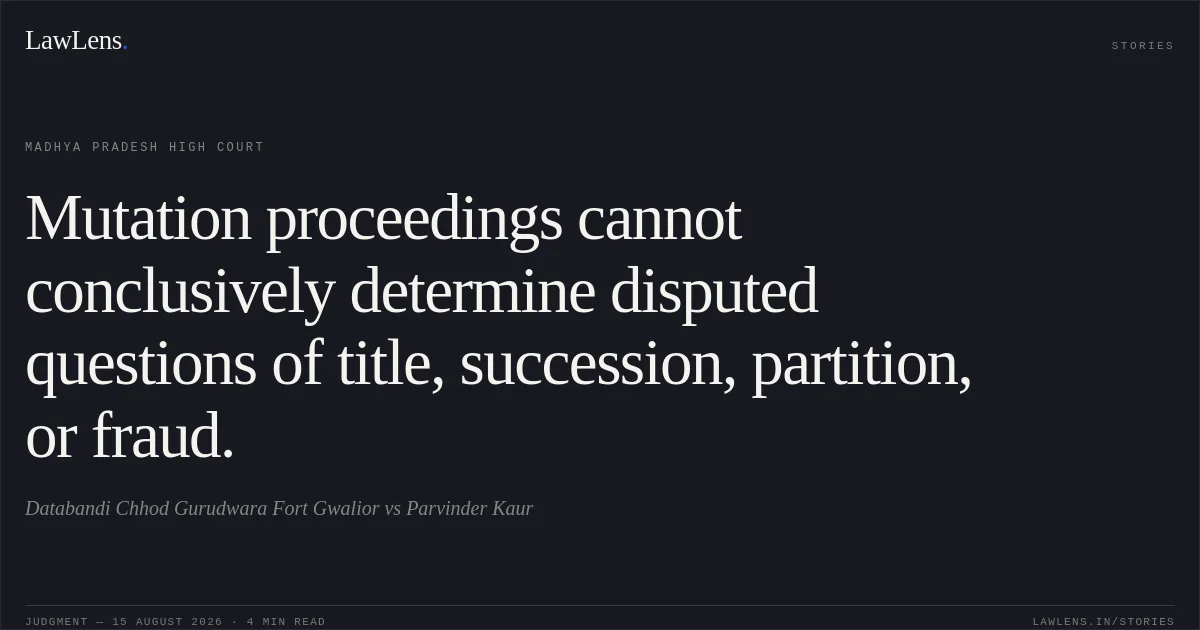
Source reference: paras. 14, 19, 30The Court applied the settled principle that mutation entries are fiscal in nature and do not create or extinguish title; disputed questions concerning title, succession, the validity of a Will, partition, alienation and fraud must ordinarily be determined by a competent civil court.
Source reference: para. 31Reasoning
The Court held that the challenge to the Board’s jurisdiction under the amended Section 50(2) could not succeed on the available record because the date on which the revision was instituted was not conclusively established in relation to 25.09.2018.
Source reference: paras. 26, 34It recognised that the delay exceeded three decades and therefore required a careful, reasoned assessment of the explanation for the entire period.
Source reference: paras. 27–29Respondent No. 1’s claim of knowledge only in 2016 was directly disputed by the petitioners’ reliance on her 2014 written statement, while respondent No. 1 alleged that the document was incomplete and that relevant circumstances had been suppressed.
Source reference: paras. 22, 27–29The Court did not finally determine which version was correct.
Source reference: paras. 27–29It further held that the Board’s findings on the alleged right, Will, partition, succession and alienation could not operate as a conclusive adjudication of civil rights because those matters involved disputed facts and title, which lay within the province of the competent civil court.
Source reference: paras. 23, 30–32Holding
The Court declined to interfere with the Board of Revenue’s order dated 16.05.2019 merely on the ground of the amendment to Section 50(2), as the record did not conclusively establish that the revision was instituted after the amendment came into force.
However, it clarified that the Board’s findings concerning ultimate title, succession, validity of the Will, partition and alienation would not prejudice either party in appropriate civil proceedings.
Source reference: para. 33The parties were left at liberty to pursue their substantive civil remedies, and the revenue authorities were directed to abide by the final adjudication of the competent civil court.
Source reference: paras. 33–35All connected writ petitions were disposed of.
Source reference: paras. 33–35Acts & Sections Cited
5 provisions across 3 statutes referred to in this judgment. Each provision opens on LawLens.
MP Land Revenue Code 19593
Limitation Act, 19631
Hindu Succession Act, 19561
Original Court PDF
Databandi Chhod Gurudwara Fort GwaliorvsParvinder Kaur
Click to open original judgment
Original judgment, available to read, download and summarize on LawLens.in