Facts
The petitioners, owners of premises no. 18/1A (now part of 7A, Short Street), claimed ownership interest in a common passage measuring 1 cottah 3 chhitaks 36 square feet based on registered indentures from 1990
Source reference: p. 1-2The respondent nos. 8 to 10 recently purchased the adjacent property (18/1B) via a deed dated 19th May, 2025
Source reference: p. 2The dispute arose when the Deputy Assessor-Collector (South) of the Kolkata Municipal Corporation (KMC) mutated the records on 10th March, 2026, in favor of the respondents based on a conveyance deed that purportedly depicted the common passage as the exclusive property of the respondents
Source reference: p. 2A title suit (CS/127/2025) regarding the same property was already pending
Source reference: p. 2-3During proceedings, the respondents clarified that their claim to "exclusive" rights was intended to mean exclusive to the owners of both adjacent premises (18/1A and 18/1B) and not to the exclusion of the petitioners
Source reference: p. 3Issues
1. Whether the mutation granted by the KMC in favor of respondent nos. 8 to 10 regarding the common passage was liable to be quashed or amended due to the petitioners' shared interest in the said passage
Source reference: p. 1 / para. 12. Whether the term "exclusive" in the respondents’ conveyance deed could be interpreted to include the common user rights of both adjacent owners to resolve the mutation dispute
Source reference: p. 3 / para. 3-4Law Applied
The court applied principles of Constitutional Writ Jurisdiction under Article 226, specifically concerning the administrative actions of municipal authorities in mutation matters.
Source reference: p. 3-4It relied on the principle of equitable resolution through party admissions and clarifications regarding testamentary/conveyance language to correct public records
Source reference: p. 3-4The court also exercised its power to direct a statutory body (Kolkata Municipal Corporation) to amend its records to reflect the actual nature of property rights (common vs. exclusive) to prevent future litigation
Source reference: p. 4Reasoning
The court noted that while the petitioners alleged the respondents had improperly mutated the common passage as their own, the respondents provided a critical clarification via instruction
Source reference: p. 3The respondents admitted that the passage is currently owned and possessed by both the owners of 18/1A and 18/1B and that the term "exclusive" in their deed was meant to define the user rights as belonging solely to these two properties against the general public, rather than excluding the petitioners
Source reference: p. 3Based on this admission, the court found that the factual dispute regarding the nature of the passage (as a common passage) was effectively resolved
Source reference: p. 4Consequently, the court determined that the municipal records needed to be synchronized with this shared understanding to "remove all future difficulties"
Source reference: p. 4Holding
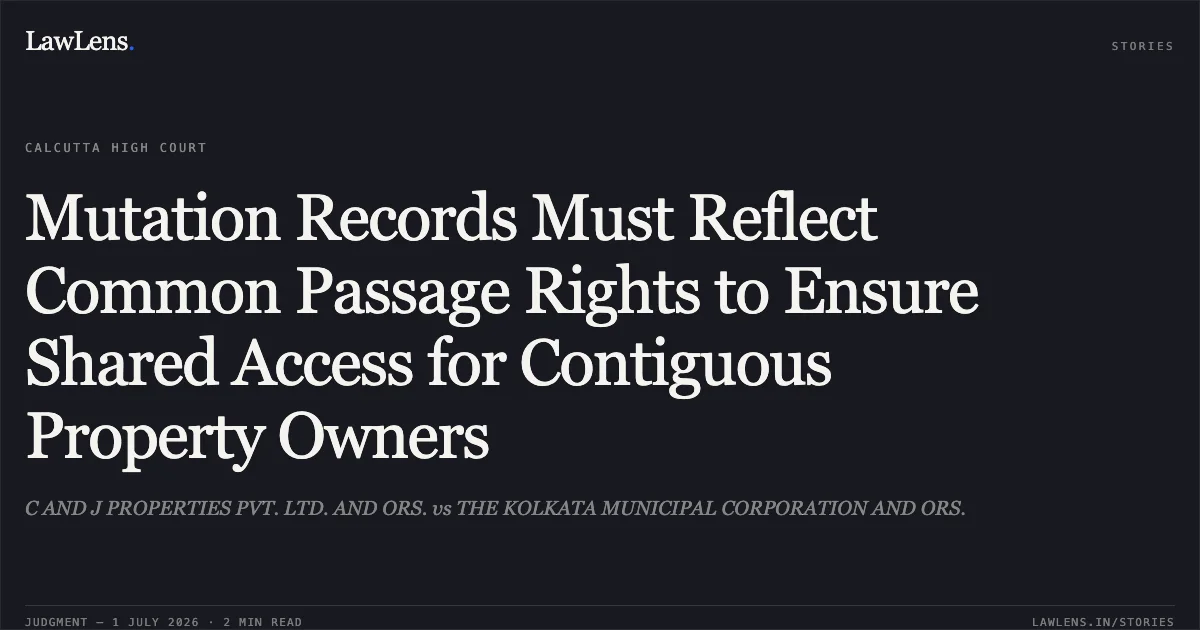
The court disposed of the writ petition by holding that the passage in question is a common passage meant for the exclusive user of both premises 18/1A and 18/1B
The Kolkata Municipal Corporation was directed to treat the strip of land as a common passage and accordingly amend the municipal records
Source reference: p. 4The court held that in light of the respondents' clarifications and the resulting consensus, no further adjudication on the merits was required
Source reference: p. 3-4Acts & Sections Cited
1 provisions across 1 statute referred to in this judgment. Linked provisions open on LawLens.
Kolkata Municipal Corporation Act, 19801
Original Court PDF
C AND J PROPERTIES PVT. LTD. AND ORS.vsTHE KOLKATA MUNICIPAL CORPORATION AND ORS.
Click to open original judgment
Original judgment, available to read, download and summarize on LawLens.in