Facts
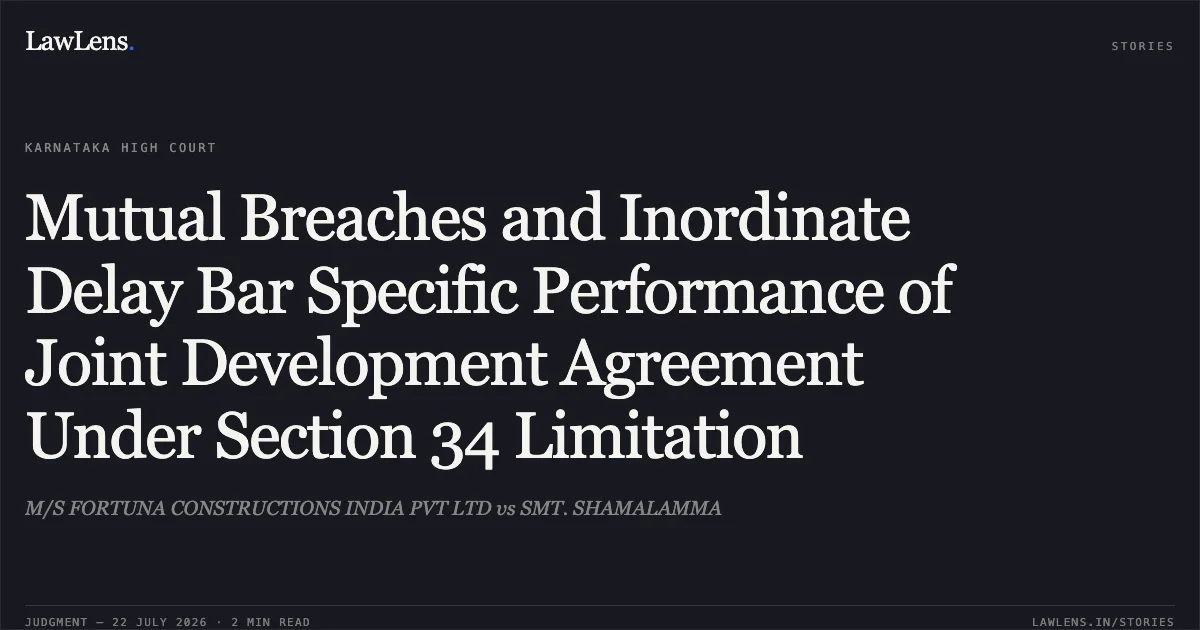
The Appellant (FCIPL) and the Respondents (Landowners) entered into a Memorandum of Understanding (MOU) in 2013 and a registered Joint Development Agreement (JDA) in 2014 for an apartment complex
Source reference: p. 8-9Execution was delayed primarily due to an order by the National Green Tribunal (NGT) regarding buffer zones around water bodies, which was subsequently challenged in the Supreme Court
Source reference: p. 10The Landowners terminated the JDA in 2018 alleging breach of time-lines, whereas FCIPL claimed the Landowners obstructed the project by withdrawing cooperation after the Supreme Court's 2019 ruling
Source reference: p. 11, 29A Sole Arbitrator passed an award dated 12.06.2023 cancelling the JDA and GPA, while directing the Landowners to refund ₹65,00,000/- to FCIPL
Source reference: p. 13Both parties challenged the award under Section 34 of the Arbitration and Conciliation Act, which the Commercial Court dismissed on 30.01.2024
Source reference: p. 17-18Issues
1. Whether the Arbitral Tribunal exceeded its jurisdiction by deciding "ex aequo et bono" (interests of justice and equity) without express authorization, in violation of Section 28(2) of the Act
Source reference: p. 18 / para. 282. Whether the award was patently illegal due to contradictory findings regarding mutual breach and the resulting cancellation of the JDA
Source reference: p. 19 / para. 293. Whether the court could interfere with the Arbitrator’s factual determination of the refund amount
Source reference: p. 17 / para. 25Law Applied
Section 28(2) of the Arbitration and Conciliation Act, 1996, which prohibits an arbitrator from deciding ex aequo et bono unless expressly authorized
Source reference: p. 36Section 34 regarding the limited grounds for setting aside an award, specifically focusing on "patent illegality" and "public policy"
Source reference: p. 14, 41Dyna Technologies (P) Ltd. v. Crompton Greaves Ltd., which mandates that an award must have intelligible and adequate reasoning, but the court should not set aside awards for mere "gaps in reasoning" if the conclusion is plausible
Source reference: p. 38-39Reasoning
The Court examined the Arbitrator’s reasoning that both parties were responsible for the project's failure
Source reference: para. 56While the Arbitrator used the phrase "interest of justice and equity," the Court analyzed this not as a departure from the law, but as a practical consequence of the finding of mutual breach
Source reference: para. 62-64The Court noted that FCIPL's failure to take "effective steps" to resubmit plans after the NGT stay was lifted constituted a breach, rendering the denial of specific performance a legal and plausible outcome
Source reference: p. 35, 37Regarding the refund of ₹65,00,000/-, the Court held that the Arbitrator meticulously analyzed the evidence and receipts produced by FCIPL, and a Section 34 court cannot re-evaluate such factual findings or supplant its own opinion
Source reference: p. 38, 40Holding
The High Court dismissed both appeals, affirming the Commercial Court's refusal to set aside the award
It held that the Arbitrator’s decision to cancel the JDA and restore parties to their pre-contract position via a monetary refund was a "plausible view" not vitiated by patent illegality
Source reference: p. 40-41The cancellation of the GPA was upheld as a natural consequence of the JDA's termination
Source reference: p. 16The Landowners' challenge to the monetary award was also rejected as it was based on factual evidence accepted by the Tribunal
Source reference: p. 17Acts & Sections Cited
9 provisions across 3 statutes referred to in this judgment. Each provision opens on LawLens.
Arbitration and Conciliation Act, 19967
Commercial Courts Act, 20151
Code of Civil Procedure, 19081
Original Court PDF
M/S FORTUNA CONSTRUCTIONS INDIA PVT LTDvsSMT. SHAMALAMMA
Click to open original judgment
Original judgment, available to read, download and summarize on LawLens.in