Facts
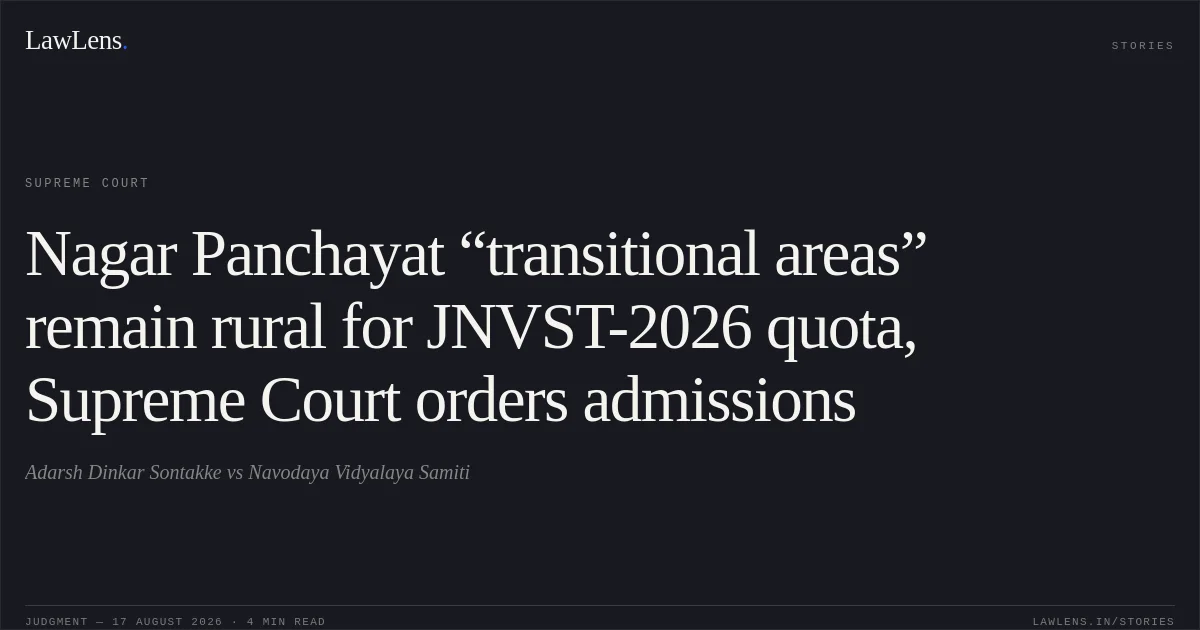
The appellants qualified on merit in the JNVST-2026 for admission to Class VI against the 75% Rural Category seats and were issued provisional selection letters.
Source reference: no citationTheir admissions were subsequently denied because, during Class III, IV or V, they had studied in schools situated at Pombhurna, Sindewahi, Gondpipri and Sawali, which had been constituted as Nagar Panchayats under Article 243-Q(1)(a) of the Constitution and Section 341-A of the Maharashtra Municipal Councils, Nagar Panchayats and Industrial Townships Act, 1965.
Source reference: no citationThe respondents treated these “transitional areas” as urban areas under Clause 4.7 of the JNVST-2026 Prospectus.
Source reference: no citationThe Bombay High Court upheld that view in Arpita Santosh More (Minor) v. Navodaya Vidyalaya Samiti, followed by an identical decision in Gargi Nitesh Rasse (Minor) v. Navodaya Vidyalaya Samiti.
Source reference: paras. 3–8The appellants relied upon the earlier contrary Division Bench decision in Jiya Jitendra Nagrale v. State of Maharashtra and contended that the UDISE Guidelines dated 27 March 2026 could not retrospectively affect a selection process whose applications, examination and provisional results had already been completed.
Source reference: paras. 9–18, 39–46Issues
1. Whether a Nagar Panchayat constituted for a “transitional area” under Article 243-Q(1)(a) is necessarily an “urban area” for determining eligibility under the Rural Category of the JNVST-2026.
Source reference: paras. 4, 28–402. Whether a Division Bench of the High Court could depart from the earlier decision of a coordinate Division Bench without referring the issue to a larger Bench.
Source reference: paras. 22–273. Whether the UDISE Guidelines issued after completion of the JNVST-2026 selection process could be applied to alter or verify the appellants’ eligibility to their prejudice.
Source reference: paras. 16–18, 41–46Law Applied
Article 243-Q(1) distinguishes between a Nagar Panchayat for a “transitional area,” a Municipal Council for a “smaller urban area,” and a Municipal Corporation for a “larger urban area”; these expressions must ordinarily be given distinct meanings.
Source reference: para. 28Under Sections 341-A, 341-C and 341-D of the Maharashtra Municipal Councils, Nagar Panchayats and Industrial Townships Act, 1965, a Nagar Panchayat is constituted for an area transitioning from rural to urban status, and the area attains the status of a smaller urban area only upon the requisite subsequent notification.
Source reference: paras. 29–31Clause 4.7 of the JNVST-2026 Prospectus provides that only areas notified by the Government as urban on the last date for submission of applications are urban, while all other areas are rural.
Source reference: paras. 39–40Judicial discipline requires a coordinate Bench to follow an earlier decision of equal strength or, if it doubts its correctness, refer the matter to a larger Bench; this principle was affirmed in U.P. Gram Panchayat Adhikari Sangh v. Daya Ram Saroj and Central Board of Dawoodi Bohra Community v. State of Maharashtra.
Source reference: paras. 25–26The “rules of the game” principle, recognised in K. Manjusree v. State of A.P., prohibits alteration of eligibility criteria after commencement of the selection process to the prejudice of participating candidates.
Source reference: paras. 16, 41–45Reasoning
The Court held that the constitutional and statutory scheme treats a transitional area as distinct from a smaller or larger urban area.
Source reference: paras. 28–31Since no notification under Section 341-D had converted Pombhurna, Sindewahi, Gondpipri or Sawali into smaller urban areas, they retained their transitional status and were not “urban areas” within the specific meaning of Clause 4.7 of the Prospectus.
Source reference: paras. 28–31, 39–40Consequently, the appellants’ schools were to be treated as situated in rural areas for JNVST-2026.
Source reference: no citationThe High Court’s reliance on Rakam Singh v. State of Uttar Pradesh was misplaced because that case concerned an industrial township under the proviso to Article 243-Q(1), not a Nagar Panchayat constituted during a rural-to-urban transition.
Source reference: paras. 32–38Independently, the later Division Bench in Arpita Santosh More had effectively overruled the coordinate-Bench decision in Jiya Jitendra Nagrale without a proper reference, contrary to judicial discipline.
Source reference: paras. 23–27Further, the UDISE Guidelines were issued on 27 March 2026, after applications, the examination and provisional selection had concluded, and the Prospectus did not notify candidates that UDISE classifications would determine eligibility; therefore, those Guidelines could not retrospectively disqualify the appellants.
Source reference: paras. 41–46Holding
The appeals were allowed and the impugned Bombay High Court judgments were set aside.
The Court held that, for JNVST-2026, a Nagar Panchayat constituting a transitional area remains rural unless and until a final notification confers municipal/smaller urban area status under the applicable statutory framework.
Source reference: para. 48The respondents were directed to forthwith admit the appellants to Class VI of Jawahar Navodaya Vidyalaya against the Rural Category seats.
Source reference: no citationIf the academic session had commenced, the respondents were directed to provide bridge classes or other necessary academic support.
Source reference: paras. 50–51The ruling was confined to JNVST-2026 and did not prevent the Navodaya Vidyalaya Samiti from adopting UDISE-based or other verification criteria for future admission cycles, provided such criteria were notified prospectively before commencement of the relevant process.
Source reference: para. 52Acts & Sections Cited
1 provisions across 1 statute referred to in this judgment. Each provision opens on LawLens.
Maharashtra Municipal Councils, Nagar Panchayats and Industrial Townships Act, 19651
Original Court PDF
Adarsh Dinkar SontakkevsNavodaya Vidyalaya Samiti
Click to open original judgment
Original judgment, available to read, download and summarize on LawLens.in