Facts
The Appellant (NHAI) and Respondent (Unitech-NCC JV) entered into a contract on 25.05.2001 for the upgrade of NH-5 in Andhra Pradesh
Source reference: p.2The project was delayed by 13 months, completing on 20.03.2005 instead of February 2004
Source reference: p.3Disputes arose regarding financial consequences of the delay, leading to horizontal arbitration. A three-member Tribunal rendered an Award on 16.05.2011, granting the Respondent compensation for additional mobilization (Claim 3), idling costs (Claim 4), and loss of opportunity to earn a bonus (Claim 7)
Source reference: p.3-4NHAI challenged the Award under Section 34 of the Arbitration and Conciliation Act, 1996 ("A&C Act"), which the learned Single Judge dismissed on 30.05.2025
Source reference: p.5Issues
1. Whether the Arbitral Tribunal’s award for additional mobilization and idling of machinery (Claims 3 and 4) was based on sufficient evidence or was patently illegal
Source reference: p.18, 252. Whether the award of compensation for "loss of opportunity to earn bonus" (Claim 7) was contrary to express contractual prohibitions (Clause 47.3)
Source reference: p.30-313. Whether the delay of eight months in the pronouncement of the Section 34 judgment vitiated the decision
Source reference: p.17Law Applied
The Court applied the restrictive standards for judicial interference under Sections 34 and 37 of the A&C Act, relying on NHAI v. M. Hakeem and UHL Power Co. Ltd. v. State of Himachal Pradesh to establish that Section 37 jurisdiction is narrower than Section 34 and prohibits merit-based reassessment
Source reference: p.14, 16It relied on McDermott International Inc. v. Burn Standard Co. Ltd. regarding the arbitrator's prerogative to interpret contracts
Source reference: p.15Section 73 of the Indian Contract Act, 1872, was applied to award damages for breach of contract (failure to provide a clear site)
Source reference: p.26, 31Regarding delay in judgment, it followed the principle from Anil Rai v. State of Bihar that delay is not ipso facto fatal unless prejudice is shown
Source reference: p.17Reasoning
The Court observed that the Tribunal's findings on Claim 3 were rooted in contemporaneous records like Monthly Progress Reports (MPRs) and the Engineer's letter confirming that the site was handed over in 36 fragmented pieces, necessitating additional machinery deployment
Source reference: p.18-19The Court rejected NHAI's argument that the award was speculative, noting the Tribunal actually used NHAI's own data to reduce the claim significantly
Source reference: p.20For Claim 4, the Court found that the Tribunal properly distinguished between "additional mobilization" and "idling costs of minimum resources" during the extension period
Source reference: p.25-27Regarding Claim 7, the Court reasoned that while Clause 47.3 prohibited contractual bonus during extensions, the Tribunal awarded it as damages under Section 73 for the loss of opportunity to earn that bonus caused by NHAI’s breaches
Source reference: p.30-31The Court emphasized that interpreting these clauses and assessing evidence falls within the sole domain of the arbitrator; as long as the view is "plausible," the Court cannot substitute it with its own
Source reference: p.33Holding
The Court answered all issues in the negative and dismissed the Appeal
It held that the Tribunal’s findings were based on a plausible interpretation of the contract and evidenced by contemporaneous project records. The effective relief under Claim 7 was neutralized by adjustments against Claim 3 to prevent double recovery. The Court affirmed the Single Judge's decision, ruling that NHAI failed to demonstrate patent illegality or perversity warranting interference under Section 37
Source reference: p.29, 34Acts & Sections Cited
3 provisions across 2 statutes referred to in this judgment. Each provision opens on LawLens.
Arbitration and Conciliation Act, 19962
Indian Contract Act, 18721
Original Court PDF
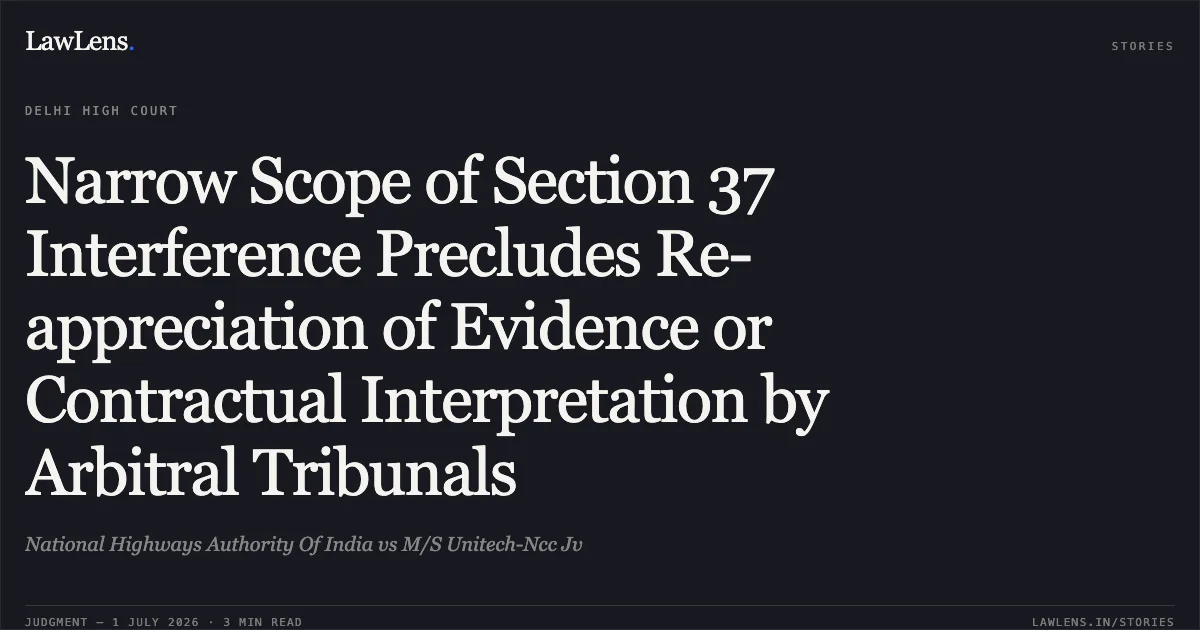
National Highways Authority Of IndiavsM/S Unitech-Ncc Jv
Click to open original judgment
Original judgment, available to read, download and summarize on LawLens.in