Facts
The Petitioner, convicted under Sections 302, 307, and 452 of the IPC, was originally awarded a death sentence, which the Supreme Court later commuted to 25 years of actual imprisonment.
Source reference: para. 10(i)-(iii)Having undergone over 16 years of actual imprisonment, the Petitioner was released on COVID-19 pandemic parole on 06.08.2020 but failed to surrender on time, returning after a delay of 370 days.
Source reference: para. 10(iv)-(vi)the Deputy Inspector General of Prisons (DIG) rejected his furlough application on 11.06.2024 based on Rule 4(10) of the 1959 Rules.
Source reference: para. 10(vii)on 26.12.2024, the DIG imposed a punishment of permanent forfeiture of remission under Section 48-A of the Prisons Act, 1894, without considering the Petitioner’s detailed explanation regarding his father’s illness and subsequent death.
Source reference: para. 10(viii)-(x)Issues
1. Whether, for determining the eligibility period under Rule 7(2) of the 2024 Rules, an explanation must be called for from the prisoner and whether such period can be reduced for sufficient cause.
Source reference: para. 11(i)2. Whether the order dated 26.12.2024, passed under Section 48-A (Bombay Amendment) of the Prisons Act, 1894, is legal and valid given the lack of consideration of the Petitioner's explanation.
Source reference: para. 11(ii)Law Applied
Section 48-A of the Prisons Act, 1894 (Bombay Amendment), which mandates that punishment for overstaying leave can only be awarded "after obtaining [the prisoner's] explanation".
Source reference: para. 26constitutional mandates of Articles 14 and 21 as interpreted in Sunil Batra v. Delhi Administration, holding that prisoners retain fundamental rights and must be protected against procedural unfairness.
Source reference: para 14the "reformative theory" of sentencing from Asfaq v. State of Rajasthan, which characterizes parole and furlough as humanistic tools for social re-integration.
Source reference: para. 16principle from C.B. Gautam v. Union of India that principles of natural justice (audi alteram partem) must be read into statutory provisions that entail adverse civil consequences, even if the statute is silent.
Source reference: para. 31-32Reasoning
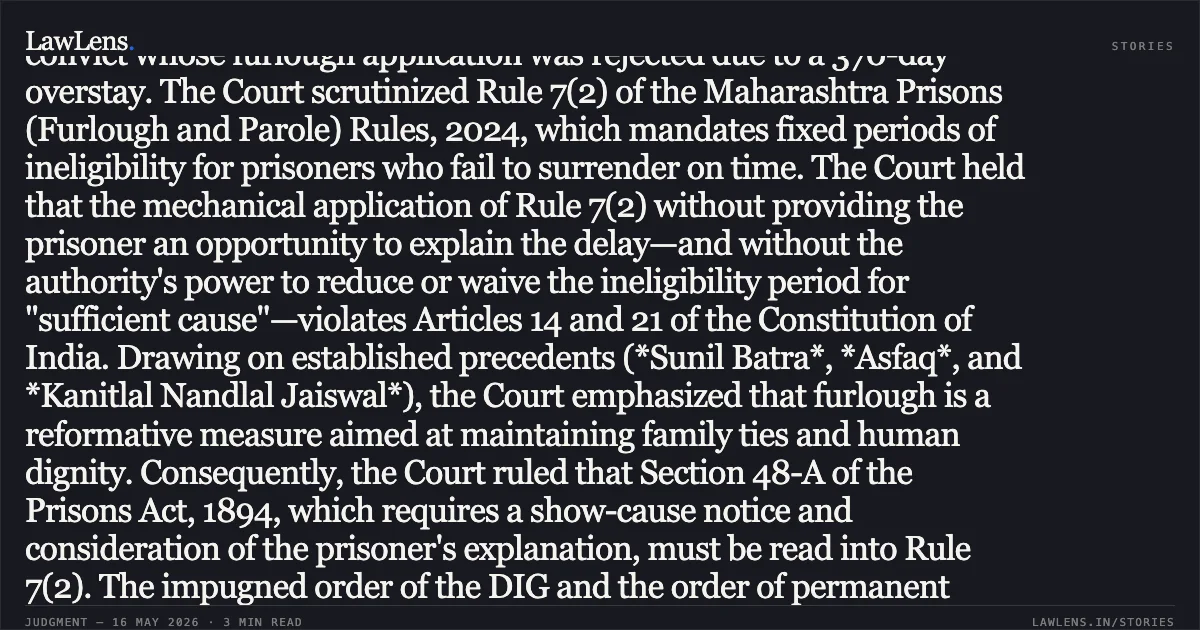
The Court observed that Rule 7(2) of the 2024 Rules, which mechanically bars furlough eligibility for fixed periods (1 to 5 years) due to overstaying, is arbitrary because it lacks a mechanism for considering a prisoner's explanation.
Source reference: para. 21-23The Court reasoned that a prisoner who overstays due to a "sufficient cause" (e.g., a serious accident or family tragedy) cannot be treated the same as a wilful defaulter without violating Article 14.
Source reference: para. 24Regarding the DIG's order under Section 48-A, the Court found it legally flawed as it merely acknowledged the receipt of the Petitioner's explanation but dismissed it as "not satisfactory" without any substantive discussion or consideration of the merits regarding his father's hospitalization and death.
Source reference: para. 10(x), 25The Court concluded that Rule 7(2) must be read in conjunction with the principles of natural justice and Section 48-A to allow the authorities the discretion to waive or reduce the bar on furlough if sufficient cause is shown.
Source reference: para. 34-36Holding
The Court held that Rule 7(2) of the 2024 Rules is violative of Articles 14 and 21 if read as an absolute, mechanical bar without the right to a hearing.
The Court quashed the order dated 11.06.2024 rejecting the furlough and the order dated 26.12.2024 forfeiting remission. The DIG was directed to decide the Petitioner’s applications afresh by passing a "Speaking Order" after duly considering the Petitioner's explanation for the 370-day delay.
Source reference: para. 39(i), (ii), (iii), (iv)Acts & Sections Cited
6 provisions across 2 statutes referred to in this judgment. Each provision opens on LawLens.
Prisons Act, 18942
Indian Penal Code, 18604
Original Court PDF
Dilip Premnarayan TiwarivsState Of Maharashtra
Click to open original judgment
Original judgment, available to read, download and summarize on LawLens.in


