Facts
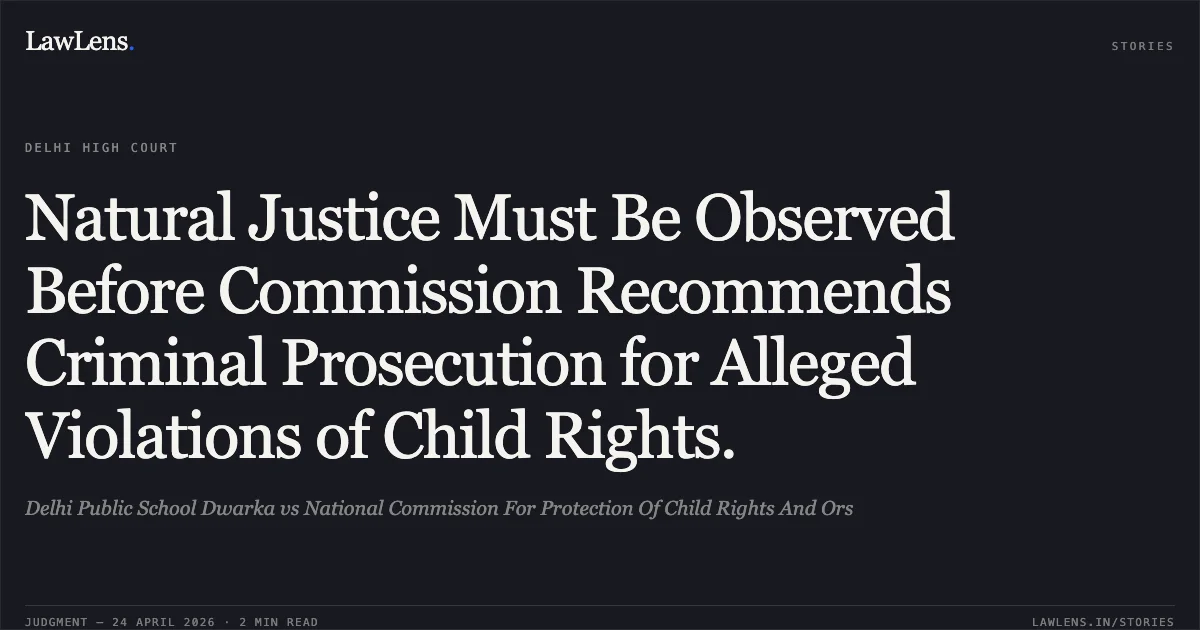
The Petitioner-School challenged a notice/recommendation dated 18.07.2024 issued by the National Commission for Protection of Child Rights (NCPCR).
Source reference: para. 1The NCPCR, purportedly acting under the Commissions for Protection of Child Rights Act, 2005, directed the registration of an FIR against the school under Section 75 of the Juvenile Justice Act, 2015, for striking off students' names due to non-payment of fees.
Source reference: para. 2, 4The Petitioner contended that the recommendations were made without providing an opportunity for a hearing, violating principles of natural justice and threatening their reputation and rights under Article 19(1)(g) of the Constitution.
Source reference: para. 3-4Issues
1. Whether the NCPCR is required to adhere to the principles of natural justice and provide a hearing to the affected party before recommending the registration of an FIR.
Source reference: para. 9, 112. Whether the advisory nature of the NCPCR’s recommendations exempts it from the obligation to follow procedural fairness.
Source reference: para. 11Law Applied
Section 13(1)(c) and Section 13(1)(j) of the Commissions for Protection of Child Rights Act, 2005, which empowers the Commission to inquire into child rights violations and recommend the initiation of proceedings.
Source reference: para. 2, 9The administrative law principle of Audi Alteram Partem (natural justice), holding that recommendations triggering criminal investigations cause "irreversible reputational harm".
Source reference: para. 11Section 75 of the Juvenile Justice Act, 2015, which penalizes the assault or willful neglect of children.
Source reference: para. 4Reasoning
The court reasoned that while the NCPCR has the statutory power to inquire into violations under Section 13(1)(c), it must form a reasoned opinion by hearing all stakeholders before drawing a conclusion.
Source reference: para. 9The court rejected the Respondent’s argument that because the recommendations are "advisory" or "benign," they do not require a prior hearing.
Source reference: para. 5, 11The court observed that a recommendation to register an FIR sets a criminal process in motion, which carries significant legal and reputational consequences for an educational institution.
Source reference: para. 11Since the Commission conceded that the Petitioner was not heard prior to the impugned notice, the court found the process procedurally flawed.
Source reference: para. 5, 10Holding
The court set aside the impugned notice/recommendation dated 18.07.2024.
The court held that the NCPCR must extend an opportunity for a hearing to the Petitioner and other relevant stakeholders, including parents if necessary, before making such recommendations.
Source reference: para. 10, 12The court directed that the inquiry must proceed strictly in accordance with the Act of 2005 and allowed parties to be represented by legal counsel.
Source reference: para. 13, 16-17The writ petition was disposed of with liberty to the Commission to re-examine the matter following due process.
Source reference: para. 18Acts & Sections Cited
2 provisions across 2 statutes referred to in this judgment. Each provision opens on LawLens.
Commissions for Protection of Child Rights Act, 20051
Juvenile Justice (Care and Protection of Children) Act, 2015.1
Original Court PDF
Delhi Public School DwarkavsNational Commission For Protection Of Child Rights And Ors
Click to open original judgment
Original judgment, available to read, download and summarize on LawLens.in


