Facts
The Appellant, a juvenile aged 17 years and 3 months at the time of the incident, was accused of committing rape under the POCSO Act.
Source reference: para 2, 3Following a preliminary assessment under Section 15 of the Juvenile Justice (Care and Protection of Children) Act, 2015 (J.J. Act), the Juvenile Justice Board (JJB) determined the Appellant should be tried as an adult before the Children Court.
Source reference: para 3The Appellant’s regular bail application was rejected by the 1st Additional District and Sessions Judge-cum-Special Judge, Children Court, Rohtas, on February 28, 2025, primarily on the grounds of the seriousness of the allegation and the existence of material supporting the prosecution's case.
Source reference: para 1The Appellant challenged this order, asserting that Social Investigation Reports (SIR) showed no criminal antecedents and that detention was not in the child’s best interest.
Source reference: para 6Issues
1. Whether the seriousness of the offence and the strength of the prosecution’s evidence are valid grounds for denying bail to a juvenile under the J.J. Act, 2015.
Source reference: para 9, 132. Whether Section 12 of the J.J. Act, 2015, applies to a juvenile being tried as an adult by a Children Court.
Source reference: para 14, 26(1)3. Whether the refusal of bail was justified based on the exceptions carved out in the proviso to Section 12(1) of the J.J. Act.
Source reference: para 29, 30Law Applied
Section 12 of the J.J. Act, 2015, which mandates that a juvenile "shall" be released on bail notwithstanding the CrPC, unless release brings them into association with known criminals, exposes them to danger, or defeats the ends of justice.
Source reference: para 8, 9The court relied on the "Principle of best interest" (Section 3(iv)) and "Institutionalisation as a measure of last resort" (Section 3(xii)).
Source reference: para 19, 23Precedential weight was given to Juvenile in Conflict with Law v. State of Rajasthan (2024 SCC OnLine SC 5297) regarding the necessity of specific findings under the Section 12 proviso.
Source reference: para 10Lalu Kumar @ Lal Babu v. State of Bihar (2019 (6) BLJ 2016) which held that gravity of the offence is irrelevant for juvenile bail.
Source reference: para 13Reasoning
The Court reasoned that Section 12 of the J.J. Act overrides general criminal law and establishes bail as the rule, even for juveniles tried as adults.
Source reference: para 9, 14It found that the Children Court erred by focusing on the "seriousness of the offence," which is not a statutory ground for denial.
Source reference: para 29Upon reviewing the Social Background and Investigation Reports, the Court observed that the Appellant had no criminal antecedents and the incident allegedly arose from a love affair, suggesting that the "environment at home" was not detrimental.
Source reference: para 30, 31The Court emphasized that "ends of justice" in juvenile jurisprudence refers to the child's reformation and rehabilitation, rather than punishment.
Source reference: para 18, 22Consequently, since the SIR did not support the three restrictive conditions of the Section 12 proviso, the denial of bail was deemed legally unsustainable.
Source reference: para 29-31Holding
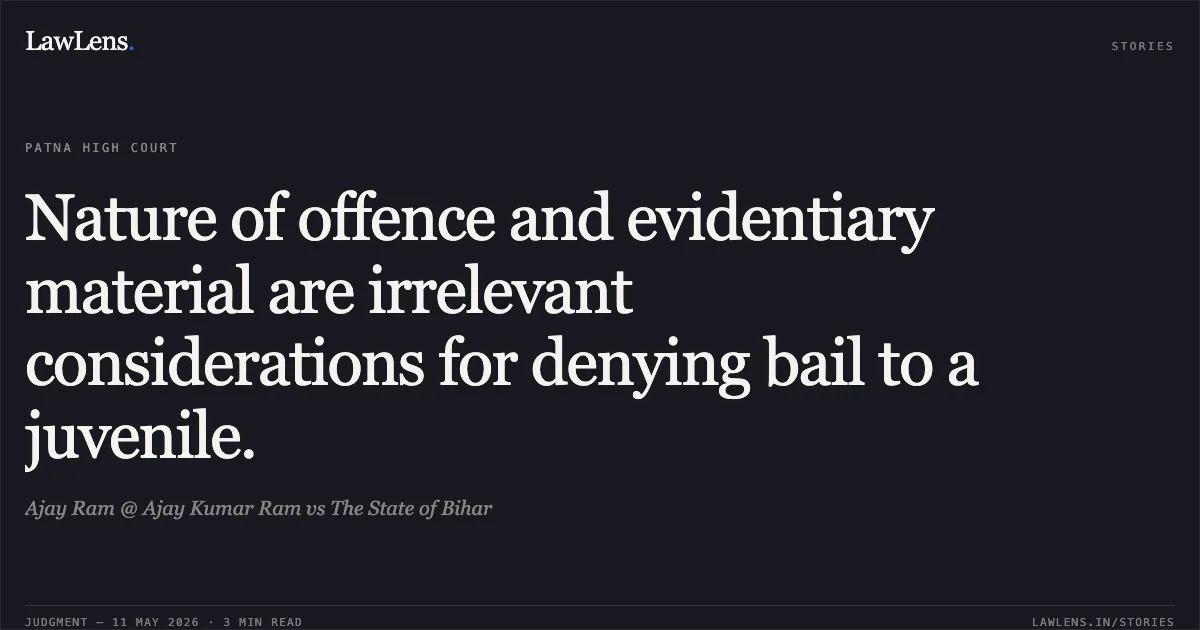
The Court allowed the appeal and set aside the impugned order and held that bail to a juvenile cannot be rejected on the ground of the gravity of the offence.
The Appellant was ordered to be released on a bail bond of Rs. 10,000/- with an undertaking from his father to ensure supervision, with further directions to the DLSA and District Magistrate to facilitate access to welfare schemes and livelihood opportunities for the family.
Source reference: para 33, 34Acts & Sections Cited
5 provisions across 1 statute referred to in this judgment. Each provision opens on LawLens.
Juvenile Justice (Care and Protection of Children) Act, 2015.5
Original Court PDF
Ajay Ram @ Ajay Kumar RamvsThe State of Bihar
Click to open original judgment
Original judgment, available to read, download and summarize on LawLens.in


