Facts
The applicants were Sepoys in the Narcotics Control Bureau (NCB), appointed under the applicable Recruitment Rules at Pay Level 1.
Source reference: para. 2–6, 14–16They sought placement at Pay Level 3, equivalent to Grade Pay ₹2,000, claiming parity with Constables in other Central Police Organisations/CAPFs based on comparable recruitment standards, duties and responsibilities.
Source reference: para. 2–6, 14–16The NCB and Ministry of Home Affairs had repeatedly proposed an upgrade, but the Department of Expenditure had not agreed.
Source reference: para. 2–6, 14–16After an earlier direction to decide the applicants’ claim by a speaking order, the respondents rejected it on 6 October 2023.
Source reference: para. 2–6, 14–16The applicants challenged that order before the Tribunal.
Source reference: para. 2–6, 14–16Issues
Whether the applicants’ recruitment standards, duties and responsibilities were sufficiently comparable to those of corresponding Constables in other Central Police Organisations/CAPFs to warrant pay parity
Source reference: para. 7–13, 19–21Whether the respondents could deny or defer the claimed parity because the Department of Expenditure had not approved the proposal and the NCB cadre proposal was under consideration in connection with the Eighth Central Pay Commission
Source reference: para. 15–16, 23–25Law Applied
The Tribunal applied the principle of equal pay for equal work, recognised in Randhir Singh v. Union of India, (1982) 1 SCC 618, as a constitutional goal flowing from Articles 14 and 16; pay differentiation between employees performing substantially comparable duties must rest on relevant and rational considerations.
Source reference: para. 9, 22While pay determination ordinarily lies within the executive’s and expert bodies’ domain, it remains subject to equality and non-arbitrariness.
Source reference: para. 22The Tribunal also considered Nehru Yuva Kendra Sangathan v. Rajesh Mohan Shukla, (2007) 6 SCC 9, and the Delhi High Court decision in Constable (GD) Jitender Singh & Ors. v. Union of India & Ors., W.P. (C) No. 8006/2013, as authorities and comparative material relied upon by the applicants.
Source reference: para. 6, 10, 12, 21Reasoning
The Tribunal found that the recruitment standards, qualifications, physical and medical requirements, and duties on record supported the applicants’ claim that they were comparable in material respects to corresponding Constables.
Source reference: para. 19–25The respondents had not established a sufficiently significant distinction to justify the pay disparity.
Source reference: para. 19–25Nor was the distinction between direct recruitment and deputation/absorption, by itself, conclusive.
Source reference: para. 19–25The NCB’s own proposals and the Delhi High Court’s decision concerning NCRB Constables were relevant considerations that reinforced the need to address the disparity.
Source reference: para. 19–25The pending Eighth Central Pay Commission exercise could not, in the Tribunal’s view, justify leaving an allegedly unjustified disparity unresolved under the existing Seventh CPC framework.
Source reference: para. 19–25Holding
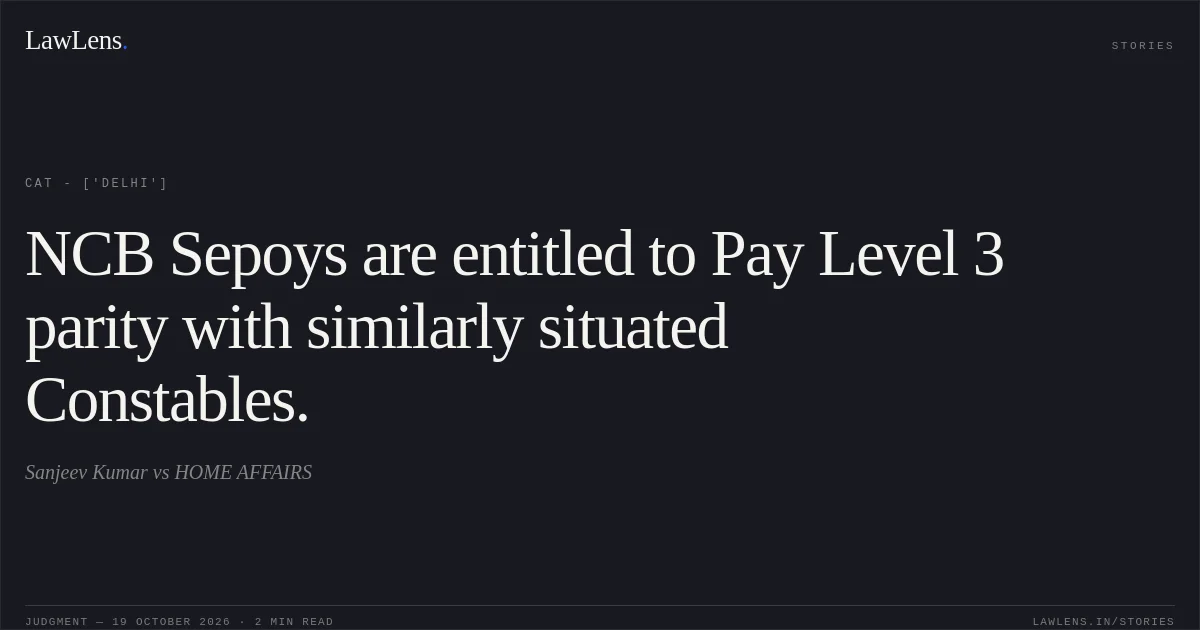
The Tribunal allowed the OA to the extent stated and set aside the impugned order dated 6 October 2023.
It directed the respondents to extend Pay Level 3 parity to the applicants, subject to verification of eligibility and applicable service conditions, and to determine the effective date by reference to when corresponding personnel became entitled to the higher level.
Source reference: para. 26–29Consequential pay fixation and monetary benefits are to be calculated and released in accordance with law within three months of receipt of the order.
Source reference: para. 26–29The respondents must pursue the broader NCB cadre proposal separately; consideration by the Eighth Central Pay Commission must not defer or defeat the directed benefit under the Seventh CPC framework.
Source reference: para. 26–29No order as to costs.
Source reference: para. 26–29Original Court PDF
Sanjeev KumarvsHOME AFFAIRS
Click to open original judgment
Original judgment, available to read, download and summarize on LawLens.in