Facts
The appellant challenged the NCLT, Indore Bench’s order dated 17 April 2026 passed in CP (IB) No. 60 of 2021.
Source reference: paras. 1–10; pp. 1–3The order was pronounced in the appellant’s presence, but the appellant claimed that his erstwhile counsel did not promptly communicate it to him.
Source reference: paras. 1–10; pp. 1–3He applied for a certified copy on 19 May 2026 and subsequently filed the appeal electronically on 29 June 2026, together with an application seeking condonation of a 43-day delay.
Source reference: paras. 1–10; pp. 1–3The respondent opposed the application, arguing that the appeal was filed beyond the statutory 30-day period and the maximum additional 15-day condonable period under Section 61(2) of the IBC.
Source reference: paras. 1–10; pp. 1–3Issues
Whether the appellant’s application for condonation of a 43-day delay was maintainable under the proviso to Section 61(2) of the Insolvency and Bankruptcy Code, 2016, where the appeal was filed beyond the aggregate period of 30 days plus 15 days?
Source reference: paras. 8, 14–16; pp. 2, 10–11Whether the appellant could rely on the date of applying for or receiving the certified copy to extend or postpone limitation, despite applying for the copy after expiry of the initial 30-day limitation period?
Source reference: paras. 12–15; pp. 3–10Law Applied
Section 61(1) and (2) of the IBC prescribes a 30-day limitation period for appeals from NCLT orders, with power to condone delay only for a further period not exceeding 15 days upon sufficient cause; delay beyond this outer limit is not condonable.
Source reference: paras. 13–16; pp. 3–11In V. Nagarajan v. SKS Ispat and Power Ltd., the Supreme Court held that limitation under the IBC begins from the pronouncement of the order, unlike Section 421(3) of the Companies Act, and that an aggrieved party must diligently apply for a certified copy; under Section 12(2) of the Limitation Act, only the time requisite for obtaining the copy after such application may be excluded.
Source reference: paras. 12–13; pp. 3–10Rule 22(2) of the NCLAT Rules requires an appeal to be accompanied by a certified copy of the impugned order, but this procedural requirement does not postpone commencement of limitation.
Source reference: para. 13; pp. 6–10The Tribunal also relied on Tata Steel Ltd. v. Raj Kumar Banerjee, which reaffirmed that the NCLAT has no jurisdiction to condone delay beyond the statutory period of 30 days plus 15 days.
Source reference: para. 14; p. 10The appellant’s reliance on Sagufa Ahmed v. Upper Assam Plywood Products Pvt. Ltd. was rejected as inapplicable because that decision concerned Section 421(3) of the Companies Act and not the distinct limitation framework under Section 61(2) of the IBC.
Source reference: paras. 7, 9, 12–13; pp. 2–10Reasoning
The Tribunal held that the impugned order was pronounced on 17 April 2026, and limitation therefore commenced on 18 April 2026.
Source reference: para. 15; p. 10The initial 30-day period expired on 17 May 2026, while the maximum condonable period expired on 1 June 2026.
Source reference: para. 15; p. 10Although the appellant claimed to have applied for a certified copy on 19 May 2026, that application was made after the expiry of the statutory 30-day period and, in any event, no documentary proof of the application was produced.
Source reference: para. 15; p. 10The appellant’s lack of prompt knowledge due to counsel’s alleged failure to communicate the order did not alter the statutory commencement of limitation, particularly because the appellant was represented before the NCLT when the order was pronounced.
Source reference: para. 15; p. 10Since the appeal was filed on 29 June 2026—43 days beyond the prescribed 30-day period and beyond the outer 15-day condonable limit—the Tribunal lacked jurisdiction to condone the delay, irrespective of the explanation offered.
Source reference: paras. 14–16; pp. 10–11Holding
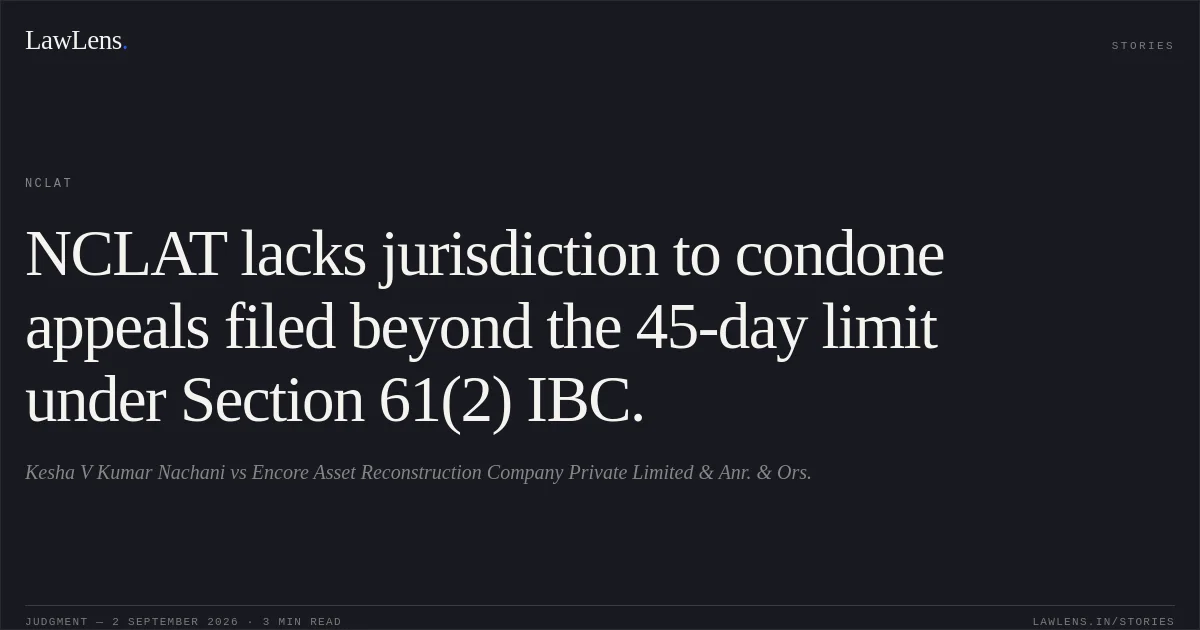
The NCLAT dismissed I.A. No. 5174 of 2026, holding that the application seeking condonation of the 43-day delay was not maintainable because the appeal was filed beyond the maximum 45-day period permitted under Section 61(2) of the IBC.
Consequently, Comp. App. (AT) (Ins.) No. 1324 of 2026 was also dismissed as time-barred.
Source reference: para. 17; p. 11Acts & Sections Cited
9 provisions across 3 statutes referred to in this judgment. Each provision opens on LawLens.
Insolvency and Bankruptcy Code, 2016.6
Companies Act, 20132
Limitation Act, 19631
Original Court PDF
Kesha V Kumar NachanivsEncore Asset Reconstruction Company Private Limited & Anr. & Ors.
Click to open original judgment
Original judgment, available to read, download and summarize on LawLens.in