Facts
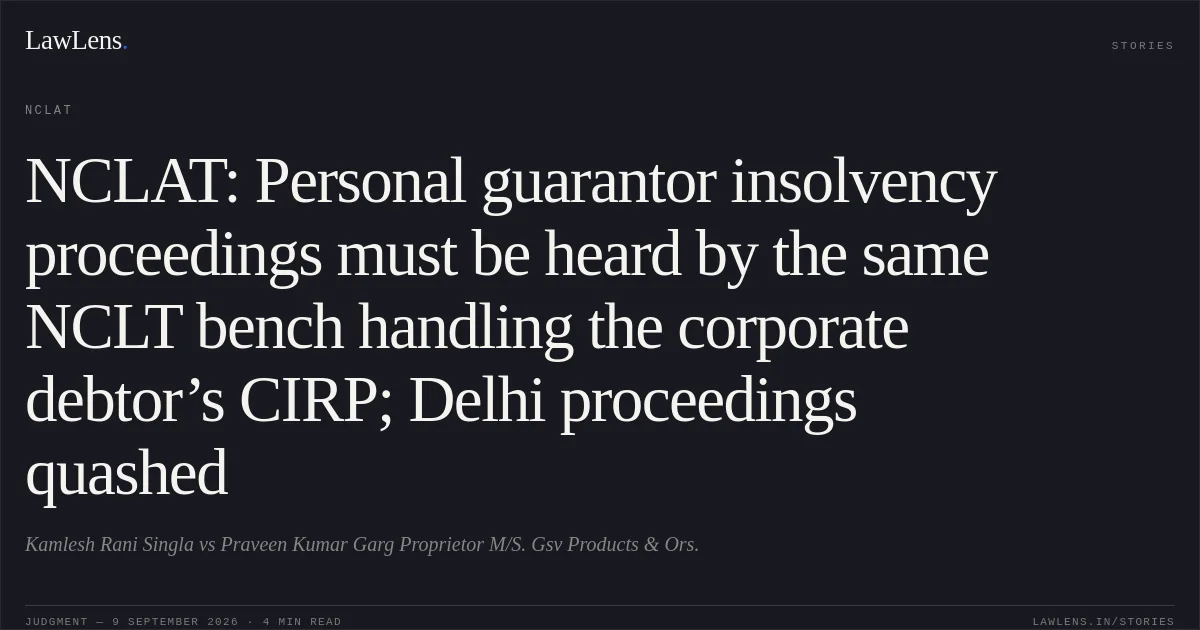
Laxmi Pipes Ltd., the corporate debtor, was undergoing CIRP before NCLT, Chandigarh Bench-II, in proceedings initiated by Praveen Kumar Garg, proprietor of M/s GSV Products. The corporate debtor had admitted an operational debt payable to Respondent No. 1, and a Resolution Professional had been appointed.
Source reference: pp. 3–4Respondent No. 1 subsequently initiated proceedings under Section 95 of the Insolvency and Bankruptcy Code, 2016 against Kamlesh Rani Singla, described as the personal guarantor and suspended director of the corporate debtor, before NCLT, New Delhi Bench-II, in CP (IB) No. 419/ND/2023. The proceedings were admitted on 28 May 2024 and Mr. Gautam Singhal was appointed as Resolution Professional.
Source reference: p. 4The Appellant contended that, because the corporate debtor’s CIRP was pending before NCLT, Chandigarh, Section 60(2) of the IBC mandated that proceedings against the personal guarantor be filed and heard before the same NCLT Bench. She therefore filed T.A. (IBC) No. 50(PB)/2024 seeking transfer of the Section 95 proceedings from New Delhi to Chandigarh.
Source reference: pp. 4–5The NCLT Principal Bench dismissed the transfer application on 5 December 2025, relying on the Gujarat High Court’s decision in Arcelor Mittal Nippon Steel India Ltd. v. NCLT, which had held that Rule 16(d) of the NCLT Rules did not authorise transfers beyond the territorial jurisdiction of a Bench. The Appellant challenged that order before the NCLAT.
Source reference: pp. 5–6, para. 12Issues
Whether NCLT, New Delhi, could exercise jurisdiction over proceedings under Section 95 of the IBC against the personal guarantor when the corporate debtor’s CIRP was pending before NCLT, Chandigarh?
Source reference: p. 9, Issue 1; paras. 13–15Whether Section 60(2) of the IBC mandated that the personal guarantor’s insolvency proceedings be instituted and heard before the same NCLT dealing with the corporate debtor’s CIRP?
Source reference: pp. 11–16, paras. 14–18Whether Rule 16(d) of the NCLT Rules, 2016 empowered the President of the NCLT to transfer proceedings between Benches situated in different territorial jurisdictions in order to give effect to Section 60(2) of the IBC?
Source reference: p. 9, Issue 3; paras. 20–24Whether dismissal of the transfer application without an effective hearing on the jurisdictional objection violated the principles of natural justice?
Source reference: p. 9, Issue 2Law Applied
Section 60(1) of the IBC confers jurisdiction over insolvency proceedings on the NCLT having territorial jurisdiction over the registered office of the corporate person. Section 60(2), beginning with a non-obstante clause, provides that where the CIRP or liquidation of a corporate debtor is pending before an NCLT, any application concerning the insolvency resolution, liquidation or bankruptcy of its corporate or personal guarantor shall be filed before the same NCLT; the provision is mandatory and intended to prevent parallel and conflicting proceedings.
Source reference: pp. 11–16, paras. 14–18Section 60(3) further contemplates transfer of pending guarantor proceedings to the NCLT handling the corporate debtor’s insolvency.
Source reference: p. 12, para. 14Rule 16(d) of the NCLT Rules, 2016 empowers the President to “transfer any case from one Bench to other Bench when the circumstances so warrant,” while Rule 2(7) defines “Bench” broadly, including circuit Benches.
Source reference: p. 17, para. 20The Tribunal relied on Ankit Miglani v. State Bank of India, Company Appeal (AT) (Insolvency) No. 58 of 2023, which treated Section 60(2) as mandatory, and State Bank of India v. Mahendra Kumar Jajodia, Company Appeal (AT) (Insolvency) No. 60 of 2022, which held that Section 60(2) requires guarantor proceedings to be brought before the same NCLT where the corporate debtor’s CIRP is pending.
Source reference: pp. 12–15, paras. 16–17Reasoning
The NCLAT found that the corporate debtor’s CIRP was pending before NCLT, Chandigarh, while the personal-guarantor proceedings under Section 95 had been initiated before NCLT, New Delhi. Applying Section 60(2), the Tribunal held that the Chandigarh Bench alone had jurisdiction over the personal-guarantor proceedings because the provision is mandatory and overrides the ordinary territorial rule in Section 60(1).
Source reference: paras. 15–18The New Delhi Bench therefore lacked territorial and inherent jurisdiction, and the proceedings instituted there were non-est and void for want of jurisdiction.
Source reference: paras. 18–19, 24The Tribunal further held that Rule 16(d) was not confined to intra-territorial transfers. A narrow interpretation would defeat Section 60(2) and create anomalous parallel proceedings before different Benches.
Source reference: paras. 20–24Accordingly, the President of the NCLT possessed power to transfer the proceedings from New Delhi to Chandigarh to ensure that both matters were dealt with by the same Adjudicating Authority.
Source reference: paras. 20–24The reliance on the Gujarat High Court’s decision was therefore misplaced because that decision concerned an administrative transfer and could not override the statutory mandate of Section 60(2).
Source reference: paras. 12, 21–24Holding
The NCLAT allowed the appeal and set aside the order dated 5 December 2025 passed by the NCLT Principal Bench in T.A. (IBC) No. 50(PB)/2024.
It held that NCLT, New Delhi, lacked jurisdiction to entertain or continue CP (IB) No. 419/ND/2023 because the corporate debtor’s CIRP was pending before NCLT, Chandigarh, as required by Section 60(2) of the IBC.
Source reference: paras. 18–19, 24The proceedings before NCLT, New Delhi were quashed, and the respondents were granted liberty to initiate proceedings under Section 95 before the NCLT having appropriate jurisdiction.
Source reference: para. 26Acts & Sections Cited
8 provisions across 2 statutes referred to in this judgment. Each provision opens on LawLens.
Companies Act, 20132
Insolvency and Bankruptcy Code, 2016.6
Original Court PDF
Kamlesh Rani SinglavsPraveen Kumar Garg Proprietor M/S. Gsv Products & Ors.
Click to open original judgment
Original judgment, available to read, download and summarize on LawLens.in