Facts
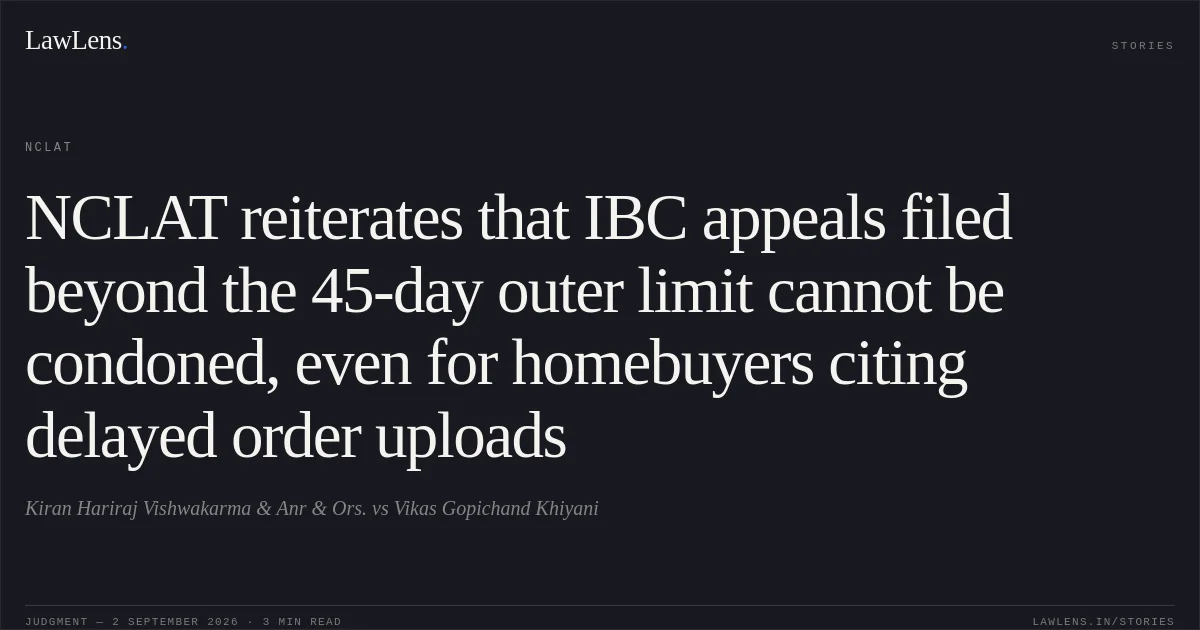
The appellants, individual homebuyers, challenged the NCLT, Mumbai Bench’s orders dated 18 November 2025 in I.A. Nos. 3892 and 3893 of 2025 in CP (IB) No. 285 of 2024, by which their applications were dismissed as premature.
Source reference: para. 1The orders were pronounced in open court on 18 November 2025 in the presence of the appellants’ counsel.
Source reference: para. 11The appeals were e-filed on 3 February 2026.
Source reference: no citationThe appellants sought condonation of delay, asserting that the orders were uploaded only in December 2025, that their counsel’s office remained closed from 8 December 2025 to 2 January 2026, and that public holidays and difficulties in executing affidavits further delayed filing.
Source reference: paras. 3–5The Registry calculated the limitation period from 19 November 2025 and reported that the thirty-day period expired on 18 December 2025, with the appeals filed 45 days beyond the prescribed period.
Source reference: para. 7Issues
Whether limitation for an appeal under Section 61 of the Insolvency and Bankruptcy Code, 2016, commenced from the date of pronouncement of the NCLT order in open court or from the date on which the order was uploaded on the tribunal’s portal?
Source reference: paras. 11–13Whether the appellants had shown sufficient cause for condoning the delay in filing the appeals under the proviso to Section 61(2) of the IBC?
Source reference: paras. 3–5, 17Whether the NCLAT had jurisdiction to condone a delay exceeding the statutory maximum of fifteen days beyond the initial thirty-day limitation period?
Source reference: paras. 8, 16–18Law Applied
Section 61(2) of the IBC requires an appeal to the NCLAT to be filed within thirty days and permits condonation only for a further period not exceeding fifteen days upon sufficient cause.
Source reference: para. 8Rule 3 of the NCLAT Rules, 2016, and Section 12(1) of the Limitation Act, 1963, exclude the day from which limitation is reckoned.
Source reference: paras. 9–10Under V. Nagarajan v. SKS Ispat & Power Ltd., limitation begins upon pronouncement of the order, and time spent obtaining a certified copy is excludable only where the appellant applies for the copy within the limitation period.
Source reference: para. 14Sanket Kumar Agarwal v. APG Logistics Pvt. Ltd. clarifies that limitation stops on e-filing, that the date of pronouncement is excluded, and that the time taken to provide a certified copy may be excluded if the copy was applied for within the prescribed period.
Source reference: para. 15Sanjay Pandurang Kalate v. Vistara ITCL (India) Ltd. applies where there was no pronouncement on the date borne by the order and limitation therefore commenced upon actual pronouncement/uploading.
Source reference: paras. 5, 12Under Tata Steel Ltd. v. Raj Kumar Banerjee, read with Kalpraj Dharamshi v. Kotak Investment Advisors Ltd., the NCLAT has no power to condone delay beyond the aggregate statutory period of thirty days plus fifteen days.
Source reference: para. 16Reasoning
The Tribunal held that the NCLT orders were pronounced in open court on 18 November 2025, and therefore limitation commenced from that date, subject to exclusion of the pronouncement date under the applicable rules.
Source reference: paras. 11, 15The appellants’ reliance on the later portal-upload date and on Sanjay Pandurang Kalate was rejected because, unlike in that case, there was an actual pronouncement in the present matter.
Source reference: paras. 12–13The appellants also did not demonstrate that they had applied for certified copies in a manner that could justify exclusion of the relevant period under Section 12 of the Limitation Act and V. Nagarajan.
Source reference: para. 14Accordingly, the thirty-day limitation expired on 18 December 2025, and the maximum fifteen-day condonable period expired on 2 January 2026.
Source reference: para. 16Since the appeals were filed only on 3 February 2026, the Tribunal lacked jurisdiction to condone the delay, regardless of the explanations concerning non-communication, counsel’s office closure, public holidays, or notarisation.
Source reference: paras. 16–17Holding
The NCLAT held that limitation commenced from the open-court pronouncement of the NCLT orders on 18 November 2025, not from their subsequent uploading.
The appeals were filed beyond both the thirty-day limitation period and the additional fifteen-day period that the NCLAT could statutorily condone.
Source reference: paras. 17–18The delay-condonation applications—I.A. Nos. 5636 and 5639 of 2026—were dismissed as not maintainable, and consequently both appeals were also dismissed.
Source reference: paras. 17–18Acts & Sections Cited
5 provisions across 3 statutes referred to in this judgment. Each provision opens on LawLens.
Insolvency and Bankruptcy Code, 2016.2
Companies Act, 20132
Limitation Act, 19631
Original Court PDF
Kiran Hariraj Vishwakarma & Anr & Ors.vsVikas Gopichand Khiyani
Click to open original judgment
Original judgment, available to read, download and summarize on LawLens.in