Facts
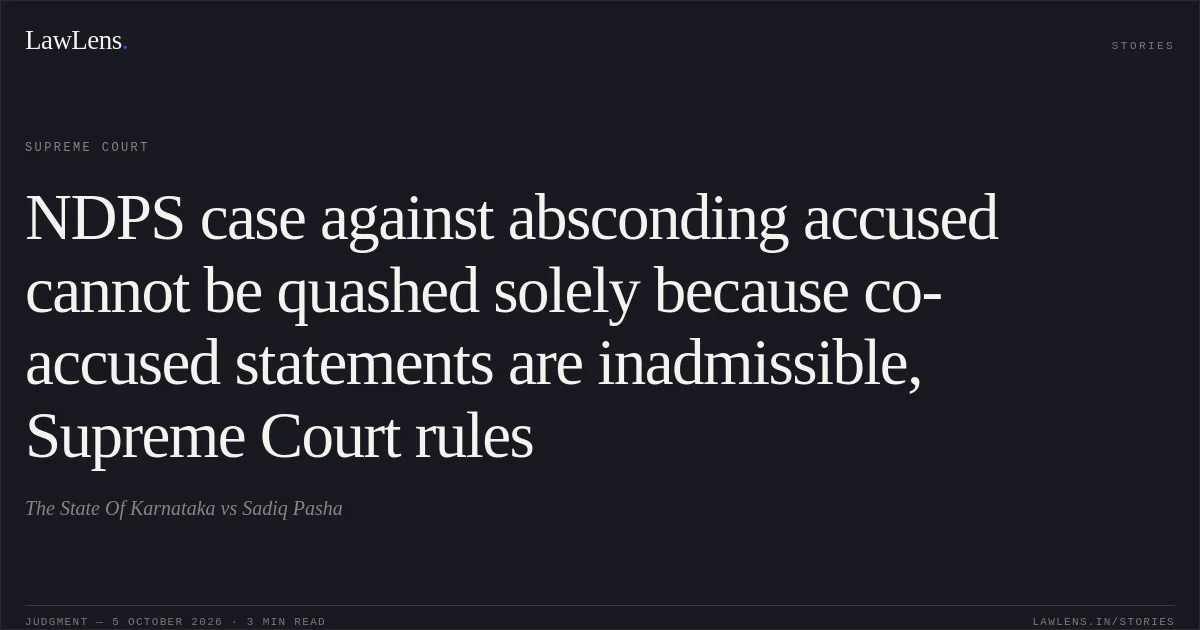
Police found two persons near a car and seized 32.615 kg of ganja concealed in it; a third person fled and was later identified as the respondent, who was arrayed as Accused No. 3 and shown as an absconder in a split chargesheet.
Source reference: paras. 4–5, pp. 2–3The High Court quashed the pending NDPS proceedings, reasoning that the respondent had not been apprehended at the scene, no contraband was found in his possession, and his implication rested on a co-accused’s statement.
Source reference: para. 5, p. 3The State appealed.
Source reference: no citationThe Supreme Court noted that the respondent’s name appeared in the First Information Statement, but no disclosure statement had been recorded from the co-accused and no Section 67 statement had been recorded from the respondent.
Source reference: para. 12, p. 9Issues
1. Whether proceedings pending before the Special Court could be quashed on the ground that a confession or disclosure statement would be inadmissible at trial, without examining the chargesheet and the material gathered against the accused.
Source reference: paras. 11–12, pp. 8–92. Whether the cited decisions concerning conviction or cancellation of bail required quashing the pending prosecution in this case.
Source reference: paras. 5, 11, pp. 3, 8Law Applied
Under Tofan Singh v. State of Tamil Nadu, officers empowered under Section 53 of the NDPS Act are police officers for the purposes of Section 25 of the Evidence Act, 1872; a confession recorded under Section 67 of the NDPS Act cannot be used as a confession to convict an accused.
Source reference: para. 7, pp. 4–5The Court stated that a Section 67 confession or a disclosure statement under Section 53A of the NDPS Act has no evidentiary value at trial and that a co-accused’s disclosure cannot, by itself, be placed before the court to establish guilt where the maker is neither examined as a witness nor made an approver.
Source reference: para. 13, p. 9The decisions relied on by the High Court concerned appeals against conviction or applications for cancellation of bail in which the confessional statement was the sole incriminating material; they did not determine whether a pending prosecution should be quashed without considering the prosecution material as a whole.
Source reference: paras. 8–11, pp. 5–8Reasoning
The Supreme Court distinguished the cited cases because they addressed whether a confession could sustain a conviction or justify cancellation of bail, whereas the present case concerned quashing a pending prosecution.
Source reference: paras. 8–11, pp. 5–8The respondent was alleged to have fled from the scene where the contraband was seized, and his name was recorded in the First Information Statement; the record did not establish that the prosecution case rested on a Section 67 statement by him or a recorded disclosure statement by a co-accused.
Source reference: para. 12, p. 9Although such statements cannot establish guilt at trial, that principle alone did not justify quashing the proceedings without examining the chargesheet and the material against the respondent.
Source reference: paras. 12–14, pp. 9–10The Court left open his opportunity to contest the sufficiency of that material at the cognizance or discharge stage.
Source reference: paras. 12–14, pp. 9–10Holding
The Supreme Court held that quashing the proceedings on the stated ground was improper, set aside the High Court’s order, and restored the Special Case to the file of the Special Court.
It made no finding on the merits and left the respondent’s objections to be raised at the appropriate stage.
Source reference: paras. 14–15, p. 10The respondent was directed to appear before the Special Court within two weeks; upon appearance, he was to be released on bail on terms fixed by that court, failing which steps could be taken to secure his apprehension and production.
Source reference: paras. 14–15, p. 10Acts & Sections Cited
4 provisions across 2 statutes referred to in this judgment. Each provision opens on LawLens.
Narcotic Drugs and Psychotropic Substances Act, 19853
Code of Criminal Procedure, 19731
Original Court PDF
The State Of KarnatakavsSadiq Pasha
Click to open original judgment
Original judgment, available to read, download and summarize on LawLens.in