Facts
On 09.01.2025, acting on intelligence regarding transportation of narcotic substances, a police and BSF team intercepted the appellant near Katigorah on NH-06 at about 8:30 p.m. and allegedly recovered 34 soap cases containing suspected brown sugar weighing approximately 342 grams from his possession.
Source reference: pp.2–3, para.2An FIR was registered under Section 21(c) of the NDPS Act, and the appellant was subsequently charged, convicted, and sentenced by the Special Judge, NDPS Act, Cachar, Silchar, to ten years’ rigorous imprisonment and a fine of ₹1,00,000, with a default sentence of six months’ simple imprisonment.
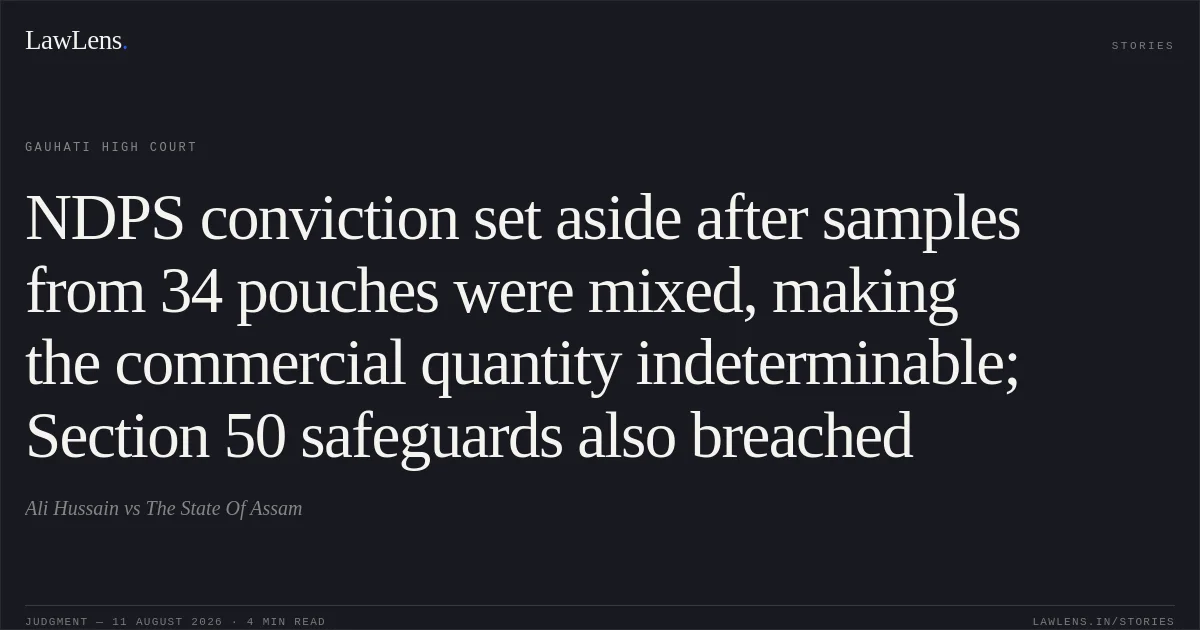
Source reference: pp.2–3, para.2Before the Magistrate, the contents of all 34 pouches were sampled by taking small quantities from each pouch, mixing them into a composite 16-gram sample, and drawing three 5-gram samples from that mixture.
Source reference: pp.13–14, para.16The prosecution evidence also contained inconsistencies regarding the number and weight of the packets, the place and manner of recovery, the bag allegedly carried by the appellant, the seizure documentation, and compliance with statutory search requirements.
Source reference: pp.4–12, paras.6–15; pp.20–22, paras.29–34Issues
Whether mixing samples drawn from all 34 individual pouches and testing only the composite mixture complied with Rules 3 and 10 of the Narcotic Drugs and Psychotropic Substances (Seizure, Storage, Sampling and Disposal) Rules, 2022, and whether the sampling lapse rendered the alleged commercial quantity of heroin indeterminable.
Source reference: pp.14–19, paras.17–27Whether the search and recovery were vitiated by non-compliance with Section 50 of the NDPS Act, where the prosecution case involved both the search of a bag allegedly carried by the appellant and a personal search of the appellant.
Source reference: pp.19–22, paras.28–32Whether the cumulative procedural and evidentiary discrepancies rendered the alleged recovery and the appellant’s conviction unsafe.
Source reference: pp.22–23, paras.33–35Law Applied
The Court applied Section 52A(2) of the NDPS Act, which requires preparation and Magistrate-certification of the inventory, photographs, and representative samples, read with Rules 3(2) and 10 of the 2022 Rules.
Source reference: pp.15–17, paras.20–25Rule 3(2) requires packages or containers to be weighed separately and serially numbered, while Rule 10(1) requires one sample, in duplicate, from each package or container; bunching is permissible only where the packages are identical in size, weight, marking, and contents, and after conclusive colour testing, subject to the prescribed lot limits and representative sampling requirements.
Source reference: pp.15–17, paras.20–25Relying on Bharat Aambale v. State of Chhattisgarh, 2025 INSC 78, the Court held that every breach of Section 52A or the applicable rules is not automatically fatal, but the court must assess whether the lapse creates discrepancies in the physical evidence or causes prejudice and doubt regarding recovery and quantity.
Source reference: pp.17–19, para.26The Court also applied Hira Singh v. Union of India, AIR 2020 SC 3255, on counting the weight of neutral substances where applicable, while clarifying that the principle cannot cure the mixing of untested contents from separate containers.
Source reference: p.19, para.27Under Section 50 of the NDPS Act, when a person is to be personally searched, the person must be informed of the right to be searched before a Gazetted Officer or Magistrate; as explained in State of Rajasthan v. Parmanand, Section 50 applies where both the person and a bag carried by him are searched, although it does not apply to a bag-only search.
Source reference: pp.19–22, paras.28–32Reasoning
The Court found that the prosecution neither established that the 34 pouches were identical nor showed that a drug-identification-kit test had been conducted to justify bunching them into lots under Rule 10(2). Instead, samples from every pouch were mixed into one composite sample, contrary to Rules 3(2) and 10, thereby destroying the individual identity of the contents.
Source reference: pp.14–19, paras.18–27Although the composite sample tested positive for heroin, the evidence could not establish that all 34 pouches contained heroin or determine the legally relevant total quantity; consequently, the alleged commercial quantity was not reliably proved.
Source reference: pp.14–19, paras.18–27The Court further noted that the FIR, GD entries, forwarding report, seizure list, and charge-sheet did not mention recovery from a bag, although witnesses introduced that version during trial.
Source reference: pp.20–22, paras.29–32The bag was not produced, and the prosecution failed to prove that the appellant had been informed of his Section 50 right despite evidence indicating that his person was also searched.
Source reference: pp.20–22, paras.29–32These defects were aggravated by the absence of written reasons for the nighttime search, lack of requisite reports, failure to preserve the seal impression, discrepancies in the number and weight of the packets, and deficiencies in the seizure and chain-of-custody evidence.
Source reference: pp.5–12, paras.7, 10, 14Viewed cumulatively, the lapses created substantial doubt about both the recovery and the quantity of contraband, making reliance on the statutory presumption under Section 54 impermissible.
Source reference: pp.17–19, para.26; pp.22–23, paras.33–34Holding
The Court held that the composite sampling procedure violated the mandatory methodology under the 2022 Rules and rendered the alleged commercial quantity indeterminable.
It further held that the prosecution failed to establish compliance with Section 50 of the NDPS Act where both personal and bag searches were involved.
Source reference: p.23, paras.35–37The cumulative discrepancies undermined the factum of recovery and vitiated the conviction.
Source reference: p.23, paras.35–37Accordingly, the judgment of conviction and sentence dated 19.12.2025 was set aside, the appeal was allowed, and the appellant was directed to be released forthwith, subject to there being no other legal impediment.
Source reference: p.23, paras.35–37Acts & Sections Cited
11 provisions across 4 statutes referred to in this judgment. Each provision opens on LawLens.
Bharatiya Nagarik Suraksha Sanhita, 20231
Narcotic Drugs and Psychotropic Substances Act, 19858
Bharatiya Sakshya Adhiniyam, 20231
Code of Criminal Procedure, 19731
Original Court PDF
Ali HussainvsThe State Of Assam
Click to open original judgment
Original judgment, available to read, download and summarize on LawLens.in