Facts
On 12 September 2017, the police received secret information that respondent No. 1, Rupesh Kumar Sahu, was carrying and attempting to sell brown sugar near the Circuit House, Durg. After recording the information and arranging witnesses, the police conducted his personal search pursuant to notices under Section 50 of the NDPS Act. Thirty paper packets containing suspected brown sugar were allegedly recovered from his trouser pocket; the substance weighed 24.390 grams after excluding the packaging. The contraband was seized, sealed, deposited in the malkhana, and subsequently sent to the Forensic Science Laboratory, which confirmed it as brown sugar
Source reference: pp. 2–3, paras 3–4, 26–27The independent witnesses and the weighing witness turned hostile. The Investigating Officer admitted several procedural irregularities, including that the seized article was not produced before the Station House Officer, the original form of seizure was not deposited in the malkhana, there was a discrepancy in the recorded weight, and the statutory report under Section 57 was allegedly not properly documented. The Special Judge, NDPS, Durg acquitted all three accused of offences under Sections 21(b) and 27(a) of the NDPS Act on 26 April 2019, principally finding non-compliance with statutory safeguards and a break in the chain of custody
Source reference: pp. 4–5, para 8; p. 5, para 10The State preferred an appeal under Section 378(1) Cr.P.C. The High Court re-examined the findings concerning compliance with Sections 50, 55 and 57 of the NDPS Act, the chain of custody, the evidentiary effect of hostile independent witnesses, and the limited scope of interference with an acquittal
Source reference: pp. 7–8, para 15; pp. 19–20, paras 34–35Issues
Whether the trial court was correct in holding that the requirements of Sections 50, 55/56 and 57 of the NDPS Act had not been complied with?
Source reference: p. 7, para 15; pp. 9–14, paras 17–25Whether the prosecution established an unbroken chain of custody between the substance allegedly seized from respondent No. 1 and the sample examined by the FSL?
Source reference: pp. 14–16, paras 26–29Whether the testimony of the police officials could support conviction despite the independent witnesses turning hostile?
Source reference: pp. 16–18, paras 30–33Whether the High Court could interfere with the acquittal judgment in an appeal under Section 378 Cr.P.C., and, if so, whether the evidence justified interference against each respondent?
Source reference: pp. 19–20, paras 34–36Law Applied
The Court applied Section 50 of the NDPS Act, which requires that a person subjected to a personal search be informed of the right to be searched before a Magistrate or Gazetted Officer; a valid and informed consent to search by the investigating officer may establish compliance where the statutory option has been properly communicated
Source reference: pp. 8–10, paras 16–20; Vijaysinh Chandubha Jadeja v. State of Gujarat, (2011) 1 SCC 609Sections 55 and 57 of the NDPS Act were treated as directory rather than mandatory: non-compliance does not automatically vitiate the prosecution, although serious lapses may affect the reliability of the seizure and chain of custody
Source reference: pp. 11–14, paras 21–25; Babubhai Odhavji Patel v. State of Gujarat, 2005 INSC 535; Gurbax Singh v. State of Haryana, (2001) 3 SCC 28The Court held that the prosecution must nevertheless establish the identity, safe custody and transmission of the seized substance; a matching seal and FSL record may prove continuity of the sample
Source reference: pp. 14–16, paras 26–29; Rizwan Khan v. State of Chhattisgarh, (2020) 9 SCC 627Testimony of official witnesses cannot be rejected merely because of their official status or because independent witnesses turned hostile, provided it is cogent and trustworthy
Source reference: pp. 16–18, paras 31–33; Surinder Kumar v. State of Punjab, (2020) 2 SCC 563In an appeal against acquittal, interference is justified where the judgment is perverse, based on a misreading or omission of material evidence, or where no two reasonable views are possible and guilt is the only sustainable conclusion
Source reference: pp. 19–20, paras 34–36; Babu Sahebagouda Rudragoudar v. State of Karnataka, (2024) 8 SCC 149Reasoning
The High Court found that respondent No. 1 had been informed through the Section 50 notice of his right to be searched before a Magistrate or Gazetted Officer and had expressly consented to a search by the Investigating Officer. The trial court therefore erred in treating Section 50 as violated
Source reference: pp. 9–10, paras 17–19Although the Investigating Officer admitted that the seized article had not been produced before the Station House Officer and that certain procedural formalities under Section 55 had not been followed, the Court held that these provisions were directory and that the defence had not demonstrated prejudice
Source reference: pp. 11–14, paras 21–24It also accepted the Section 57 report and rejected the trial court’s doubts regarding its receipt and authenticity
Source reference: p. 14, para 25Regarding the chain of custody, the Court relied on the seizure documents, sample-seal memorandum, malkhana and FSL records, and held that the seal described in the FSL report corresponded with the seal used at seizure. It therefore concluded that the substance examined by the FSL was the same substance recovered from respondent No. 1
Source reference: pp. 14–16, paras 26–29The hostile independent witnesses did not, in the Court’s view, undermine the prosecution because the testimony of the Investigating Officer was considered consistent and reliable
Source reference: pp. 16–18, paras 31–33However, the prosecution produced no reliable incriminating material connecting respondents Nos. 2 and 3 with the alleged offence; the memorandum statement relied upon against them was not proved because its witnesses turned hostile
Source reference: p. 16, para 30The acquittal of those respondents was therefore a reasonable and sustainable view
Source reference: no citationHolding
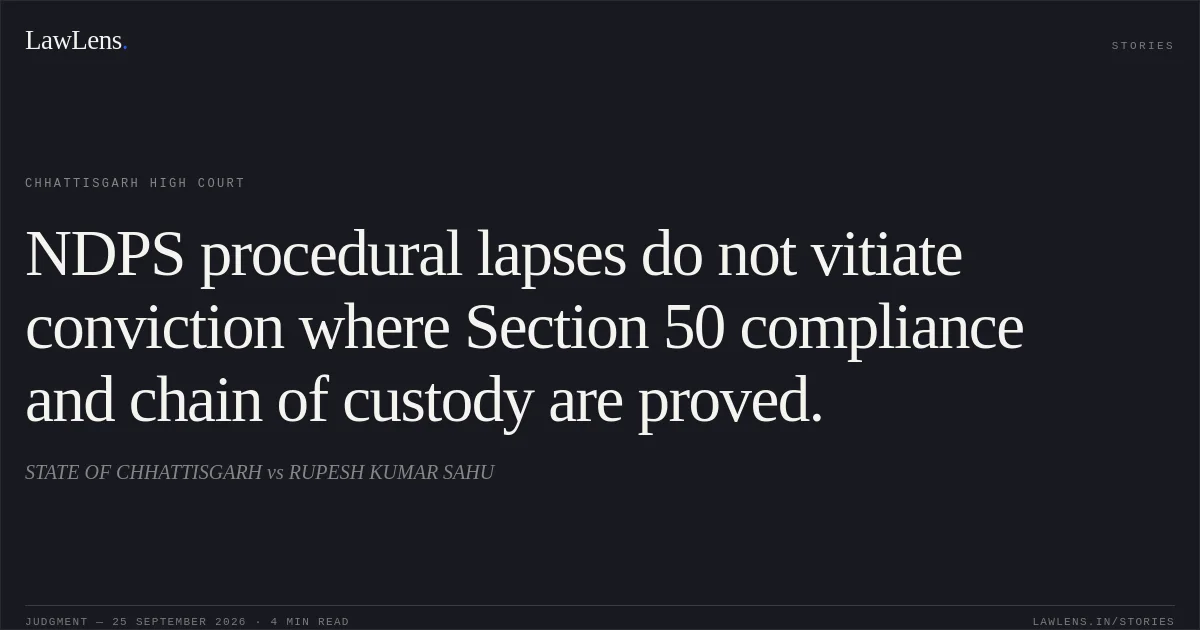
The High Court partly allowed the State’s appeal. It set aside the acquittal of respondent No. 1, Rupesh Kumar Sahu, and convicted him under Sections 21(b) and 27(a) of the NDPS Act, holding that the alleged violations of Sections 50, 55 and 57 and the asserted break in the chain of custody were not established as fatal defects
The acquittals of respondents Nos. 2 and 3, Lokesh Ameshar and Trilok Nirmalkar, were affirmed for want of sufficient incriminating evidence
Source reference: p. 16, para 30; p. 20, para 37Since the acquittal of respondent No. 1 was reversed, the Court directed that he and his counsel be heard separately on sentence and listed the matter for that purpose on 5 October 2026
Source reference: p. 21, paras 38–39Acts & Sections Cited
19 provisions across 3 statutes referred to in this judgment. Each provision opens on LawLens.
Code of Criminal Procedure, 19737
Narcotic Drugs and Psychotropic Substances Act, 1985
Bharatiya Nagarik Suraksha Sanhita, 20232
Original Court PDF
STATE OF CHHATTISGARHvsRUPESH KUMAR SAHU
Click to open original judgment
Original judgment, available to read, download and summarize on LawLens.in