Facts
On August 20, 2025, acting on secret information, police apprehended co-accused Kaushal Patel with 50 tablets of Alprazolam.
Source reference: para. 3The petitioner was implicated in FIR No. 68/2025 registered at Police Station Panduka based on a memorandum statement given by the co-accused, who alleged he purchased the drugs from the petitioner.
Source reference: para. 3Following the investigation, Charge-sheet No. 97/2025 was filed for offences under Section 22(B) of the NDPS Act.
Source reference: para. 2The trial court took cognizance on November 14, 2025, and framed charges on November 25, 2025.
Source reference: para. 2The petitioner filed the present petition under Section 528 of the Bhartiya Nagrik Suraksha Sanhita (BNSS), 2023, seeking to quash the charge-sheet and the entire criminal proceedings, contending that no contraband was recovered from him and his implication was based solely on an inadmissible statement.
Source reference: para. 2, 4Issues
1. Whether the criminal proceedings against the petitioner are liable to be quashed under Section 528 of the BNSS on the grounds that the implication is based solely on the memorandum statement of a co-accused without independent recovery.
Source reference: para. 4, 92. Whether the material on record prima facie discloses the commission of a cognizable offence under the NDPS Act to justify the continuation of the trial.
Source reference: para. 9Law Applied
The Court primarily applied Section 528 of the Bhartiya Nagrik Suraksha Sanhita, 2023 (corresponding to Section 482 of the Cr.P.C.), regarding the inherent powers of the High Court to quash proceedings.
Source reference: para. 2, 8It considered Sections 22(b) and 29 of the Narcotic Drugs and Psychotropic Substances (NDPS) Act, 1985, relating to the possession of psychotropic substances and criminal conspiracy.
Source reference: para. 5, 9The Court relied on the landmark precedent of State of Haryana v. Bhajan Lal, which established the categories of cases where quashing is permissible.
Source reference: para. 4, 7M/s Neeharika Infrastructure Pvt. Ltd. v. State of Maharashtra, which held that the power to quash should be exercised sparingly and only in the rarest of rare cases without evaluating the reliability of allegations at the threshold.
Source reference: para. 5, 8Reasoning
The Court observed that the power to quash an FIR or charge-sheet must be exercised with circumspection and is reserved for cases where the allegations, even if accepted in their entirety, fail to disclose an offence.
Source reference: para. 7-8In this instance, the Court found that the prosecution's case—including the recovery of Alprazolam from a co-accused and the subsequent disclosure of the petitioner’s involvement—disclosed a prima facie case under Section 22(b) read with Section 29 of the NDPS Act.
Source reference: para. 5, 9The Bench reasoned that at the stage of quashing under Section 528 BNSS, the Court cannot conduct a mini-trial to assess the reliability or evidentiary value of the co-accused's memorandum statement.
Source reference: para. 8-9Since the investigation had already resulted in a charge-sheet and the framing of charges, the arguments regarding the lack of independent recovery or the admissibility of evidence were deemed disputed questions of fact to be adjudicated during the trial.
Source reference: para. 9Holding
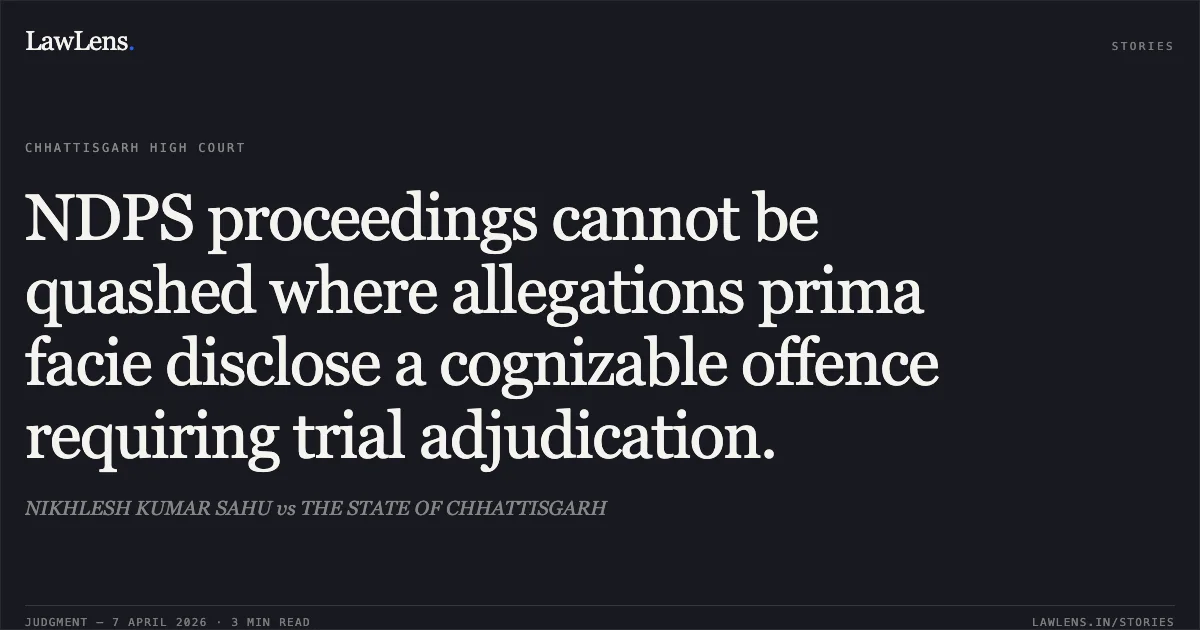
The Court answered the issues in the negative and dismissed the petition.
It held that because a prima facie case was made out and the allegations disclosed the commission of a cognizable offence, there were no grounds for interference under Section 528 BNSS.
Source reference: para. 9The Court concluded that the reliability of the evidence collected during the investigation is a matter for the trial court to determine during the evidentiary stage.
Source reference: para. 9Acts & Sections Cited
4 provisions across 3 statutes referred to in this judgment. Each provision opens on LawLens.
Bharatiya Nagarik Suraksha Sanhita, 20231
Narcotic Drugs and Psychotropic Substances Act, 19852
Code of Criminal Procedure, 19731
Original Court PDF
NIKHLESH KUMAR SAHUvsTHE STATE OF CHHATTISGARH
Click to open original judgment
Original judgment, available to read, download and summarize on LawLens.in


![Subsequent exoneration does not retrospectively invalidate a finalized promotion select list.. UNNIKRISHNAN M vs M/o Environment And Forests. CAT - ['Ernakulam']. LawLens](/stories/thumbnails/subsequent-exoneration-does-not-retrospectively-invalidate-a-finalized-promotion-select-li-ce80a0e84f2f4887857271e8b4341c42.webp)