Facts
On July 7, 2023, acting on secret information, police apprehended the Appellant near Nashti Bhawani Temple, Bilaspur, carrying a bag containing two packets of contraband
Source reference: p.2Upon weighment, the substance was identified as 9.065 kg of ganja
Source reference: p.2Following an investigation and FSL confirmation, the Appellant was charged and subsequently convicted by the Special Judge (NDPS Act), Bilaspur, on November 28, 2025
Source reference: p.2He was sentenced to five years of Rigorous Imprisonment (RI) and a fine of ₹50,000 under Section 20(b)(ii)(B) of the NDPS Act
Source reference: p.2In the present appeal, the Appellant chose not to contest the conviction on merits but confined his plea to the reduction of the sentence, noting he had already served approximately two years and nine months in custody
Source reference: p.3-4Issues
1. Whether the conviction of the Appellant under Section 20(b)(ii)(B) of the NDPS Act is legally sustainable based on the evidence on record
Source reference: p.4-52. Whether the sentence of five years RI should be reduced to the period already undergone or a lesser term based on the principles of reformative justice and the Appellant’s circumstances
Source reference: p.4-6Law Applied
The court applied Section 20(b)(ii)(B) of the Narcotics Drugs and Psychotropic Substances (NDPS) Act, which penalizes the possession of intermediate quantities of cannabis
Source reference: p.2Procedurally, the appeal was governed by Section 415(2) of the Bhartiya Nagrik Suraksha Sanhita, 2023
Source reference: p.1Regarding sentencing philosophy, the Court relied on the landmark precedent of Mohammad Giasuddin v. State of Andhra Pradesh (1977) 3 SCC 287, which emphasizes the "therapeutic" and "reformative" theory of punishment over a purely retributive approach, asserting that the state should aim to rehabilitate rather than avenge
Source reference: p.5-6Reasoning
The Court first affirmed the conviction, noting that the testimonies of nine prosecution witnesses, including the Investigating Officer (PW-9) and the FSL report (Ex.P-58), sufficiently proved the recovery and nature of the contraband
Source reference: p.4-5Regarding the quantum of sentence, the Court observed that the Appellant had served over half of his original five-year sentence and was a laborer by profession
Source reference: p.3, 6While the State pointed out six previous criminal antecedents under the IPC and Arms Act, it was noted that the Appellant had no prior history under the NDPS Act
Source reference: p.4, 6Applying the reformative logic from Mohammad Giasuddin, the Court reasoned that since there is no mandatory minimum sentence for intermediate quantities under Section 20(b)(ii)(B), a reduction in sentence would serve the interests of justice without compromising social defense
Source reference: p.6Holding
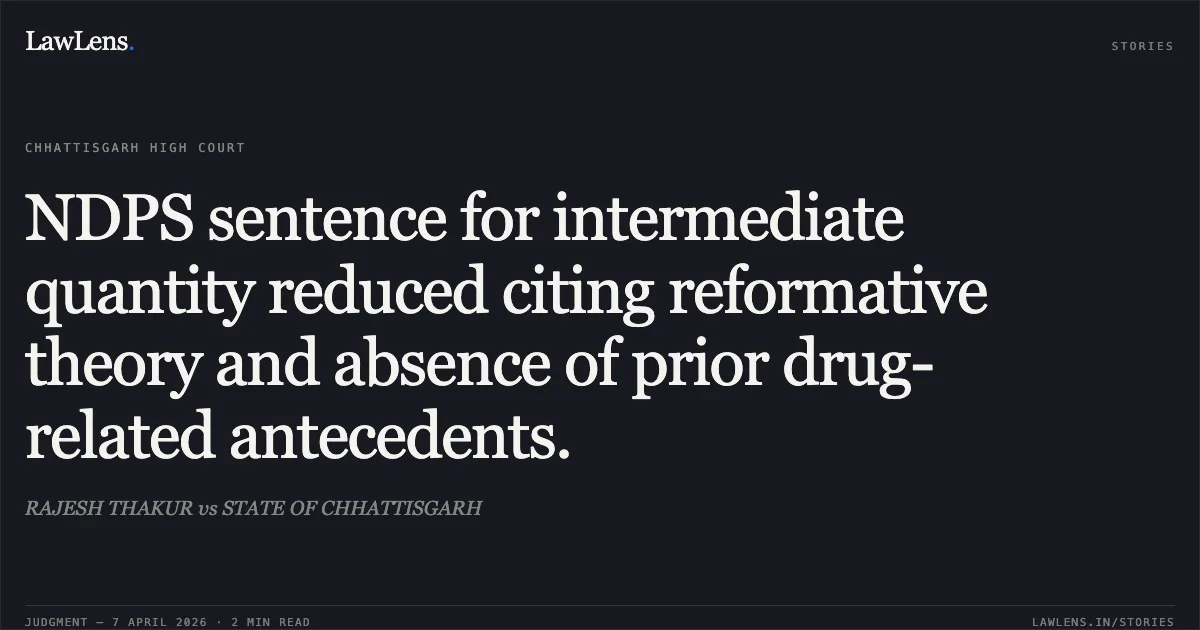
The High Court maintained the conviction under Section 20(b)(ii)(B) of the NDPS Act but partially allowed the appeal regarding the sentence
The sentence of RI was reduced from five years to three years, while the fine of ₹50,000 and the default sentence remained unchanged
Source reference: p.7The Court further directed that the Appellant be granted the benefit of set-off for the period already spent in jail since July 7, 2023
Source reference: p.7Acts & Sections Cited
4 provisions across 3 statutes referred to in this judgment. Each provision opens on LawLens.
Bharatiya Nagarik Suraksha Sanhita, 20231
Narcotic Drugs and Psychotropic Substances Act, 19852
Code of Criminal Procedure, 19731
Original Court PDF
RAJESH THAKURvsSTATE OF CHHATTISGARH
Click to open original judgment
Original judgment, available to read, download and summarize on LawLens.in


![Authorities must decide pensionary and retiral-benefit claims through a reasoned order within eight weeks.. Habibullah khan vs HOME DEPARTMENT. CAT - ['Srinagar']. LawLens](/stories/thumbnails/authorities-must-decide-pensionary-and-retiral-benefit-claims-through-a-reasoned-order-wit-d0cbe8a8119c48fbabe7df9f2d353488.webp)