Facts
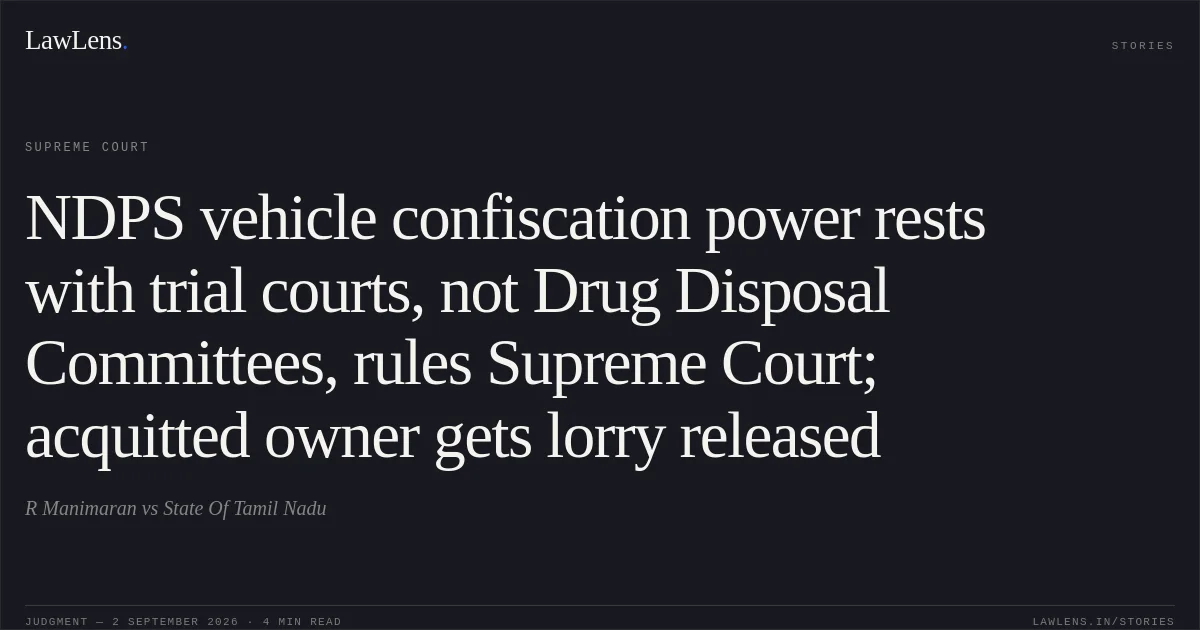
A lorry bearing registration no. TN-57-AQ-2165, manufactured by Ashok Leyland, was intercepted in Tamil Nadu and allegedly found carrying 66 kg of ganja.
Source reference: p.1–2Four persons were prosecuted under the Narcotic Drugs and Psychotropic Substances Act, 1985 (“NDPS Act”), while the lorry was seized as the conveyance allegedly used for transporting the contraband.
Source reference: p.1–2The Trial Court acquitted all accused on grounds including discrepancies in the arrest memo and crime number, absence of proper safe-custody records, unexplained transportation during pandemic restrictions, and delay in forwarding samples to the laboratory.
Source reference: p.2–3It also directed release of the lorry to its owner after expiry of the appeal period.
Source reference: p.3After the appeal period expired, the appellant applied for release of the vehicle.
Source reference: p.3–4The Trial Court rejected the application, and the High Court affirmed that decision, holding that release or disposal had to proceed through the Drug Disposal Committee (“DDC”) under Section 52A of the NDPS Act and the NDPS (Seizure, Storage, Sampling and Disposal) Rules, 2022.
Source reference: p.3–4Issues
Whether a vehicle seized in an NDPS case can be released by the criminal court under Sections 451 and 457 of the CrPC, or whether it must necessarily be dealt with by the DDC under Section 52A of the NDPS Act and the 2022 Rules
Source reference: p.4–8; paras 11–14Whether the criminal court is required to determine the vehicle’s liability to confiscation under Section 63(1) of the NDPS Act after the accused are convicted, acquitted, or discharged
Source reference: p.4–7; paras 8–12Whether, in the circumstances of the present case—particularly the acquittal of all accused and serious defects in the prosecution case—the appellant was entitled to release of the vehicle
Source reference: p.9–11; paras 15–17Law Applied
Section 63(1) of the NDPS Act requires the court trying the offence to decide, upon conviction, acquittal, or discharge, whether an article or conveyance seized under the Act is liable to confiscation under Sections 60, 61, or 62, and empowers that court to order confiscation.
Source reference: p.6–7; para. 11Under Section 60, a conveyance used for carrying the offending substance may be confiscated, subject to the owner’s defence under Section 60(3) that it was used without the owner’s knowledge or connivance and despite the owner having taken reasonable precautions.
Source reference: p.6–7; para. 11The confiscation proceeding is distinct from the criminal prosecution: acquittal does not automatically require release because confiscation is determined on the preponderance of probabilities, whereas criminal guilt must be proved beyond reasonable doubt.
Source reference: p.6; para. 10The Court followed Biswajit Dey v. State of Assam, (2025) 3 SCC 241, holding that the trial court may invoke Sections 451 and 457 of the CrPC, or analogous BNSS provisions, for interim custody of a seized vehicle and that confiscation must be decided by the court, not independently by the DDC.
Source reference: p.4–8; paras 8–13Although Rule 16 of the NDPS (Seizure, Storage, Sampling and Disposal) Rules, 2022 permits disposal of conveyances under Section 52A, that power must operate with the permission and supervision of the competent criminal court.
Source reference: p.7–8; paras 11–12Reasoning
The Supreme Court held that the High Court’s reliance on Nahoorkani v. State was inconsistent with the principle laid down in Biswajit Dey.
Source reference: p.4–8; paras 8–12Section 63(1) expressly places the power to determine confiscation in the court trying the NDPS offence; consequently, the DDC cannot independently sell or otherwise dispose of the vehicle while bypassing the court’s statutory jurisdiction.
Source reference: p.4–8; paras 8–12At the same time, the court may order interim custody under Sections 451 and 457 of the CrPC to prevent deterioration and wastage of the vehicle during or after the proceedings.
Source reference: p.8–9; para. 13In the present case, no confiscation proceedings had been initiated during the trial or immediately after the acquittal, and the Trial Court had already directed release of the lorry.
Source reference: p.3–4; para. 7The acquittal rested on serious evidentiary and procedural deficiencies, including the appearance of a crime number in an arrest memo prepared before registration of the FIR, inadequate safe-custody documentation, unexplained circumstances surrounding interception, delay in sample transmission, and other inconsistencies concerning seizure, weighment, search, recording of information, and sampling.
Source reference: p.2–3, 9–11; paras 4, 15–16These circumstances rendered the interception and prosecution case sufficiently suspect to justify release of the vehicle, subject only to verification of the appellant’s ownership.
Source reference: p.9–11; para. 16Holding
The appeal was allowed.
The Supreme Court set aside the High Court’s order and the subsequent Trial Court order refusing release of the lorry.
Source reference: p.11–12; para. 16It held that the vehicle was to be released to the appellant, and directed that, if the lorry had already been transmitted to the DDC, the DDC must release it forthwith.
Source reference: p.11; para. 17The Court clarified that confiscation under Section 63(1) is for the criminal court to decide, while disposal by the DDC under the 2022 Rules requires the court’s permission and cannot displace the court’s statutory power over confiscation.
Source reference: p.7–8; paras 11–14Acts & Sections Cited
7 provisions across 2 statutes referred to in this judgment. Each provision opens on LawLens.
Narcotic Drugs and Psychotropic Substances Act, 19854
Code of Criminal Procedure, 19733
Original Court PDF
R ManimaranvsState Of Tamil Nadu
Click to open original judgment
Original judgment, available to read, download and summarize on LawLens.in