01Facts
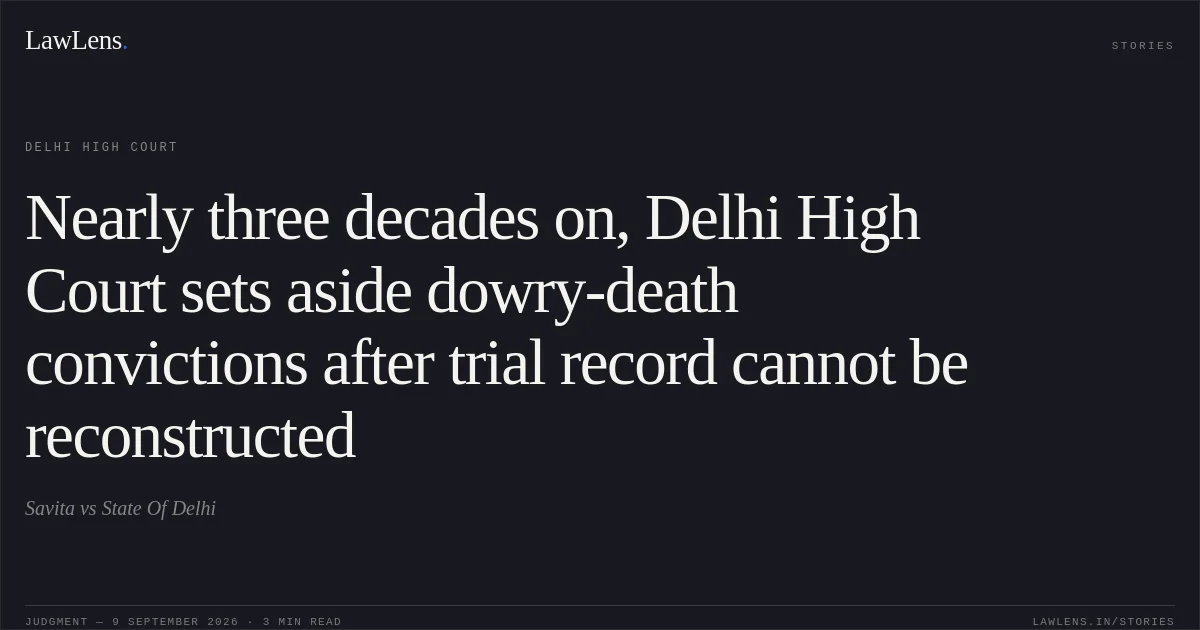
The appellants were convicted by the Sessions Court in Sessions Case No. 97/97 arising from FIR No. 107/1996, Police Station Jaffarpur Kalan, for offences under Sections 304B and 498A read with Section 34 IPC. They were sentenced to ten years’ rigorous imprisonment under Section 304B/34 IPC and two years’ rigorous imprisonment with fine under Section 498A IPC, with concurrent sentences.
p. 2 · ¶ 2During the pendency of the appeal, appellant Mehtab Singh died, and the appeal abated against him but continued against Jitender.
p. 2 · ¶ 3An earlier decision affirming the convictions was set aside by the Supreme Court, which remanded the appeals for fresh adjudication on merits.
p. 2 · ¶ 4On remand, it emerged that substantial portions of the Trial Court Record could not be traced or reconstructed despite efforts by the Registry, the trial court, the prosecution and the parties. The missing material included the depositions of most prosecution witnesses, the statements of the accused under Section 313 Cr.P.C., the defence evidence, medical and documentary exhibits, and case property.
pp. 3–6 · ¶ 6The police also reported that the missing documents were unavailable in the relevant records.
p. 3 · ¶ 502Issues
i.Whether the appeals could be adjudicated on merits when substantial and material portions of the Trial Court Record, including witness depositions, Section 313 statements and defence evidence, were unavailable and could not be reconstructed?
pp. 3–8 · ¶ 5–10ii.Whether retrial was a feasible and legally appropriate remedy in the circumstances, or whether the convictions and sentences were required to be set aside?
pp. 6–8 · ¶ 7–1003Law Applied
The Court applied Section 386 Cr.P.C., which governs the powers of the appellate court in criminal appeals, including the power to reverse a finding and sentence or order a retrial.
pp. 6–7 · ¶ 7It relied principally on State of U.P. v. Abhai Raj Singh, (2004) 4 SCC 6, which holds that the court must first attempt reconstruction of the record; if reconstruction is practicable, the appeal should be decided on merits, and if appropriate, a retrial may be ordered. However, where reconstruction is impossible and retrial is also rendered impracticable by the loss of vital foundational records, the proceedings must be closed.
pp. 6–7 · ¶ 7The Court further applied the principle that a criminal appeal cannot be fairly adjudicated without an effective and complete Trial Court Record, since determination in the absence of the evidentiary foundation would be impermissible.
p. 7 · ¶ 9Provisions in the judgment · 4 · Linked ones open on LawLens
Indian Penal Code, 1860 Section 34
Code of Criminal Procedure, 1973 Section 428Section 386Section 313
04Reasoning
The Court found that the missing material was not peripheral but constituted the foundation of the trial and appellate adjudication.
p. 7 · ¶ 8In particular, the depositions of material witnesses, the accused’s statements under Section 313 Cr.P.C. and the entire defence evidence were unavailable, preventing the Court from assessing the evidence, scrutinising the Trial Court’s reasoning or testing the correctness of the convictions.
p. 7 · ¶ 8Despite repeated efforts, reconstruction had failed and no further material could be procured from the prosecution, police records or the parties.
pp. 3–6 · ¶ 5–6Applying Abhai Raj Singh, the Court held that a retrial would not be meaningful because the alleged occurrence dated back to 1996, the conviction was recorded in 2001, nearly three decades had elapsed, and the basic material necessary for a retrial was itself unavailable.
pp. 7–8 · ¶ 9–1005Holding
The Court held that the appeals could not be decided on merits in the absence of the essential Trial Court Record and that retrial was neither feasible nor meaningful.
p. 8 · ¶ 10–11Consequently, it allowed the appeals, set aside the judgment of conviction dated 30 October 2001 and the order on sentence dated 6 November 2001, and disposed of CRL.A. Nos. 884/2001 and 10/2002 accordingly.
p. 8 · ¶ 10–11The appeal had already abated against deceased appellant Mehtab Singh.
p. 2 · ¶ 3Original Court PDF
SavitavsState Of Delhi
Click to open original judgment
Original judgment, available to read, download and summarize on LawLens.in