Facts
The petitioner participated in NEET (UG) 2026 as a candidate in the Persons with Benchmark Disabilities (PwBD) category.
Source reference: para. 3–4His UDID card, issued on 5 March 2025, recorded a 40% locomotor disability, classified as temporary and valid until 5 March 2030.
Source reference: para. 3–4Following assessment, the Medical Assessment Board and, on appeal, the Appellate Authority assessed his disability at 21%, making him ineligible for PwBD reservation.
Source reference: para. 6–7Both authorities nevertheless found him functionally competent to undertake the MBBS course, with no need for assistive support and no identified patient-safety risk.
Source reference: para. 6–7The petitioner challenged the authorities’ reassessment of his disability percentage, contending that their role was limited to assessing his functional ability.
Source reference: para. 8–12Issues
1. Whether the Medical Assessment Board and Appellate Authority could reassess the petitioner’s disability percentage, already certified by the competent authority and recorded in his UDID card, for determining PwBD reservation eligibility
Source reference: para. 8, 14–222. Whether, after finding the petitioner functionally competent to pursue the MBBS course, the authorities could deny him the benefit of PwBD reservation on the basis of their reassessed disability percentage
Source reference: para. 7, 22–26Law Applied
Section 2(r) of the Rights of Persons with Disabilities Act, 2016 defines a “person with benchmark disability” as a person with not less than 40% of a specified disability, as certified by the competent authority.
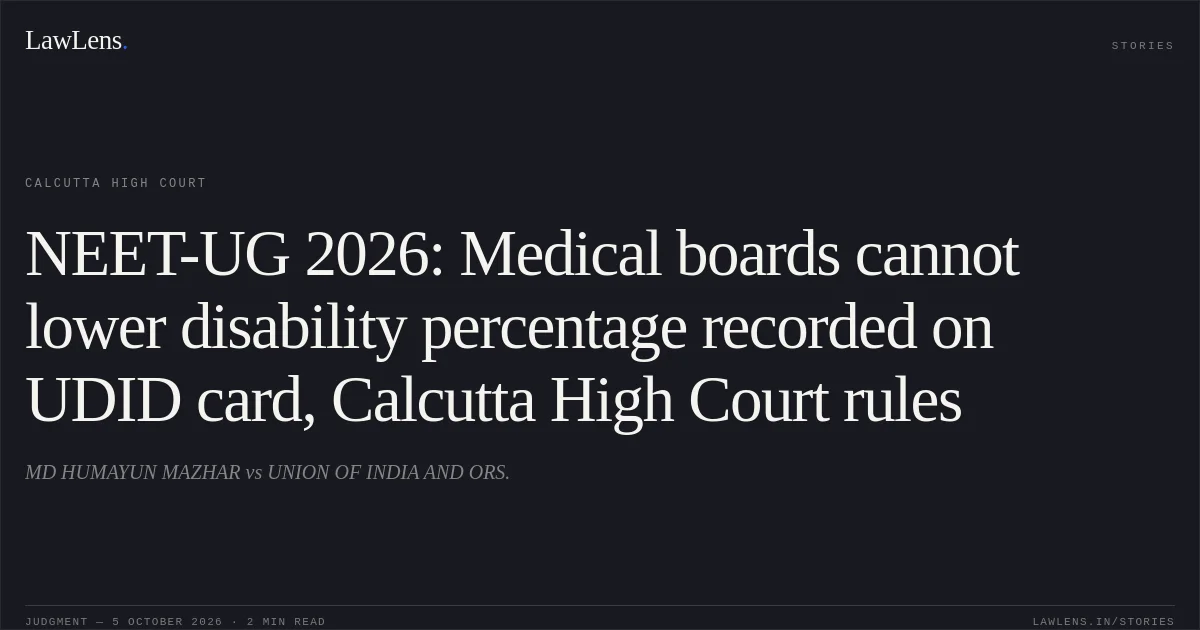
Source reference: para. 17The Court held that the competent authority’s assessment, reflected in the disability certificate and UDID card, governs the quantum of disability; the Medical Assessment Board and Appellate Authority may assess a candidate’s functional capacity to pursue the course but may not reassess that quantum.
Source reference: para. 19–22The Court relied on Om Rathod v. Director General of Health Services, 2024 SCC OnLine SC 3130, and Mitadru Sau v. State of West Bengal & Ors., 2024 SCC OnLine Cal 10317, as supporting authorities for treating the disability as recorded in the UDID card and applying the directions in Om Rathod.
Source reference: para. 10–11, 22Reasoning
The petitioner’s 40% disability had been assessed and certified by the competent authority under the 2016 Act and recorded in his UDID card.
Source reference: para. 14–18The Board and Appellate Authority could assess his functional competence under the applicable admission guidelines, but could not use that process to substitute their own disability percentage for the certified figure.
Source reference: para. 19–22Since the authorities had found the petitioner functionally competent, including on reasonable accommodation, course completion and patient safety, their further reduction of his disability percentage to 21%—and consequent denial of PwBD eligibility—was legally unsustainable.
Source reference: para. 23–24Holding
The Court set aside the finding that the petitioner was ineligible for PwBD reservation and held that the disability percentage recorded in his UDID card must be accepted.
As the petitioner had passed the functional assessment, IPGME&R, Kolkata, was directed to issue a fresh eligibility certificate relying on the UDID card by 6 October 2026.
Source reference: para. 26–29The petitioner was permitted to participate in the next counselling round on the basis of that certificate, and the writ petition was disposed of.
Source reference: para. 26–29Acts & Sections Cited
1 provisions across 1 statute referred to in this judgment. Each provision opens on LawLens.
Rights of Persons with Disabilities Act, 2016.1
Original Court PDF
MD HUMAYUN MAZHARvsUNION OF INDIA AND ORS.
Click to open original judgment
Original judgment, available to read, download and summarize on LawLens.in