Facts
The Petitioner supplied goods to the Respondent for Rs. 10,02,410/- via an invoice dated 21.08.2019
Source reference: para. 2The Respondent initially issued three cheques which were dishonoured, then made part payments totaling Rs. 3,50,000/- via NEFT
Source reference: paras. 3-4To cover the remaining balance, the Respondent issued 8 fresh cheques totaling Rs. 8,02,410/-, which were subsequently dishonoured for "funds insufficient"
Source reference: paras. 4-5The Petitioner issued a statutory demand notice for Rs. 6,52,410/- (the actual outstanding debt after deducting part payments)
Source reference: para. 5Upon non-payment, a complaint under Section 138 of the NI Act was filed, and the Metropolitan Magistrate issued a summoning order on 15.03.2021
Source reference: para. 6This order was set aside by the Sessions Court in revision on 07.10.2024, on the grounds that the demand notice was "invalid" because the amount demanded (Rs. 6,52,410/-) was less than the aggregate value of the 8 cheques (Rs. 8,02,410/-)
Source reference: paras. 7-8Issues
1. Whether a statutory demand notice under Section 138 of the NI Act is rendered invalid if the amount demanded is less than the aggregate amount of the dishonoured cheques due to accounting for part payments.
Source reference: para. 242. Whether the Sessions Court exceeded its revisional jurisdiction by adjudicating disputed questions of fact regarding legal liability at the summoning stage.
Source reference: paras. 35, 39-40Law Applied
Section 138 of the Negotiable Instruments (NI) Act, 1881, regarding the requirements for an offense of cheque dishonour, specifically the proviso (b) requirement to demand "the said amount of money"
Source reference: para. 25The court relied on Suman Sethi v. Ajay K. Churiwal (2000) to establish that while a notice must demand the cheque amount, it must be read as a whole and is only "bad" if it makes an omnibus demand without specifying the debt
Source reference: para. 28The court cited Alliance Infrastructure Project (P) Ltd. v. Vinay Mittal (2010) to clarify that "amount of money" means the amount actually payable, and a notice is invalid if the demanded amount exceeds the payable amount without explanation
Source reference: para. 29Dashrathbhai Trikambhai Patel v. Hitesh Mahendrabhai Patel (2023) regarding the necessity of endorsements under Section 56 of the NI Act when part payments are made
Source reference: paras. 31, 38Reasoning
The Court reasoned that the Sessions Court erred in mechanically applying precedents where notices were quashed for excessive or omnibus demands to a case where the demand was less than the cheque amount due to admitted part payments
Source reference: paras. 36-37The Court found that the Petitioner’s notice was not "omnibus" because it transparently detailed the invoice value, cheque particulars, and specific NEFT part payments to arrive at the balance of Rs. 6,52,410/-
Source reference: para. 35The Court distinguished the Supreme Court's ruling in Kaveri Plastics (where the demand was double the cheque amount) from the present case (where the demand reflected the actual legally recoverable debt)
Source reference: para. 37The Court held that the applicability of Section 56 of the NI Act (regarding endorsements of part-payment) and the determination of whether the cheques represented a "legally enforceable debt" are triable issues of fact that cannot be decided in a revision petition against a summoning order
Source reference: paras. 39-40Holding
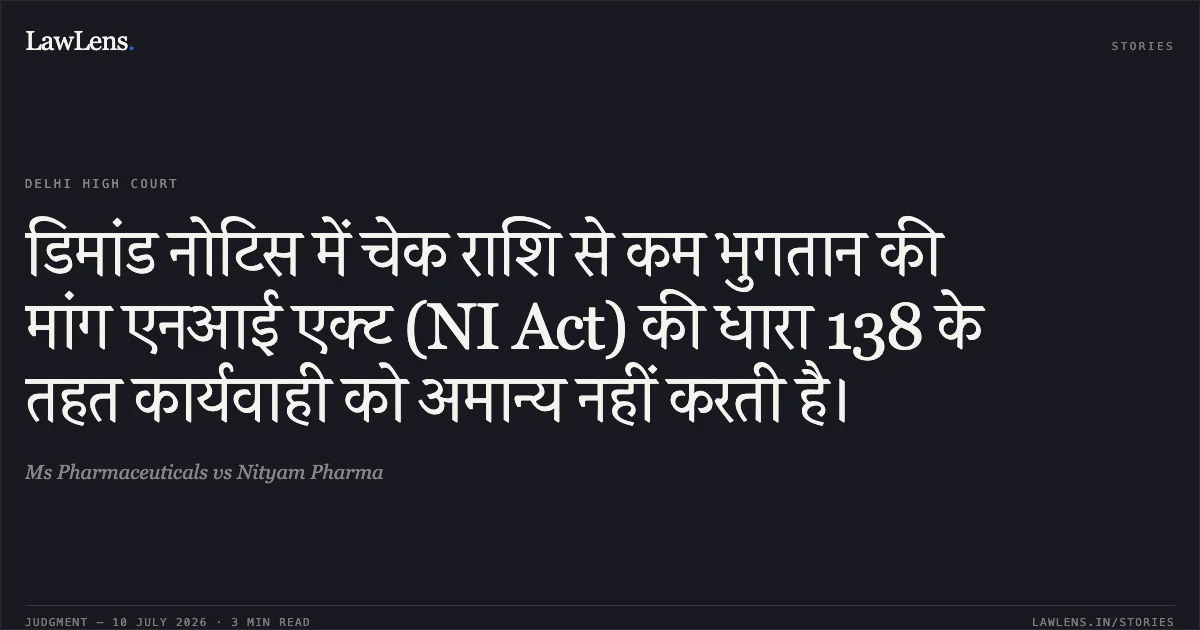
The Court held that a demand notice reflecting a sum lower than the cheque amount due to credited part payments is not ex-facie invalid
The High Court allowed the petition and set aside the Sessions Court's order dated 07.10.2024. The summoning order dated 15.03.2021 was restored, and the Trial Court was directed to proceed with the complaint on its merits, as the validity of the debt and compliance with Section 56 are matters for evidence during trial
Source reference: paras. 42-43Acts & Sections Cited
2 provisions across 2 statutes referred to in this judgment. Each provision opens on LawLens.
Bharatiya Nagarik Suraksha Sanhita, 20231
Indian Penal Code, 18601
Original Court PDF
Ms PharmaceuticalsvsNityam Pharma
Click to open original judgment
Original judgment, available to read, download and summarize on LawLens.in


![Subsequent exoneration does not retrospectively invalidate a finalized promotion select list.. UNNIKRISHNAN M vs M/o Environment And Forests. CAT - ['Ernakulam']. LawLens](/stories/thumbnails/subsequent-exoneration-does-not-retrospectively-invalidate-a-finalized-promotion-select-li-ce80a0e84f2f4887857271e8b4341c42.webp)