Facts
The appellant challenged an order passed by the Customs, Excise and Service Tax Appellate Tribunal (CESTAT) dated 29.09.2025.
Source reference: para. 2The CESTAT had upheld the dismissal of the appellant’s statutory appeal by the Commissioner (Appeals) on the grounds that it was filed beyond the limitation period prescribed under Section 35 of the Central Excise Act, 1944.
Source reference: para. 3The underlying order was received by the appellant on 18.02.2022, and the appeal was subsequently filed on 30.05.2022.
Source reference: para. 5While the Tribunal excluded the COVID-19 period (15.03.2020 to 28.02.2022) per Supreme Court directions, it held that the 60-day limitation period commenced on 01.03.2022 and expired on 29.04.2022.
Source reference: para. 6Because the appellant had not filed a condonation application for the additional 30-day discretionary period, the Tribunal rejected the contention that the limitation extended to 90 days.
Source reference: para. 7Issues
1. Whether the 90-day extension period granted by the Hon’ble Supreme Court in Suo Motu Writ Petition (C) No. 3 of 2020 applies uniformly to all litigants regardless of whether their limitation period expired during the pandemic window.
Source reference: para. 9-122. Whether the appeal filed on 30.05.2022 was within the limitation period considering the exclusion of public holidays.
Source reference: para. 13Law Applied
Section 35 of the Central Excise Act, 1944, which prescribes a limitation period of 60 days for filing an appeal, with a proviso allowing an extension of a further 30 days upon showing sufficient cause.
Source reference: para. 4Directions issued by the Hon’ble Supreme Court under Article 142 of the Constitution in Suo Motu Writ Petition (C) No. 3 of 2020 (Order dated 10.01.2022), which directed that the period from 15.03.2020 to 28.02.2022 be excluded for limitation purposes and provided a mandatory 90-day limitation period starting from 01.03.2022 for cases where limitation would have expired during the excluded period.
Source reference: para. 5, 8Reasoning
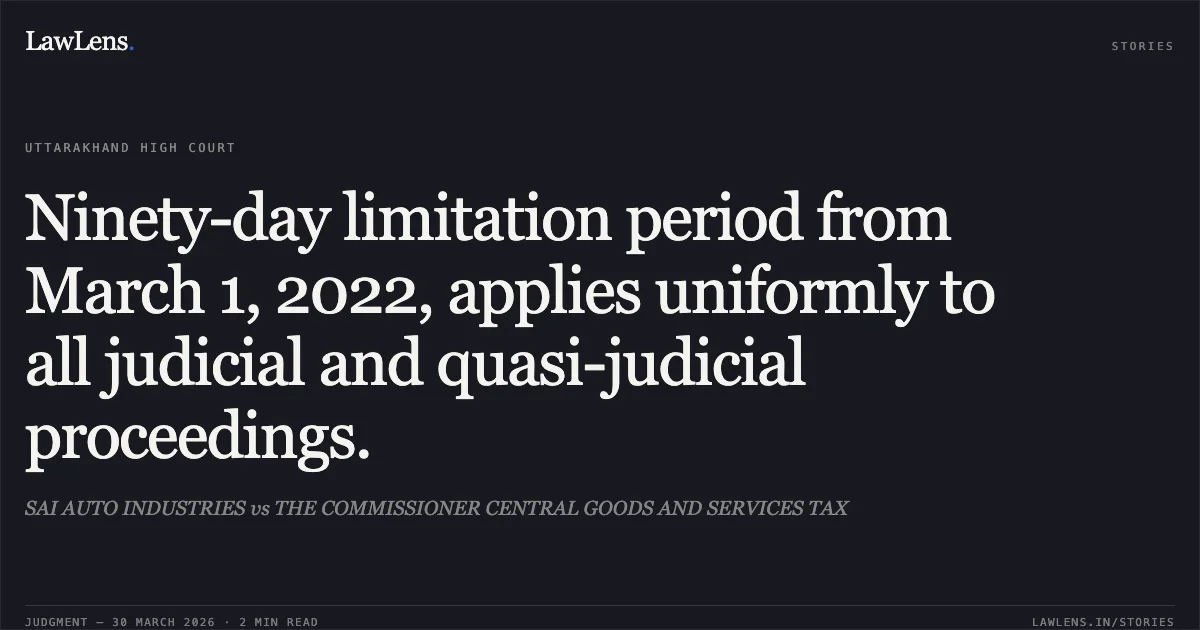
The High Court rejected the Revenue's narrow interpretation that the 90-day grace period only applied to cases where limitation strictly expired between 15.03.2020 and 28.02.2022.
Source reference: para. 10-12The Court reasoned that such an interpretation would create an "artificial distinction" between categories of litigants—those whose limitation expired during the pandemic and those whose limitation began just before or during it—which was never the intent of the Supreme Court.
Source reference: para. 12The Court held that the Supreme Court's direction intended for a uniform 90-day period to be available from 01.03.2022.
Source reference: para. 12Applying this to the facts, 90 days from 01.03.2022 expired on 29.05.2022. Since 28.05.2022 and 29.05.2022 were a Saturday and Sunday respectively, the filing of the appeal on the next working day, 30.05.2022, was deemed within time.
Source reference: para. 13-14Holding
The Court answered the issues in the affirmative, holding that the appellant was entitled to the 90-day limitation period starting from 01.03.2022 as per the Supreme Court’s Suo Motu directions.
The High Court set aside the CESTAT order dismissing the appeal as time-barred. The appeal was restored to its original number and the Tribunal was directed to decide the matter on its merits.
Source reference: para. 14-15Acts & Sections Cited
1 provisions across 1 statute referred to in this judgment. Each provision opens on LawLens.
Central Excise Act, 19441
Original Court PDF
SAI AUTO INDUSTRIESvsTHE COMMISSIONER CENTRAL GOODS AND SERVICES TAX
Click to open original judgment
Original judgment, available to read, download and summarize on LawLens.in


