Facts
The Petitioner, commissioned in the Corps of Engineers in 1984, was tried by a General Court Martial (GCM) in 2001 for misconduct while serving as Garrison Engineer at Agra.
Source reference: p.2The GCM sentenced him to be cashiered and undergo one year of rigorous imprisonment; the cashiering took effect on 04.12.2001.
Source reference: p.2-3In 2011, the Armed Forces Tribunal (AFT) upheld the conviction but remitted the matter for reconsideration of the sentence.
Source reference: p.3Consequently, the Central Government commuted the sentence to a loss of seniority and a severe reprimand, ordering his reinstatement on 15.02.2013, but specifically denied back wages for the period he was out of service (04.12.2001 to 04.03.2013) on the principle of "no work no pay".
Source reference: p.3-4The Petitioner challenged this denial before the AFT, which dismissed his plea on 09.08.2024, leading to the present writ petition.
Source reference: p.4-5Issues
Whether a service member whose conviction in a General Court Martial attained finality, but whose sentence was subsequently commuted resulting in reinstatement, is entitled to back wages for the period they did not render service.
Source reference: p.2, para 2; p.4, para 9Law Applied
The court applied the principle of "no work no pay," establishing that salary is ordinarily payable only for actual discharge of duties.
Source reference: p.5, 9Section 163(2) and Section 179 of the Army Act, 1950, regarding the power to commute sentences, noting that such powers modify punishment rather than declaring the original proceedings void ab initio.
Source reference: p.3, 8Paluru Ramakrishnaiah v. Union of India and Baldev Singh v. Union of India, which affirm that employees are not entitled to back wages for periods of non-service resulting from convictions that are not set aside.
Source reference: p.7, 9Reasoning
The Court reasoned that the Petitioner’s situation differs from cases of illegal termination or acquittal because his conviction for misconduct was never set aside and had attained finality.
Source reference: p.7-8The AFT’s 2011 intervention was strictly limited to the quantum of sentence, leaving the finding of guilt undisturbed.
Source reference: p.7The administrative commutation of the sentence by the Central Government was an act of leniency rather than an acknowledgment of a legal error that would invalidate the period of dismissal.
Source reference: p.8-9Applying the "no work no pay" doctrine, the court held that since the Petitioner was kept out of service due to his own proven misconduct and did not actually render service between 2001 and 2013, he holds no legal right to monetary benefits for that duration.
Source reference: p.9-10Holding
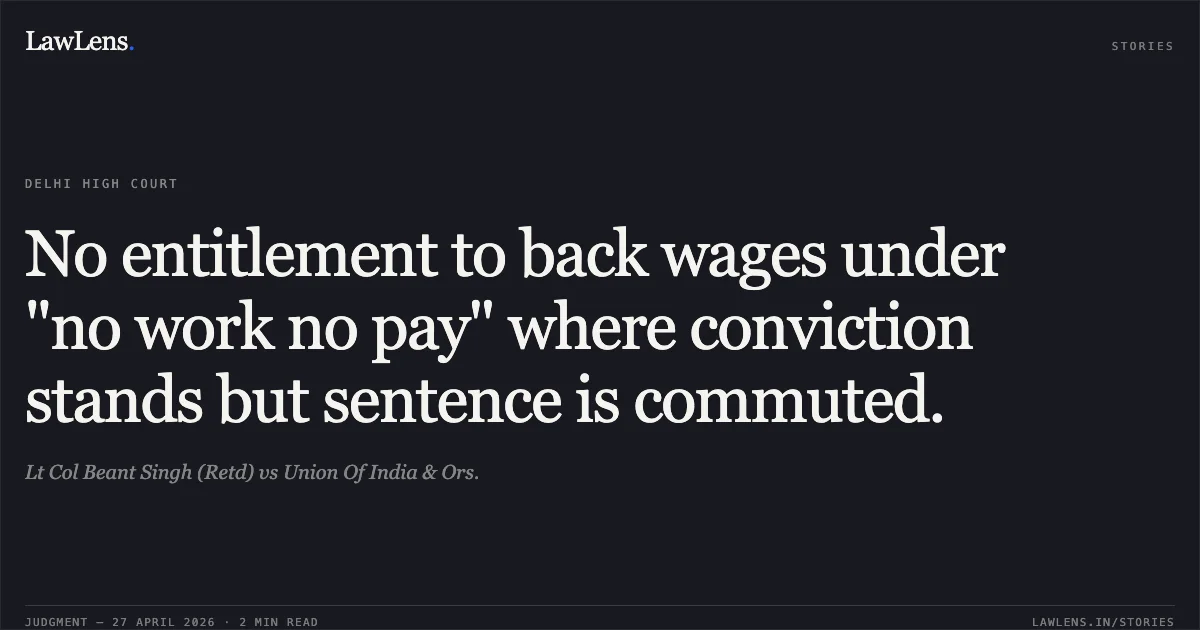
The Court affirmed the AFT's decision, concluding that the principle of "no work no pay" squarely applies where a conviction remains valid despite a subsequent modification or commutation of the sentence.
The High Court dismissed the petition, holding that the Petitioner is not entitled to back wages and no patent illegality or jurisdictional error was found in the Impugned Order.
Source reference: p.10Acts & Sections Cited
3 provisions across 1 statute referred to in this judgment. Each provision opens on LawLens.
Army Act, 19503
Original Court PDF
Lt Col Beant Singh (Retd)vsUnion Of India & Ors.
Click to open original judgment
Original judgment, available to read, download and summarize on LawLens.in


