Facts
The appellant was appointed as a Technician (Process) by the respondent-company on consolidated pay for an initial period of two years.
Source reference: paras. 3–4In his attestation form, he declared that no criminal case was pending against him.
Source reference: paras. 3–4During antecedent verification, the respondents learnt that a Non-Cognizable Report dated 03.04.2019 under Sections 323 and 504 IPC had been registered against him.
Source reference: para. 4A show-cause notice was issued alleging false declaration and suppression of material information.
Source reference: para. 4The appellant denied knowledge of the NCR, stating that he had neither been arrested nor summoned or called to the police station.
Source reference: para. 5He relied on a police character certificate dated 09.07.2020 recording no adverse entry against him.
Source reference: para. 5He subsequently produced a police certificate and final report showing that his name had been deleted from the array of accused after no evidence was found against him.
Source reference: para. 6The respondents terminated his appointment on 05.08.2023.
Source reference: para. 7The Kerala High Court dismissed his writ petition and writ appeal, holding that his alleged lack of knowledge involved disputed questions of fact.
Source reference: para. 8The appellant challenged that decision before the Supreme Court.
Source reference: no citationIssues
1. Whether the appellant had suppressed or furnished false information regarding the pendency of the NCR, when he claimed that he had no knowledge of its registration.
Source reference: paras. 19, 24, 26–322. Whether, even assuming the existence of a criminal antecedent, termination of the appellant’s employment was legally permissible without considering the nature of the offence, the nature of the post, the outcome of the criminal proceedings, and other relevant circumstances.
Source reference: paras. 19–24, 333. Whether the writ petition was maintainable despite the availability of an alternative remedy under the Industrial Disputes Act, 1947 and the alleged disputed questions of fact.
Source reference: para. 18Law Applied
The Court applied the principles governing suppression of criminal antecedents laid down by the three-Judge Bench in Avtar Singh v. Union of India, (2016) 8 SCC 471.
Source reference: para. 20The candidate’s declaration regarding conviction, acquittal, arrest, or pendency of a criminal case must be truthful; however, the employer must consider the special circumstances of the case, applicable rules, the nature and seriousness of the offence, the nature of the post, and the eventual outcome of the criminal proceedings before cancelling candidature or terminating employment.
Source reference: para. 20Suppression or false information cannot be established unless knowledge of the relevant fact is attributable to the candidate.
Source reference: paras. 20, 31Even where a criminal case was pending but unknown to the candidate, the employer must independently assess its seriousness and its impact on suitability; termination is not automatic.
Source reference: paras. 20–21The Court also relied on Ravindra Kumar v. State of U.P., 2024 INSC 131, and Umesh Chandra Yadav v. Inspector General, Railway Protection Force, (2022) 14 SCC 244, which require an objective, non-arbitrary assessment of the nature of the post, the suppression, its impact on suitability, and the circumstances of the case.
Source reference: paras. 22–23The existence of an alternative remedy is not an absolute bar to writ jurisdiction, particularly where the legality of the termination order itself is challenged.
Source reference: para. 18Reasoning
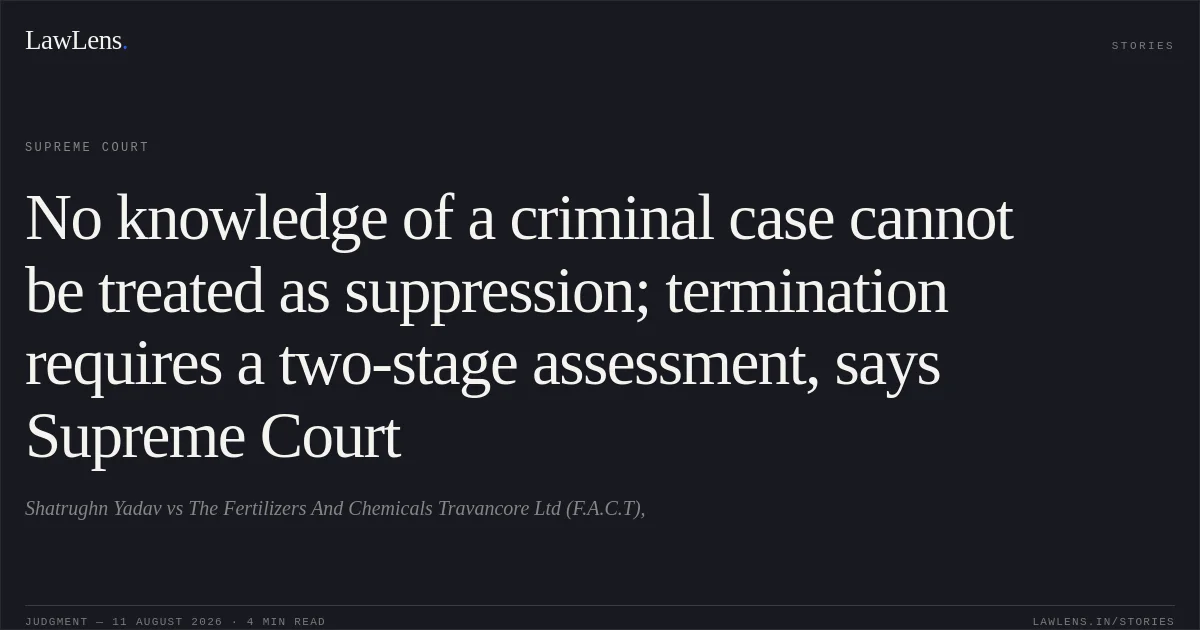
The Court held that the enquiry had two stages: first, whether there was actual suppression or false information in light of the appellant’s knowledge at the relevant time; and second, whether the antecedent and alleged suppression justified termination.
Source reference: para. 24On the first stage, the appellant’s consistent denial of knowledge was supported by the 2020 character certificate issued after registration of the NCR, the subsequent police certificate confirming that he had never been summoned, questioned, or arrested, and the deletion of his name after investigation.
Source reference: paras. 26–29The respondents’ assertion that the appellant must have known of the NCR because his parents were also named was held to be speculative and unsupported by evidence.
Source reference: para. 30Since knowledge is a prerequisite to suppression, the appellant could not be held liable for concealing a fact of which he was unaware; in any event, his claim of ignorance was substantiated by documentary material and was not a bare assertion.
Source reference: paras. 31–32On the second stage, the authorities had treated the mere existence of the NCR as automatically disqualifying.
Source reference: para. 33They failed to examine the specific nature and gravity of the alleged offences, their relevance to the appellant’s post, the effect of the proceedings, or the subsequent deletion of his name.
Source reference: para. 33The termination therefore reflected non-application of mind and was inconsistent with Avtar Singh and the requirement of objective decision-making.
Source reference: para. 33Holding
The Supreme Court held that the termination was not permissible in law because the appellant had not been shown to have deliberately suppressed the NCR, and the respondents had failed to undertake the required objective assessment of whether the antecedent justified termination.
The High Court’s judgment and the termination order were set aside.
Source reference: para. 35The respondents were directed to reinstate the appellant forthwith with all consequential benefits, subject to back wages being restricted to 50%, payable within eight weeks; failing payment within that period, interest at 6% per annum would accrue from the date the amount became due until disbursement.
Source reference: para. 35The appeal was accordingly allowed.
Source reference: para. 36Acts & Sections Cited
2 provisions across 1 statute referred to in this judgment. Each provision opens on LawLens.
Indian Penal Code, 18602
Original Court PDF
Shatrughn YadavvsThe Fertilizers And Chemicals Travancore Ltd (F.A.C.T),
Click to open original judgment
Original judgment, available to read, download and summarize on LawLens.in