Facts
The petitioners, retired teachers under the age of 65, were engaged as Block Resource Persons (BRPs) on a contractual basis in Siwan district under the Sarv Shiksha Abhiyan (SSA) scheme.
Source reference: p. 3-4Their primary responsibility was school monitoring and inspection.
Source reference: p. 5Following a review, the Education Department found significant discrepancies between the inspection reports submitted by contractual/outsourced personnel and the actual ground reality (fake/concocted data).
Source reference: p. 5, 9Consequently, the Additional Chief Secretary issued a directive (Memo No. 10 dated 20.02.2025) to cease using outsourced/contractual employees for inspections.
Source reference: p. 5-6The District Education Officer, Siwan, subsequently issued Memo No. 906 dated 28.03.2025, terminating the petitioners’ services effective 31.03.2025.
Source reference: p. 6Issues
1. Whether contractual/retired employees possess a legal right to continue in service until the age of 65 or until regular appointments are made.
Source reference: p. 6, 122. Whether the termination of such contractual services based on a policy decision regarding unsatisfactory performance and financial considerations violates Article 311 of the Constitution or principles of natural justice.
Source reference: p. 7, 12Law Applied
The Court clarified that the protections under Article 311 of the Constitution of India apply only to civil posts and regular government employees, not to contractual engagements following retirement.
Source reference: p. 11, 12It relied on the principle that courts should not interfere in the "policy decisions" of the State, especially regarding the efficacy of inspection mechanisms and the allocation of public funds.
Source reference: p. 11-12It distinguished State of Haryana v. Piara Singh (1992 4 SCC 118) and Ramana Dayaram Shetty v. IAAI (1979 3 SCC 489), holding that the rule against replacing one ad-hoc employee with another does not apply to retired personnel whose specific contractual functions have been abolished or restructured.
Source reference: p. 13Reasoning
The Court reasoned that the petitioners' engagement was purely contractual and subject to specific conditions, including Clause 7 of the appointment letter, which allowed for immediate termination if services were found unsatisfactory.
Source reference: p. 14The Court found that the State’s decision was rooted in an objective analysis of data which revealed that the BRPs were providing "fake and concocted" reports.
Source reference: p. 9, 14Since the very purpose of the engagement—accurate monitoring—had failed, continuing the contracts would result in a "futile exercise and loss of public money".
Source reference: p. 14the Court noted that the petitioners were not being replaced by other temporary workers; rather, the Government had restructured its policy to conduct inspections through its own regular officials to ensure accountability.
Source reference: p. 11, 13Holding
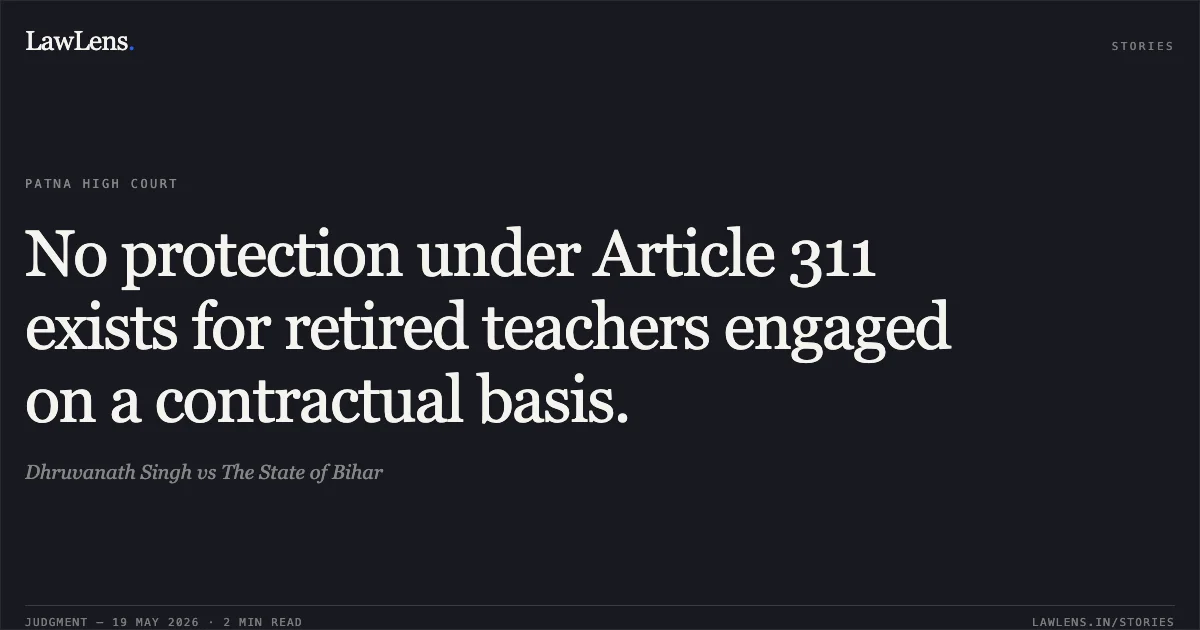
The Court held that the petitioners, as retired teachers on contract, have no vested right to continue in service and cannot claim the protections of Article 311.
The court affirmed that the termination was a valid policy decision by the Bihar Education Project Council (BEPC) to protect the public exchequer and improve educational standards.
Source reference: p. 12-14The court found no violation of natural justice as the termination was based on a broad policy shift due to unsatisfactory systemic performance. The writ petition was dismissed.
Source reference: p. 14, 15Acts & Sections Cited
1 provisions across 1 statute referred to in this judgment. Linked provisions open on LawLens.
Sarv Shiksha Abhiyan1
Original Court PDF
Dhruvanath SinghvsThe State of Bihar
Click to open original judgment
Original judgment, available to read, download and summarize on LawLens.in


![Authorities must decide pensionary and retiral-benefit claims through a reasoned order within eight weeks.. Habibullah khan vs HOME DEPARTMENT. CAT - ['Srinagar']. LawLens](/stories/thumbnails/authorities-must-decide-pensionary-and-retiral-benefit-claims-through-a-reasoned-order-wit-d0cbe8a8119c48fbabe7df9f2d353488.webp)