Facts
The Appellant (NHAI) entered into a contract with the Respondent (Progressive Constructions) on 08.09.2005 for highway widening in Assam.
Source reference: p.2Delays occurred, and while the "Engineer" recommended seven Extensions of Time (EOTs) citing governing delays by NHAI and concurrent delays by the Respondent, the Appellant only formally approved EOTs up to 06.03.2011.
Source reference: p.60NHAI terminated the contract on 14.03.2016 citing non-performance.
Source reference: p.6The Arbitral Tribunal (AT) issued an award on 20.02.2019, declaring the termination illegal and allowing 15 of the Respondent's claims.
Source reference: p.7-8The Single Judge of the High Court partially set aside the award but upheld Claims 6 and 8.
Source reference: p.8-10The Appellant challenged the decision regarding specific claims (1, 6, 7, 8, 9, and 11) under Section 37 of the Arbitration and Conciliation Act, 1996.
Source reference: p.55Issues
1. Whether the termination of the contract by NHAI was illegal and void due to failure to grant EOTs.
Source reference: para. 12.3.2.7 / p.692. Whether the Arbitral Tribunal was justified in awarding Claim No. 1 for unpaid work based on financial progress percentages derived from NHAI's own documents.
Source reference: p.72, 783. Whether the contractor was entitled to Claims 6, 7, and 8 (Overheads and Prolongation costs) despite the Engineer’s recommendation rejecting such costs due to concurrent delay.
Source reference: p.83-854. Whether Claim 9 (Confiscated Machinery) was based on sufficient evidence or was patently illegal due to depreciated value.
Source reference: p.89-91Law Applied
The court applied the narrow scope of judicial review under Sections 34 and 37 of the Arbitration and Conciliation Act, 1996, as established in Somdatt Builders NCC-NEC v. NHAI and MMTC Ltd. v. Vedanta Ltd., which prohibits re-appreciation of evidence unless the award is "patently illegal" or "perverse".
Source reference: p.56-57It applied Section 23(3) of the Act regarding the amendment of claims.
Source reference: p.74Regarding damages, it considered the Hudson Formula for overheads.
Source reference: p.81Principles of "Acquiescence and Waiver" and the requirement for "Contemporaneous Records" under Clause 53.4 of the COPA.
Source reference: p.23, 84-85It further relied on Associate Builders v. DDA for the "no evidence" test of perversity.
Source reference: p.91Reasoning
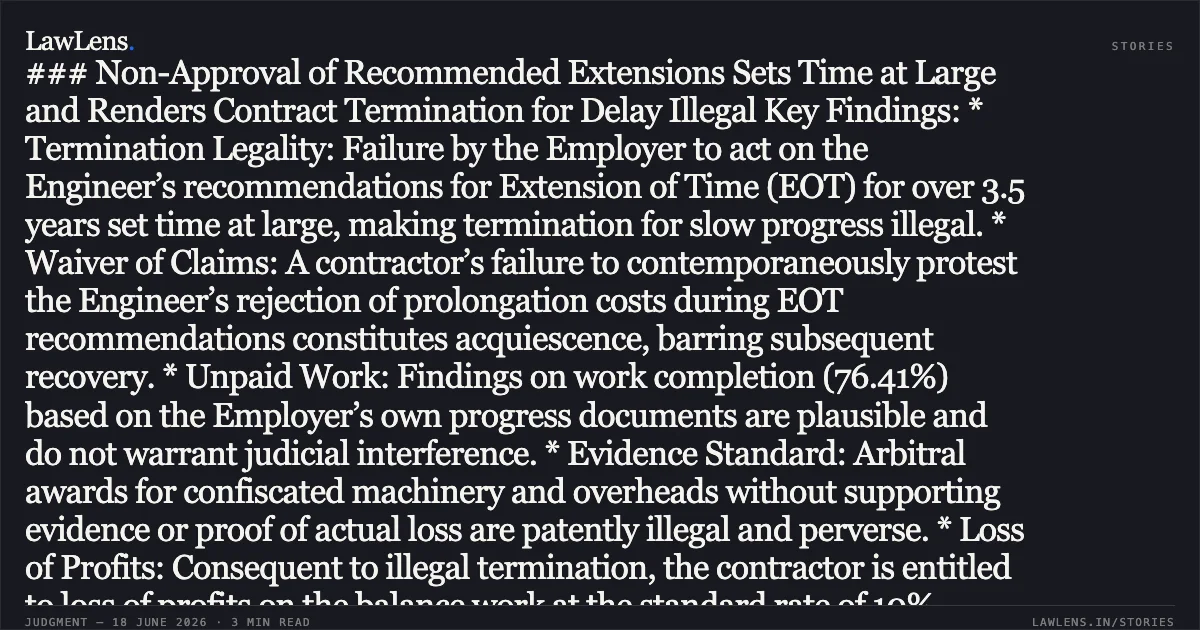
The court upheld the AT's finding on illegal termination, noting that NHAI’s failure to act on EOT recommendations for 3.5 years set "time at large".
Source reference: p.61, 70On Claim 1, the court found the AT’s reliance on NHAI’s own progress reports (R-132, R-134) to calculate unpaid work (76.41% completion) was a "plausible view" based on record.
Source reference: p.78-79Regarding Claims 6, 7, and 8, the court found the AT committed a patent illegality by ignoring the fact that the Respondent had accepted EOTs for years where the Engineer specifically denied prolongation costs due to concurrent delays; the Respondent's failure to protest at the time constituted acquiescence.
Source reference: p.84-85On Claim 9, the court found the award "perverse" as the AT awarded ₹7.70 crore for 8-year-old machinery without considering NHAI’s plea that the depreciated value was nil, effectively granting the claim without evidence of actual value.
Source reference: p.90-92Claim 11 (Loss of Profit) was upheld as a logical consequence of illegal termination.
Source reference: p.92Holding
The Respondent's entitlement to overheads and prolongation costs was rejected based on the principle of waiver.
The court allowed the appeal in part. It set aside the Single Judge’s judgment and the Arbitral Award with respect to Claims 6, 7, 8, and 9.
Source reference: p.92The court upheld the award for Claims 1 and 11, as they were based on plausible interpretations of facts and the finding of illegal termination.
Source reference: p.93Acts & Sections Cited
7 provisions across 1 statute referred to in this judgment. Each provision opens on LawLens.
Arbitration and Conciliation Act, 19967
Original Court PDF
National Highways Authority Of IndiavsProgressive Constructions Limited
Click to open original judgment
Original judgment, available to read, download and summarize on LawLens.in